
If You Bought This Dodge Challenger In 1970, Your Investment Is Up 30,000%
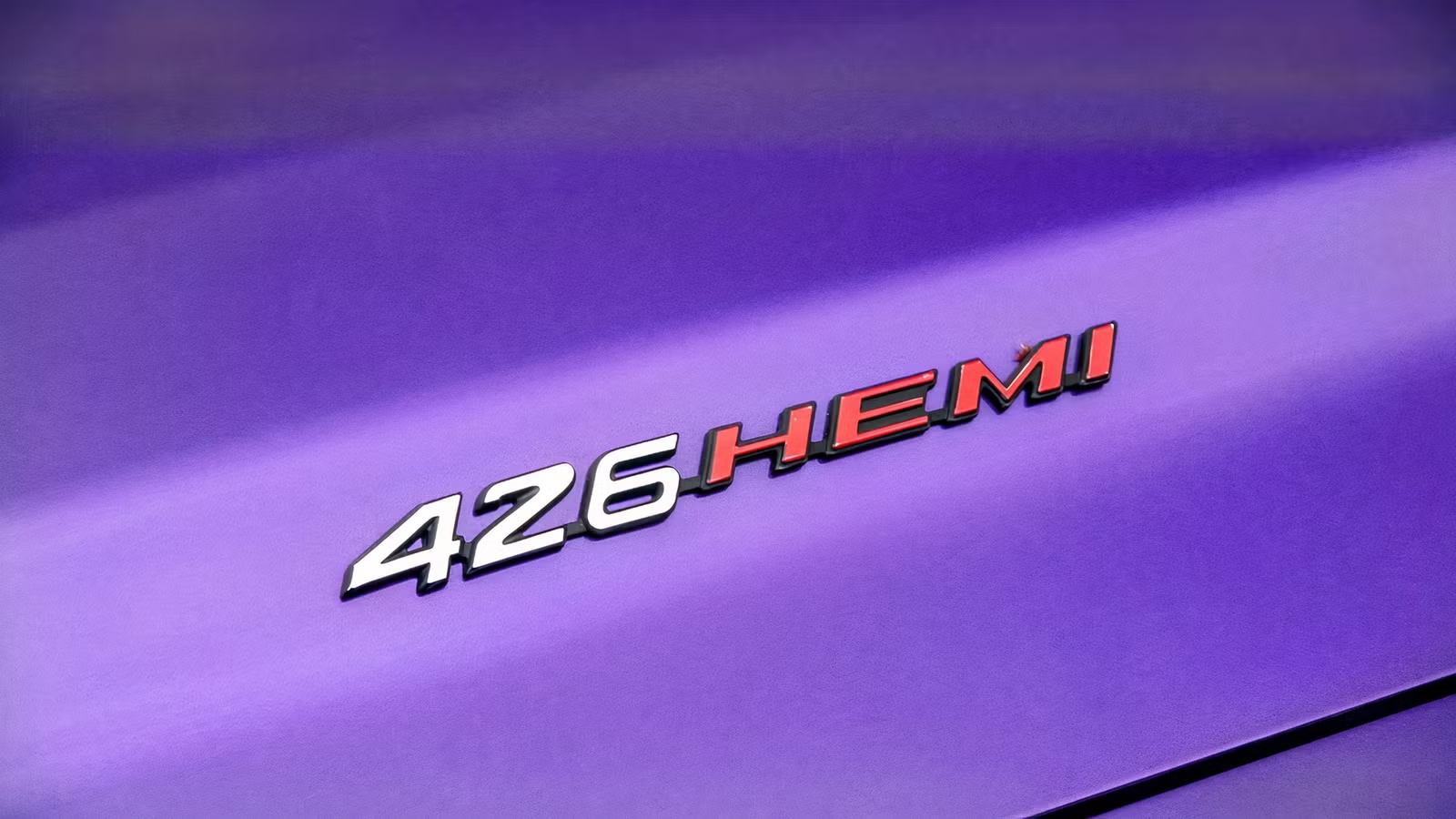
Let’s set the scene for you. It’s late 1969, or maybe early 1970 depending on the specifics. You waltz into a Dodge dealership, fresh off a pay raise that lets you buy just about any American car you want this side of an Imperial or a Cadillac. Out of the corner of your eye, you spot a 1970 Dodge Challenger R/T with a 426-cubic-inch Hemi V8, and you instantly fall in love. Little do you know, you might’ve just secured your retirement fund 40 or 50 years down the road. The only question is, why?
The 1970 Challenger: Not All of Them Are Worth Huge Money

The first-generation E-body Dodge Challenger doesn’t get nearly enough credit, but it wasn’t always a Hemi screamer from the factory. In fact, it was far more mundane most of the time. At launch in that initial 1970 model year, no less than ten different engine and carburetor combinations were available to order at the dealer. Standard on base models was a 225-cubic-inch Chrysler “Slant-Six” straight-six motor with 145 horsepower. Later in the model year, Dodge added an ultra-base Challenger Deputy with an even smaller 198-cubic-inch Slant-Six.
Up the range, the 318-cubic-inch LA-series became the first V8 option, complete with a two-barrel carburetor and 230 horsepower in most instances. From there, the handling-focused Challenger T/A offered an exclusive 340-cubic-inch LA V8 with triple two-barrel carburetors and 290 horsepower. Next up, the first choice in the larger B-series V8 made itself available, a 383-cubic-inch plant with the choice of a two or four-barrel carburetor, and the four-barrel was the standard engine for the Challenger R/T.
Leading the pack in cubic displacement, the 440-cubic-inch Magnum V8 gave the option of a single four-barrel carburetor, or the legendary Six-Pack with three two-barrels. At 390 horsepower, the 440 Six-Pack was an absolute low-RPM power monster, but it wasn’t the flagship of the range. Unusually for the time, the real standout was a little bit smaller, but far more special.

The 426 Hemi: A Generational Icon of an Engine in a World-Class Muscle Car

The 426-cubic-inch Hemi V8 wasn’t the biggest out there. Yet with its hemispherical combustion chambers, 4.25-inch bore, cross-bolted main caps, and thicker cylinder walls, the Hemi engine was significantly beefier in its architecture. Even with the same raised-block (RB) innards as the 440, the Hemi was a high-horsepower, peak-rpm screamer, while the 440 prioritized low-rpm torque and grunt.
The distinction made the Hemi the more unique and desirable of the two top Challenger engines, and helped it peak at 425 gross horsepower to the 440 Six-Pack’s 390. It also meant that the two had radically different performance profiles. While the 440 Six-Pack might beat the Hemi off the line by a hair, chances are good the Hemi would pull ahead over the course of the quarter-mile.

Only a very small portion of the Challenger’s 76,935-unit production run came fitted with the Hemi, as few as 350 and change. That makes it exceptionally rare and valuable today, but enough to fund your retirement? Well, yes, assuming it’s the real deal. Keep in mind, this spec, bare-bones with a hardtop, and no options other than the engine, retailed for just over $4,000 in 1970, or just over $34,500 in today’s money. So then, how much has that changed?
Ultra-Rare, Ultra Valuable

Keep in mind, not every Challenger 426 Hemi from 1970 will let you retire the instant you go to sell it. The real high-rollers are incredibly picky when it comes to the nitty gritty, and they’re willing to walk away entirely if a set of standards aren’t met. First of all, the rest of the car beyond the powertrain needs to be as close to numbers-matching as possible. That means everything that came with the car’s permanent drivetrain from the factory, from the engine block to the transmission and the rear axle, needs to be the same as it was the day it left the dealership parking lot.
Other components, like seats and interior trim pieces, the wheels, and suspension, as well as anything that is subject to replacement, like brakes and tires, also factor heavily into the resale price. That makes 1970 Challenger R/T Hemis that meet these specific criteria real rarities. Back in 2023, a 1970 Challenger R/T Hemi rolled across an online Hagerty auction, and looked like the real deal all around. The only problem was simple, yet a little catastrophic—the original Hemi block had been swapped out for a replacement. Just like that, the car went from one that sold for a quarter million dollars all day long to one that didn’t hit six figures before it failed to meet reserve.

With that said, the handful of examples that do meet numbers-matching criteria, complete with non-drivetrain factory components still intact, border on generational levels of value. One example, a Plum Crazy purple car with four-on-the-floor, sold for $280,500 at Barrett-Jackson’s 2026 Auction in Scottsdale. Another one, in Bright Blue but packing a three-speed Torqueflite automatic instead, sold for $187,000 on Bring a Trailer. Clearly, the lack of a clutch pedal hurt resale value somewhat, even if everything else was in order.
Elsewhere, a 1970 Challenger Hemi in Hemi Orange and a four-speed manual sold for $385,000 at Barrett-Jackson’s Palm Beach 2026 auction. To top it all off, a one-of-a-kind triple-black car with a gator-grain vinyl roof, driven by an ex-US Army Paratrooper and Detroit police officer called the Black Ghost, sold at Mecum for $1,072,500. Now, how’s that for resale value?
Source: Mecum, Barrett-Jackson, Barn Finds

Related posts




Latest Post


No Comments