
The Forgotten Naturally Aspirated Mopar That Was Faster Than A Hellcat
For a few years, Dodge was selling two completely different visions of the American muscle car at the same time. One looked backward: wrapping a supercharged V8 in familiar retro sheet metal, it became a cultural phenomenon. The other looked forward: pairing an enormous naturally aspirated V10 with a lightweight chassis, a six-speed manual, and engineering advanced enough to chase the world’s best exotics. We know which branch survived. The strange part is that the extinct, forgotten modern Mopar was quicker to 60, faster flat-out, and may have offered the more interesting blueprint for Detroit’s future.
The Hellcat Perfected Detroit’s Old School Muscle Car Recipe

Detroit’s muscle-car recipe was simple: Take one (1) large rear-drive car, mix in eight (8) cylinders with enough horsepower to win almost any straight-line argument, and serve the entire thing at a price closer to an F-150 than a Ferrari. Despite a sprinkling of modern cooling, brakes, electronics, and tires, the 21st-century incarnation of the Dodge Charger and Challenger faithfully followed this 40-year-old formula. Dodge even admitted the Challenger drew its design inspiration from the 1971 car. By the 2010s, competition from Germany and Japan threatened to finally replace the Detroit tradition. Then Dodge’s SRT division kicked things up a notch with a spicy new secret sauce.
The 6.2-liter supercharged Hemi “Hellcat” arrived for the 2015 model year with 707 horsepower and 650 lb-ft of torque. Buyers could even get the Challenger version with a six-speed manual. This fusion was spicy enough to put the world on notice, but familiar enough to dominate the domestic market. Hellcats also dominated culture, from the Fast & Furious franchise to music videos, with Pitchfork naming it rap’s signature muscle car. The new halo models breathed life into a decade-old lineup. From 2015 through 2023, FCA/Stellantis U.S. sales reports add up to 769,390 Chargers and 530,349 Challengers, or 1,299,739 cars across all trims of the two nameplates.

Dodge had finally perfected old-school theater without old-school inconvenience. A Challenger Hellcat could beat a 1960s drag-strip homologation special in the quarter-mile, while lugging around equipment 1960s drivers wouldn’t believe. It was a five-passenger coupe with a 16-cubic-foot trunk, available eight-speed automatic, climate control, and a full infotainment system with navigation. With two more doors, the Charger was even more usable: commute, road-trip with friends, then summon a supercharger whine with one hard stab of the throttle. The new recipe was brilliant, but it was not the only way Chrysler knew how to build an outrageous and uniquely American performance car.

Despite 707 Horsepower, The Hellcat Wasn’t That Quick To 60 MPH

While the Dodge Hellcat had plenty of bark, in a race to 60 mph it didn’t have much bite. Dodge claimed the 2015 Charger SRT Hellcat could hit 60 mph in 3.7 seconds. Not bad by 1970 standards, but not halo-car-fast in 2014. So what gives? The answer: the Hellcat’s two modestly sized rear contact patches. All that burnout-ready horsepower didn’t do much good when lined up at a stoplight.

Dodge tried to address the Hellcat’s embarrassing stoplight problem. The 2018 Widebody option added fender flares and enough room for 305/35ZR20 Pirellis. Dodge claimed the extra rubber dropped the 60 mph time to 3.4 seconds. When Mopar dropped the Hellcat V8 into SUVs, the Trackhawk and Durango SRT Hellcat proved just how limited their Charger/Challenger predecessors had been by rear-wheel drive. The automaker advertised both AWD SUVs with a better time to 60 mph than the original Hellcat cars: 3.5 seconds.
The Dodge Viper Took A Completely Different Route To 200 MPH

There’s more than one way to skin a Hellcat. From 1992 through 2017, Dodge’s halo car was the two-seat Viper. The irony is that the low-slung and aerodynamic supercar killer had a higher top speed rating than the infamous Hellcats: 206 mph versus 199 mph for the Challenger and 204 mph for the Charger. At the low end, the difference was even more apparent. Dodge claimed the SRT Viper could reach 60 mph from rest in about 3.3 seconds. Stellantis put the Charger SRT Hellcat at 3.7 seconds.
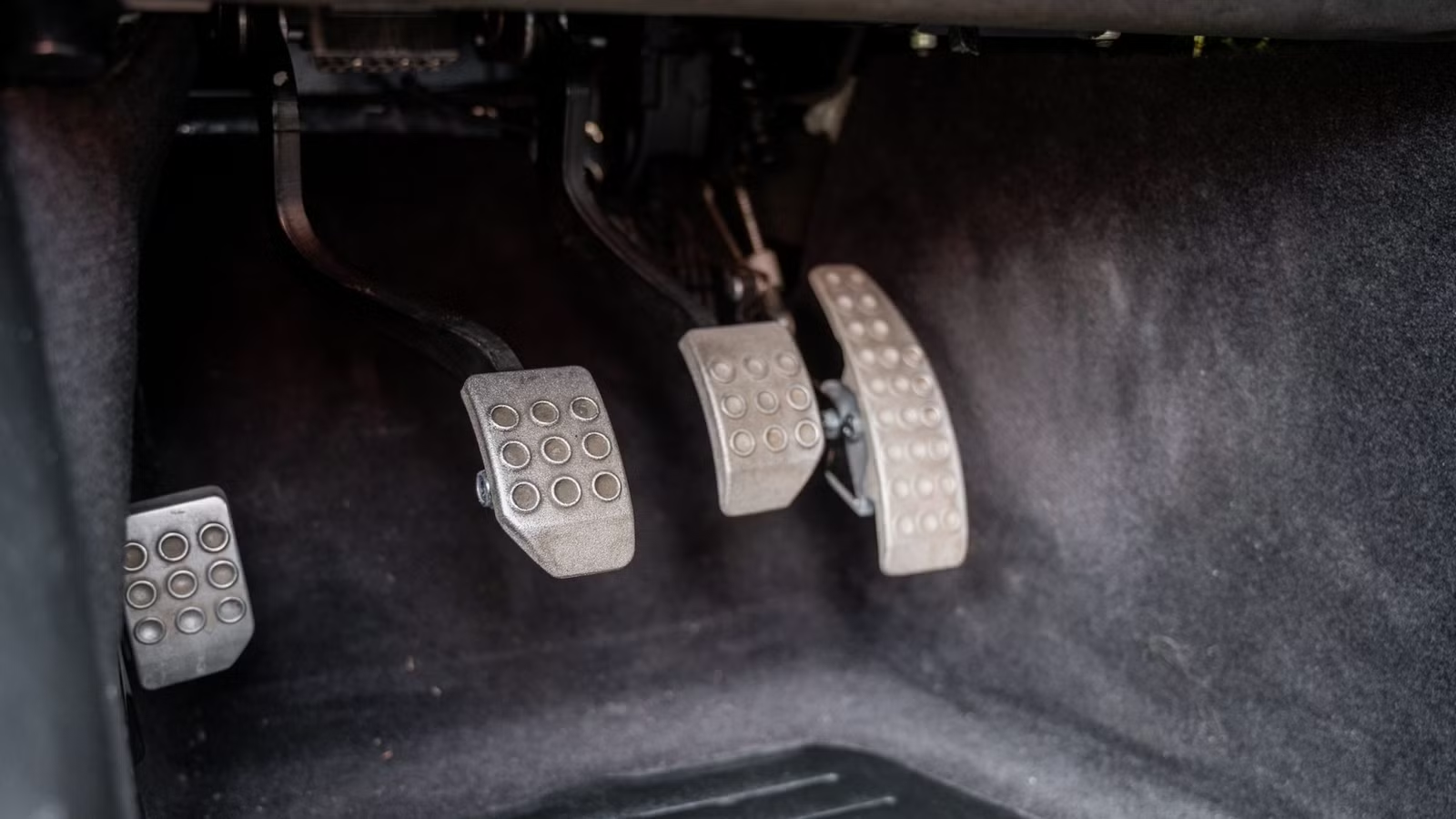
The Viper didn’t need a supercharger to hunt down Hellcats. Instead, the 2017 Viper had an 8.4-liter naturally aspirated V10 that made 645 horsepower and 600 lb-ft. Its only transmission was a Tremec TR6060 six-speed manual. And before dismissing the comparison because the Hellcat made 10% more power, consider one more number: 1,160 pounds. The 2017 Viper GTS weighed 3,415 pounds, while the Charger SRT Hellcat weighed 4,575 pounds. You’d have to make the Viper tow a trailer with two motorcycles to stage anything resembling a fair fight.

The brick-shaped Hellcat couldn’t touch the Viper’s top speed. The winner depends entirely on where you paint the finish line. But of course, the Viper wasn’t designed to only excel in a straight line. Take these two Mopars to a racetrack and the Viper might lap the Hellcat.
The Viper Asked What A Muscle Car Could Become, And Scared Exotics

You could say the Hellcat started with a simple question: What was the muscle car that 1970s Detroit wanted to build, but never got around to? The Viper started with a very different question: What would the original muscle car engineers have built with modern technology? The late-1980s team’s goal was a straightforward, high-performance driver’s car, with a “back to basics” Cobra-like philosophy and performance based on old-fashioned American torque rather than turbochargers or multivalve exotica.

Nearly three decades later, the attitude remained while the engineering had evolved drastically. The Viper still boasted a pushrod V10, a manual transmission, and side-exit exhaust. But it added advanced aero, independent suspension, Bilstein dampers, giant brakes, and a structure engineered for hard track use. Dodge explained that the fifth-gen Viper’s structure used high-strength steel, magnesium, aluminum, and carbon fiber; the chassis was 50% stiffer in torsion than the previous generation. Detroit wasn’t copying Europe, it was answering universal physics challenges in its native accent. The resulting final-generation Viper could keep up with the world’s best exotics without blending in with them.
The Viper Mapped An Intriguing Future, And Detroit Chose The Past Anyway

When it comes to raw sales numbers, the Viper walked so the Hellcat could fly. SRT had demonstrated it could build a halo car so outrageous it forced the world to take notice. It’s no shock that Dodge greenlit the Hellcat. Russ Ruedisueli held SRT vehicle-line responsibility for both Viper and Hellcat, and FCA later described the Demon program as following a route carved by the street-legal, track-focused Viper ACR. But unlike any generation or special edition of the Viper, the four-door Hellcats offered ridiculous performance in a package that thousands of ordinary drivers could daily.
The manual-only, track-focused Viper required a very special kind of buyer. In 2015 FCA reported 66,377 Challenger sales and 96,633 Charger sales in the U.S., while Viper sales totaled just 690. It looked great in a showroom, but it was low, hot, and cramped to just two seats, and engineered to be demanding.
Dodge made a shrewd financial choice when it pivoted to Hellcat-based halo trims. The entire Hellcat lineup was a perfect answer to what people actually bought. And if it was technically a step backward, the retro styling made that step feel right. But the death of the unmistakably American, undeniably modern Viper left a tantalizing “what-if” looming over the Detroit auto industry.
Sources: Pitchfork, Stellantis

Related posts





Latest Post


No Comments