
The Forgotten Ford That Won Daytona And Raided The Drag Strip The Same Year
Imagine if modern-day NASCAR Cup cars used the same powertrain as a Super Stock drag car, or vice versa. It sounds ridiculous, primarily because, in a modern context, it absolutely is. But back in the early 1960s, the differences between the two were far less black and white. In the year 1963, the two paradigms converged directly with tremendous success. The reason is multifaceted, in part due to changing rules in both disciplines, and partially because of what had transpired up to that year.
Ford in the ‘60s: Maker of Passenger Cars, Guru of Performance Engines

If you want proof-positive that technology from the racing world makes its way to the street after a while, look no further than Ford during the early 1960s. Ford invested heavily into racing during this period, more so than at any previous point in their history. With a range of oval tracks and quarter-mile strips across the country, Ford developed an engine capable of handling either side of the spectrum with competence. Ironically, Ford’s most famous race engine originates directly from its highest-profile failure, the Edsel brand.
Dubbed the “Ford-Edsel” motor through its life, the FE-series V8 did everything from haul cargo to win the world’s most famous races. Toeing the line between a small block and a big block, the FE was as close to a “medium-block” as existed back in those days. Bore and stroke varied widely through the range, with performance-minded variants featuring large bores and short strokes. This produced an engine that revved freely, like a design 30 years its junior, and in its iconic 427-cubic-inch variant, it yielded a motor so capable that no discipline went without its influence.
1963 was the introductory year for the 427 FE engine, and its debut was shepherded in by Ford’s flagship full-size passenger car platform. When the two met, the results turned out to be pure fireworks. It is not as talked about as later Fords, primarily those from the Mustang line, but no Mustang accomplished what this combination made routine.

The Ultra-Rare Ford Muscle Car Collectors Have Chased For Generations
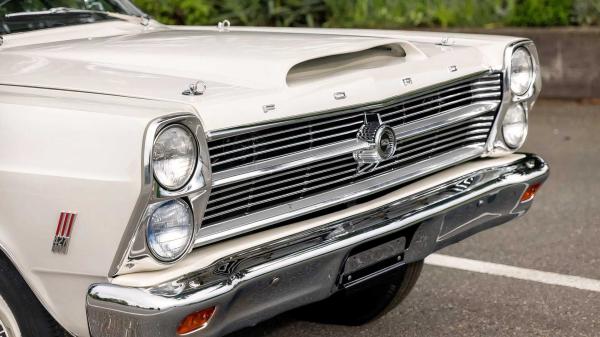
This ultra-rare factory dragster was built in numbers so limited that collectors have chased it for generations.
The Galaxie: an FE V8’s Best Friend

The Ford Galaxie gets overlooked by not just the Mustang, but also more overt, traditional muscle cars like the Torino. But make no mistake, in terms of what the Galaxie meant to the Ford lineup, it was nearly as significant as the Mustang. Perhaps far quieter, and with much less fanfare. But right under the noses of historians, the Galaxie became one of the fastest factory race cars of the period.
Larger and heavier than the unibody Fairlane, the body-on-frame Galaxie Starliner two-door hardtop was of particular interest to the racing world. Its dimensions were no different from those of the four-door Galaxie, but its fastback styling lines were sleeker, more aerodynamic, and considerably better suited for applications like stock car racing and quarter-mile drag racing. After discontinuing the Starliner, Ford tried fitting a streamlined fiberglass roof to a Galaxie convertible in an attempt to pass it off to NASCAR as an optional extra. NASCAR believed this for all of one race in 1962, a race that Ford wound up winning, before what became known as the “Starlift” was banned permanently.
In the end, the Starlift project proved somewhat unnecessary. Weirdly, the platform’s biggest problem wasn’t aero. Rather, it was its weight. As far as options go to reduce this, Ford’s were limited at that point in time. Still, that only made the end product all the more remarkable.
Ford Galaxie Generations (All Years, U.S.): Engines, Trims, Specs & Value
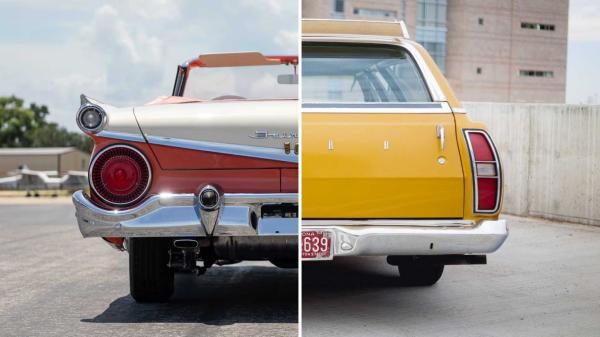
The gentlemen’s muscle car that’s often looked over. The Galaxie elevated Ford to heights unseen, and deserves the same respect you show the Mustang.
1963½ Ford Galaxie 500 Lightweight: Race Car Fast, Purpose Built From the Factory

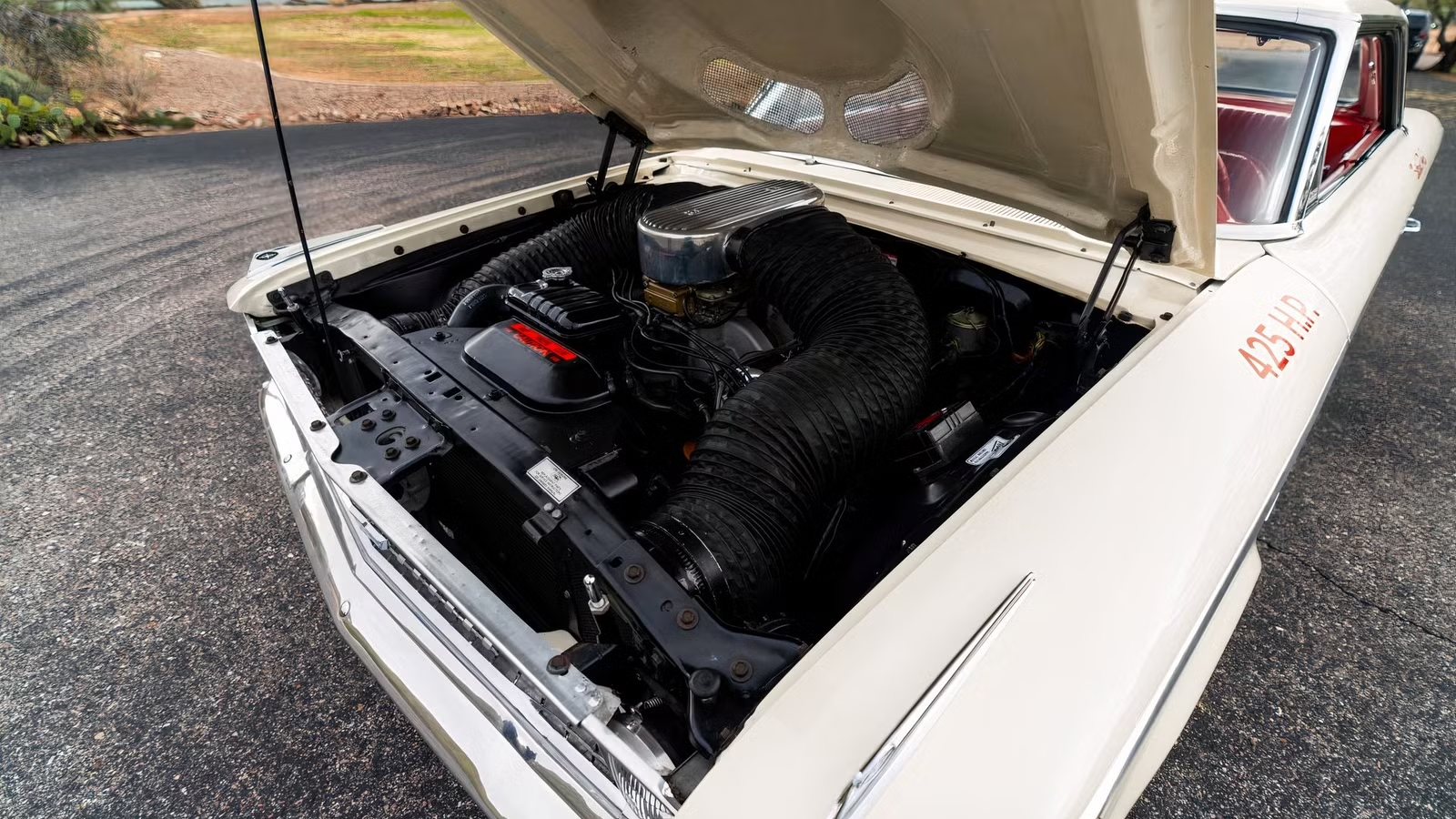
Knowing they had limited options to reduce weight for NHRA competition, Ford had to get creative with what they threw away to keep the pounds down. Any body panel that could be converted from steel to fiberglass was promptly swapped out. Large, heavily chromed bumpers gave way to thin aluminum sheet metal, and the interior carpets were nonexistent. Come to think of it, so were the armrests and door pulls, as well as the heater, defroster, dome light, and the radio.
R-Code 427 FE Specs
|
Displacement |
Power |
Torque |
|
427 Cubic-Inches |
425 HP |
480 LB-FT |
With an R-Code 427 FE featuring dual Holley four-barrel carburetors and high-flow heads, a 500 Lightweight’s engine breathed as well as it could without forced induction. In a car that weighed around 3,500 pounds without a driver, it still might sound heavy. But rest assured, for a car that is 17 feet long to weigh that little is an achievement in itself. Official horsepower figures of 425 at the crank were almost certainly understated. In reality, it was closer to 500 at the crank, making for a power to weight figure exceeding 280 horses per US short ton. That approaches the same level as a Ferrari 250 GTO Le Mans racer from the same model year.
On a more down-to-earth level, the Galaxie 500 Lightweight was every bit the rival of icons like the “Swiss Cheese” Pontiac Catalina Super Duty or 426 Race Hemi-equipped Mopar platforms. Through the early half of the 1960s, this group of heavyweights formed the foundation of the Super Stock class, a series you had to sell cars at the dealership level in order to enter. Icons of the strip like Les Ritchey and Dick Brannan piloted these Lightweight Galaxie 500s to times as low as the 12-second bracket over the standing quarter mile.
From the Strip to the Oval Like It’s Nothing

With much the same suspension as a standard Galaxie family cruiser, the Galaxie 500 wasn’t all that graceful. But along the long, sweeping curves of the Daytona Speedway, that was not much of a hindrance whatsoever. When the late, great DeWayne “Tiny” Lund strapped into a Galaxie 500 427 at the 1963 Daytona 500, he wound up winning it outright. Depending on the gearing and the track, a NASCAR-spec Galaxie 500 could reach as high as 165 mph down the straights at a superspeedway.
The biggest difference between the drag-spec and the speedway configuration was the body panels. NASCAR rules strictly prohibited fiberglass in sanctioned races, mandating steel panels and full metal roll cages. This added weight to the stock car spec, and limited its performance overall. To that end, NASCAR decided to ban Ford’s “Dual-Quad” arrangement, meaning the engine had to run a single four-barrel carburetor, producing around 410 hp. Somehow, the decline in horsepower wasn’t a hindrance with nothing but open track ahead of it. With former USAC Stock Car champ Fred Lorenzen behind the wheel, a ‘63½ Galaxie 500 R-Code 427 managed an average speed of 130.582 mph across the entire Atlanta 500 race.
Not just stints on the open straightaway, but the entire grueling race for hours on end. Far from a point-to-point specialist, these R-Code 427s were phenomenally reliable over the long term as well. For at least one half of a glorious model year, the Galaxie 427 was the undisputed king of the American racing scene. At the same time a Ferrari 250P was gearing up to win Le Mans, the Galaxie 500 was America’s equivalent to a racing sweetheart. Ironically, Ford would go on to win Le Mans just three years later, using an upgraded variant of the same 427 FE engine. As noted, the engine’s lineage originated with the Edsel—truly the farthest thing from a failure imaginable.
A 2000 SVT Cobra R With 2,200 Miles Proves Late-’90s Halo Cars Are Hotter Than Ever
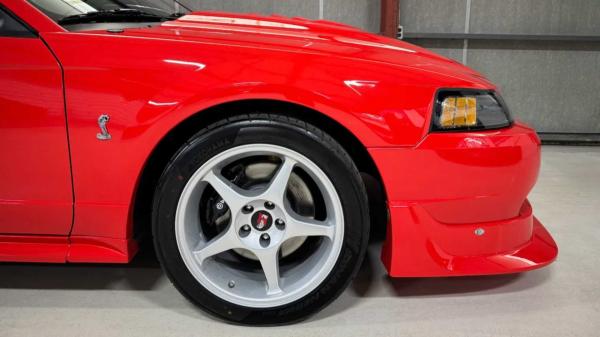
Ford’s wildest factory New Edge Mustang is back on the market, and the mileage makes it even rarer.
A Racing Icon, and Valuable on the Auction Block

Only 211 of these screaming Galaxie Lightweights were built. Enough to satisfy the NHRA’s homologation requirements, a few test articles, and that was about it. That means when one crosses the auction block in 2026, it’s an event to behold. One example, VIN number 3J66R143277, has crossed the auction block everywhere from Mecum to Bring a Trailer over the last few years. The last time it rolled onto the lot at Mecum in Glendale, Arizona, it sold for $117,500 before taxes and fees. With that in mind, if you see one sell for less, rest assured the buyer got a substantial bargain.
Source: Mecum

Related posts



Latest Post


No Comments