
Detroit’s Forgotten 560-HP V8 Was Killed By Its Own Automaker
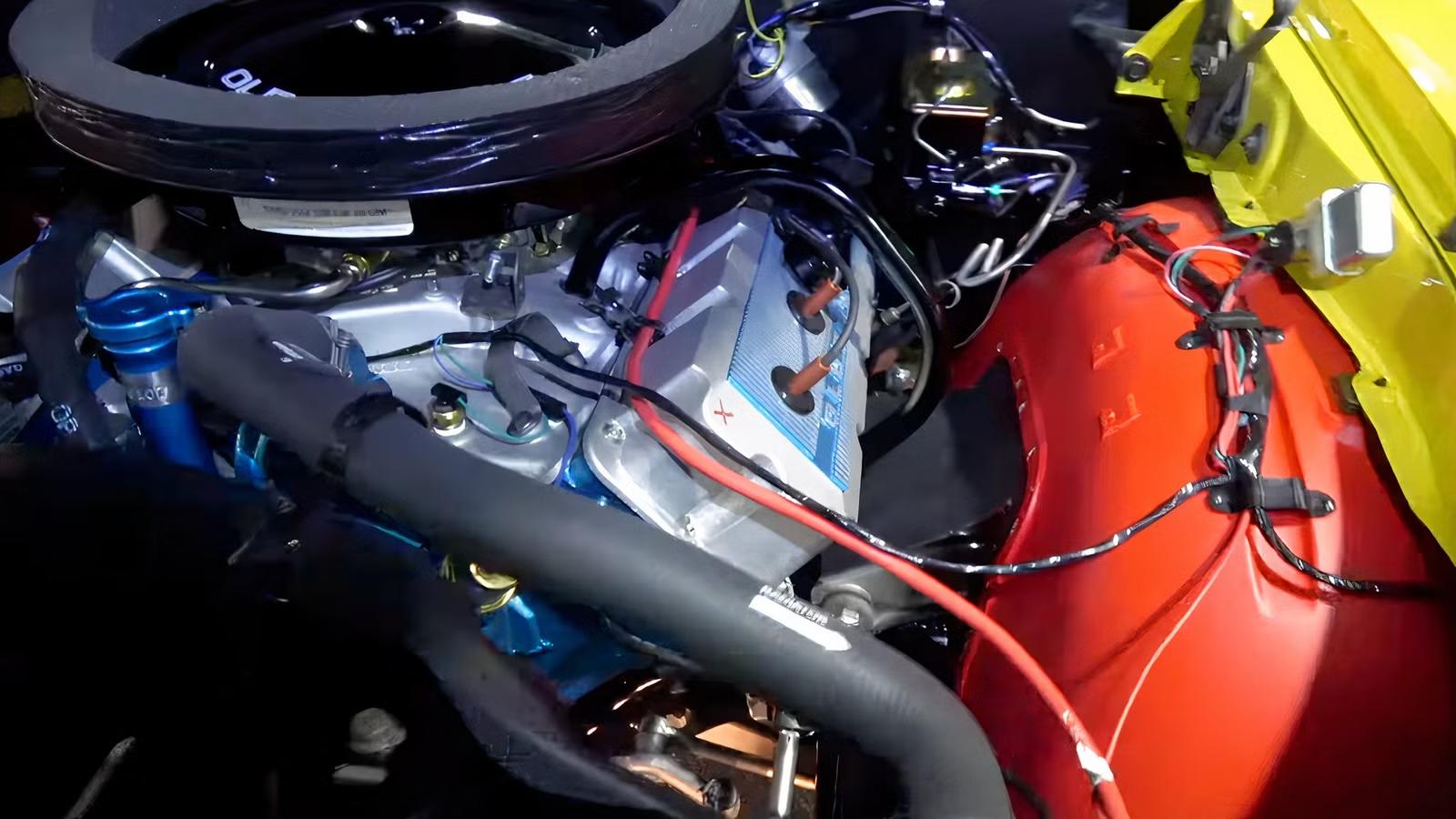
Imagine if the final exclamation point in the horsepower wars had been a V8 that used technology a decade ahead of its time to make nearly 600 horsepower. From drag races to the Bonneville salt flats, it would have had Hemis and Boss 429s struggling to keep up. Now imagine that it wore an Oldsmobile badge. Here’s the bizarre true story of the monstrous muscle car V8 that pushed pushrod technology to the absolute max in 1967, and how it died an untimely death.
By 1967, Detroit’s Best V8s Were Already Nearing 500 HP

By 1967, Detroit’s biggest V8s were already knocking on the door of 500 horsepower. Chrysler advertised its 1966 Street Hemi at 425 horsepower. But some manufacturers were downplaying output to qualify for more competitive racing classes. It’s unsurprising a near-stock Hemi made about 494 hp in a modern dyno test. Chevrolet rated its L88 Corvette V8 at just 430 hp, while a modern recreation cranked out 574.4 hp.
Chevrolet eventually claimed 450 hp for the 1970 LS6 454. That same year, Oldsmobile advertised the 455-cubic-inch V8 in its 4-4-2 W-30 at 370 hp and 500 lb-ft. But while the world’s attention was on Chevy and Chrysler, Oldsmobile’s engineers began a project in 1967 that would make a regular 455 look downright old-fashioned.
Oldsmobile Found A Way To Improve On The Legendary Hemi


Chrysler’s 426 cubic-inch Hemi made even more horsepower than its 440 cubic-inch big brother. Its hemispherical combustion chambers made room for large valves and generous ports. But even the mighty Hemi used just one intake and one exhaust valve per cylinder. What if you divided that work between four smaller valves? The combined openings would theoretically let an engine inhale more air, particularly at higher rpm.
Four-valve racing engines commonly used overhead camshafts. But Oldsmobile knew that to make mass production realistic, it would need to reuse most of its components from other Oldsmobile V8s. Its distinctly Detroit solution was to keep the pushrods and design rocker arms that could each operate two valves. The geometry was tricky, and the loads on the valvetrain were enormous. Would the end result even produce enough horsepower to be worthwhile?
Oldsmobile’s 32-Valve W-43 V8 Made 560 Horsepower

The final engine had the most Oldsmobile name possible. The company used the “W” prefix for heavy-duty engines (such as the W-30), followed by 43, which suspiciously matched its reported 43% increase in intake valve area over conventional two-valve heads.
The W-43 was based on the 455-cubic-inch V8. Four rocker shafts operated its 32 valves via 16 pushrods. With each pushrod doing double duty, early prototypes were failure-prone. Instead of swapping to an overhead cam, engineers split the difference with a special block that raised the camshaft one inch and improved pushrod geometry.

A prototype with a mild W-30 camshaft and four Weber carburetors made 440 hp at 4,600 rpm. Over 50 years later, brothers James and John Kryta reconstructed surviving pushrod W-43 hardware and installed the engine in a 1970 4-4-2. The builders claim the rebuilt engine made 560 hp at 6,000 rpm and 540 lb-ft at 3,600 rpm. Oldsmobile had aimed to make its four-valve arrangement practical for production. And if it could squeeze extra power from a massive V8, imagine what the same engineering might do for a smaller engine, perhaps even improving fuel economy across the lineup. The technology promised more than just horsepower.
GM Management Killed Oldsmobile’s W-43 In Development

The W-43’s valvetrain engineering wasn’t even the most audacious part of the project. Its massive displacement would have limited it to the division’s largest, slowest vehicles. Until 1970, GM strictly prohibited small and mid-size performance cars from offering engines over 400 cubic inches, likely to protect the Corvette. In fact, Oldsmobile used a Hurst special edition to smuggle a big-block 4-4-2 to its dealerships in 1968.
In late 1969, GM upper management ordered high-performance activity curtailed: the W-43 was canceled. A 1970 SAE paper by Oldsmobile engineers revealed the new mission: controlled-combustion systems, air injection, transmission-controlled ignition timing, and evaporative-emissions equipment were all aimed at improving emissions.
When journalists visited Oldsmobile’s Lansing engineers, they discussed the W-43’s cancellation. The engineers’ voices, the journalists said, ranged “from pride to remorse” (Hot Rod, May 1971, “Olds Super Rocket”).
Oldsmobile Struck Back With A 1,000-HP Four-Cylinder Engine

A 32-valve Detroit V8 making 500+ horsepower under the hood of a 1960s muscle car feels like a bizarre detail from an alternate history. But it nearly happened. And even after it didn’t, Oldsmobile’s enthusiasm for clever cylinder heads survived. Its 1987 Quad 4 used dual overhead camshafts and four valves per cylinder, eventually powering production cars including the Calais Quad 442 W-41, rated at 190 hp.
For the 1987 Aerotech record project, Oldsmobile commissioned specialized turbocharged four-cylinder engines based on Quad 4 design principles. The long-tail car used a Feuling-developed twin-turbo 2.0-liter estimated at approximately 1,000 hp. On August 27, A.J. Foyt averaged 267.399 mph over a flying mile; the single-turbo short-tail set a separate 257.123-mph closed-course record.
Sources: General Motors, SAE International, Hurst/Olds Club of America, Hagerty, Outright Oldsmobile, and Automobile Club de l’Ouest / 24 Hours of Le Mans

Related posts




Latest Post


No Comments