
The 2026 Chevy Tahoe Is Already A Police Staple—But $1M+ Per Unit Is A Different Beast Entirely
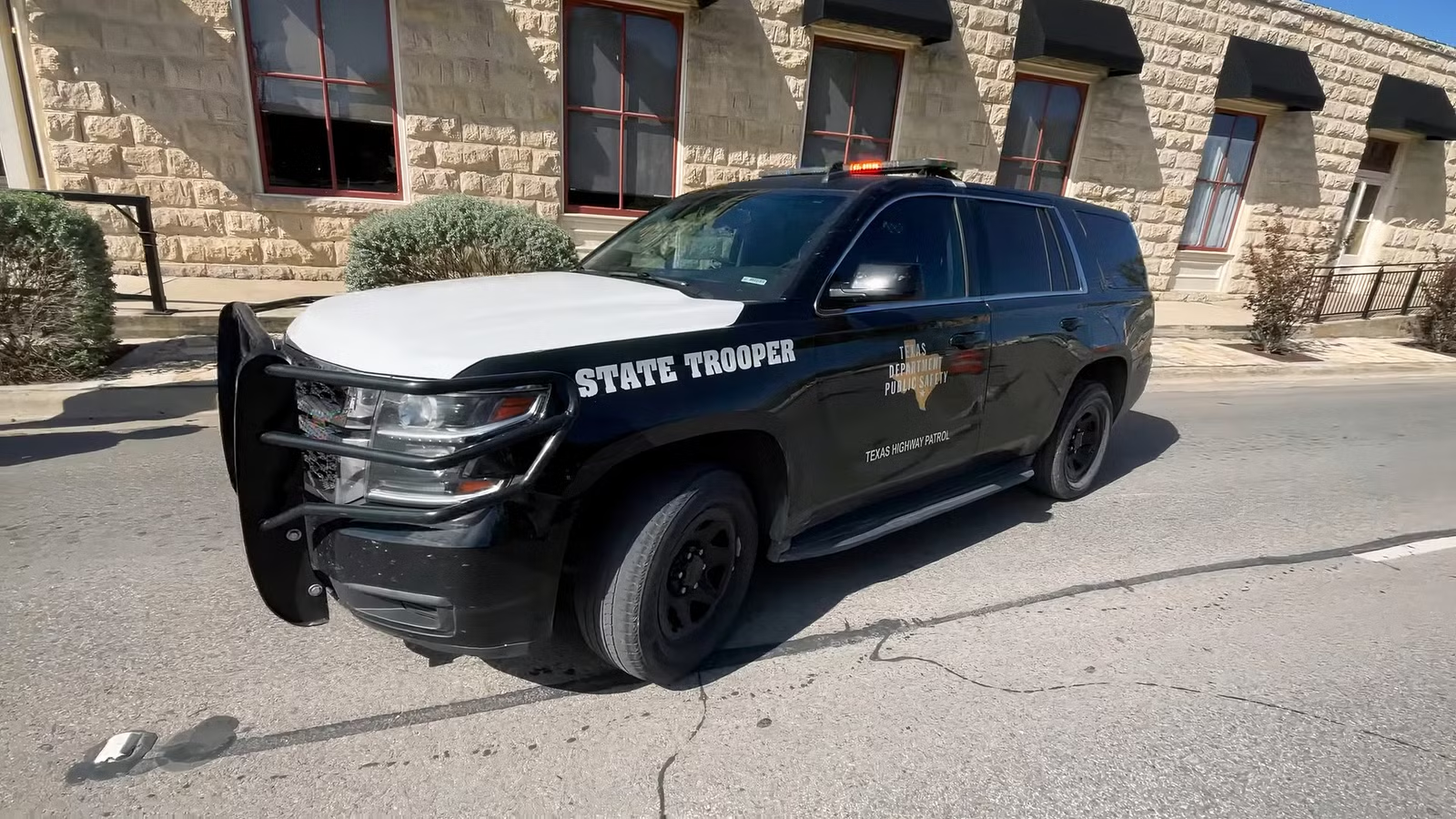
A Texas police department just signed off on a $4.5 million purchase of four 2026 Chevy Tahoes—roughly $1.125 million per vehicle. That number stops most people cold, and it should. A standard police-spec Tahoe, with the pursuit-rated suspension, the reinforced bumpers, and the factory PPV (Police Pursuit Vehicle) package, runs somewhere in the $45,000–$55,000 range depending on trim and options. So what accounts for the other $1 million?

The answer is “upfitting”—the specialized process of transforming a stock law enforcement chassis into a mission-specific platform. In this case, the mission appears to be surveillance, and the gap between a standard patrol Tahoe and a fully equipped surveillance variant reveals just how expensive modern police technology has become.
What A Baseline Police Tahoe Actually Includes
Chevrolet’s PPV Tahoe is purpose-built from the factory for law enforcement use. It ships with a heavy-duty cooling system rated for extended idling, a reinforced frame, upgraded brakes, and a calibrated suspension tuned for high-speed handling. The standard powertrain is a 5.3-liter V8 paired with a 10-speed automatic, producing around 355 horsepower—enough to keep pace with most pursuit scenarios.

Departments typically add a basic upfit package on top of that: a light bar, a push bumper, a partition cage, radio mounts, and a mobile data terminal. That layer of equipment adds roughly $15,000–$25,000 to the base price, depending on the vendor. The result is the patrol Tahoe most people recognize—functional, durable, and purpose-built for general law enforcement work. It is not, however, a surveillance platform.
Where The Price Climbs: Surveillance And Communications Systems
The jump from a $55,000 patrol unit to a $1.125 million surveillance vehicle comes from layering in technology that has little to do with routine patrol. Persistent aerial and ground-based surveillance systems—including high-resolution pan-tilt-zoom cameras, license plate readers with real-time database connectivity, and encrypted video storage—can run $100,000 to $300,000 per vehicle depending on resolution, range, and integration complexity.
Communications gear adds another significant cost tier. Encrypted multi-band radios, cellular boosters, satellite uplinks, and interoperable command systems that allow the vehicle to function as a mobile communications hub can push that figure higher still. Departments operating in multi-agency environments often require equipment certified to federal interoperability standards, which narrows the vendor pool and drives up per-unit pricing considerably.
Armor, Ballistic Protection, And Structural Modifications
Ballistic protection is one of the most expensive single line items in a high-end law enforcement upfit. Armoring a full-size SUV to NIJ Level III or Level IIIA standard—which covers protection against rifle-caliber rounds—requires replacing door panels, window glass, and floor sections with certified ballistic materials. That process alone can cost $80,000 to $150,000 per vehicle, and it adds significant weight that may require suspension and brake upgrades to compensate.
For surveillance-specific builds, structural modifications often extend to roof reinforcements to support antenna arrays and sensor mounts, as well as undercarriage protection for operations in higher-risk environments. These aren’t bolt-on accessories—they require certified installers and, in many cases, recertification of the vehicle’s safety systems after the work is complete.
What This Spending Pattern Signals About Police Fleet Priorities
The Texas purchase reflects a broader shift in how some departments are allocating fleet budgets. Rather than spreading funds across a larger number of general-purpose patrol vehicles, agencies with specific operational mandates are concentrating spending on smaller numbers of highly capable, mission-specific platforms. Four vehicles at $1.125 million each represent a different philosophy than forty vehicles at $70,000 each—even if the total outlay is comparable.
That approach makes sense for specialized units—surveillance teams, major crimes divisions, or task forces operating in complex environments—but it also means the sticker price of a “police Tahoe” can vary by a factor of twenty depending on what’s inside. The base chassis is almost incidental at this price tier. What departments are really buying is the integrated technology stack that turns a full-size SUV into a rolling command and intelligence platform.
For most departments, the standard PPV Tahoe remains the workhorse it has been for years — reliable, cost-effective, and well-supported by a deep vendor ecosystem. But the Texas purchase is a useful reminder that “police Tahoe” covers a remarkably wide spectrum. At $1.125 million per unit, the Chevy badge is almost beside the point.

Related posts

Latest Post


No Comments