The Forgotten Acura Sedan With NSX-Derived Hardware And 377 HP
9 minutes reading
Monday, 27 Jul 2026 14:00 0 75 autotech
There is a brilliant, largely forgotten Japanese alternative that completely flips this risk-reward dynamic. It is a “ghost car” that managed to fly completely under the mainstream radar when new, yet tucked neatly beneath its highly conservative bodywork is a three-motor, torque-vectoring powertrain directly descended from the iconic mid-engine NSX supercar. By combining bulletproof Japanese reliability metrics with genuinely exotic mechanical DNA, this sleeper sedan has become the ultimate undercover performance bargain on the pre-owned market.
The used luxury car market is full of hidden traps, including deep depreciation valleys where out-of-warranty flagships go to die, leaving their secondary owners with mountain-sized repair bills. Yet hidden within this volatility is the rare phenomenon of “engineering arbitrage,” where a vehicle of immense technical sophistication gets dragged down by a badge’s lack of traditional European cachet. Instead of an impending mechanical breakdown, this specific type of depreciation presents an incredible insider opportunity for driving enthusiasts.
Most buyers hunting for a swift, executive-level hybrid naturally default to continental standard-bearers like the BMW 5 Series or Mercedes-Benz E-Class. These vehicles offer plenty of curbside prestige but hide fragile, highly stressed complex electrical networks that turn into ticking financial liabilities the moment they leave the safety of a factory warranty. For the driver who prioritizes brilliant engineering over a status symbol, paying a premium to inherit that type of long-term repair exposure makes little sense.
Why European PHEVs Prioritize Compliance Over Performance
Profile action shot of 2022 BMW 530eBMW
The engineering architecture powering mainstream luxury plug-in hybrids like the BMW 530e or Mercedes-Benz E-Class PHEV reveals a fundamental compromise. These European executive sedans are designed around a single-motor configuration, where a solitary electric motor is sandwiched directly between a downsized turbocharged combustion engine and the conventional transmission. This layout is highly compact and effective for cost-efficiency, but it forces both power sources to fight for the same mechanical real estate through a single drive axis, prioritizing regional emissions compliance and corporate tax breaks over pure dynamic capability.
When you look at the real-world metrics, this single-motor compromise becomes glaringly obvious. A late-2010s BMW 530e tops out at a modest combined output of 248 horsepower and 310 pound-feet of torque, clocking a relatively leisurely 0–60 mph sprint of six seconds. For an enthusiast driver, paying a steep premium for an executive sedan that delivers eco-hatchback straight-line urgency feels underwhelming, especially when that power delivery is highly dependent on an underlying state of battery charge to avoid feeling sluggish.
The Looming Depreciated Luxury Repair Trap
2023 BMW 5 Series 530e engine close-upBMW
The secondary market has a brutal way of punishing overly complex, single-motor European luxury hybrids as they cross into high-mileage territory. Used car buyers face a daunting psychological hurdle when auditing an aging BMW or Mercedes PHEV: the high failure rate and extreme replacement costs of proprietary, integrated power electronics. Because the hybrid system is deeply embedded into the vehicle’s primary transmission housing, a failure within the electric propulsion components often triggers a cascade of labor hours and parts costs that can quickly rival the residual value of the car itself.
This widespread market anxiety creates a dramatic, downward pricing spiral that hurts original owners but sets up a prime buying opportunity for anyone who can sidestep the reliability minefield. The trick is identifying a platform that avoids these high-stress components entirely. By finding a vehicle with a powertrain decoupled from traditional European weak points, an informed buyer can secure elite mechanical engineering without acquiring a looming financial emergency.
Unveiling The Acura RLX Sport Hybrid: The Four-Door NSX In Disguise
Supercar DNA In An Executive Wrapper
2019 Acura RLX Sport Hybrid Driving Front Three-Quarter MountainsAcura
The car that successfully engineered a way out of this luxury hybrid compromise is the Acura RLX Sport Hybrid. Quietly phased out after the 2020 model year due to Acura’s broader shift toward a crossover-heavy lineup, this flagship executive sedan left behind a legacy of absolute mechanical over-engineering. Rather than utilizing a single motor to assist a small gas engine, Acura deployed its revolutionary Sport Hybrid Super-Handling All-Wheel Drive (SH-AWD) architecture, a layout designed from day one to deliver instantaneous, performance-oriented power.
The engineering layout of the RLX Sport Hybrid directly mirrors the foundational powertrain philosophy of the second-generation Acura NSX supercar, simply reversed for a front-engine layout. Up front, a characterful, naturally aspirated 3.5-liter V6 engine is paired with a lightning-fast seven-speed dual-clutch transmission and an integrated 47-horsepower electric motor. The real magic, however, happens at the rear axle, where a completely independent Twin Motor Unit (TMU) houses two separate 36-horsepower electric motors that drive the rear wheels with zero physical connection to the gasoline engine.
Outperforming The Class By Every Metric
2019 Acura RLX Sport Hybrid Powertrain UnderhoodAcura
When these four distinct power sources collaborate, they drop a hammer on the performance figures of standard European single-motor PHEVs. The Acura RLX Sport Hybrid churns out a combined 377 horsepower and 341 pound-feet of torque. This allows the heavy luxury cruiser to rocket from zero to 60 mph in just 4.9 seconds, clearing the quarter-mile marker in a swift 13.6 seconds at 102 mph, comfortably walking away from a contemporary BMW 530e in a straight line.
What makes this performance stand out is the seamless nature of the acceleration. Because electric torque is available instantly from a standstill, the RLX Sport Hybrid eliminates any hint of turbo lag, filling in the lower rev-range while the naturally aspirated V6 winds up to its sweet spot. It delivers an old-school, linear power delivery that feels robust and unyielding, transforming a heavy executive sedan into an absolute highway missile.
True Torque Vectoring Vs. Brake-Based Simulation
How The Twin Rear Electric Motors Defy Physics
2019 Acura RLX Sport Hybrid Powertrain CutawayAcura
The defining characteristic of the RLX Sport Hybrid’s SH-AWD system is its ability to perform true, positive mechanical torque vectoring. Most modern luxury sedans simulate handling agility by utilizing brake-based vectoring, essentially pinching the inside rear brake caliper during a corner to force the car to pivot. This method inherently bleeds off speed and creates unwanted heat and brake wear. Acura’s rear Twin Motor Unit (TMU) operates on a completely different level of physics.
When diving into a high-speed bend, the RLX’s system sends active, positive electrical current to speed up the outside rear wheel, while simultaneously using regenerative braking on the inside rear wheel to capture energy. This kinetic interaction generates a powerful yaw moment, actively rotating the chassis into the corner rather than dragging it through. It turns electricity into raw mechanical leverage, making a full-sized executive sedan feel remarkably light on its feet and eager to hunt apexes.
The Reality Check: An Elite Cruiser, Not A Track Weapon
2019 Acura RLX Sport Hybrid Front shot parkedAcura
While the torque-vectoring rear axle works miracles in daily driving, drivers would do well to acknowledge the car’s physical limits. Independent testing by publications like Car and Driver highlights that the RLX Sport Hybrid carries a heavy 57.2 percent front-weight bias. When pushed to its absolute limits at ten-tenths on a closed circuit, the sheer mass of that front-mounted V6 will eventually overwhelm the front tires, reverting the car back to predictable understeer. At its limit, the RLX’s suspension tuning tilts toward comfort; it can feel slightly wallowy over mid-corner road imperfections when driven like a sports car.
Instead of trying to view this vehicle as a track-day weapon, an informed buyer needs to recognize its true identity as an apex-level high-speed grand tourer. The sophisticated multi-motor layout is tuned to provide confidence during inclement weather, effortless overtaking power, and complete stability during high-speed interstate cruising. It offers real-world speed that flatters the driver without requiring a harsh, bone-jarring ride quality.
The Stealth-Wealth Arbitrage: Reliability Meets Anonymity
Flying Completely Under The Radar
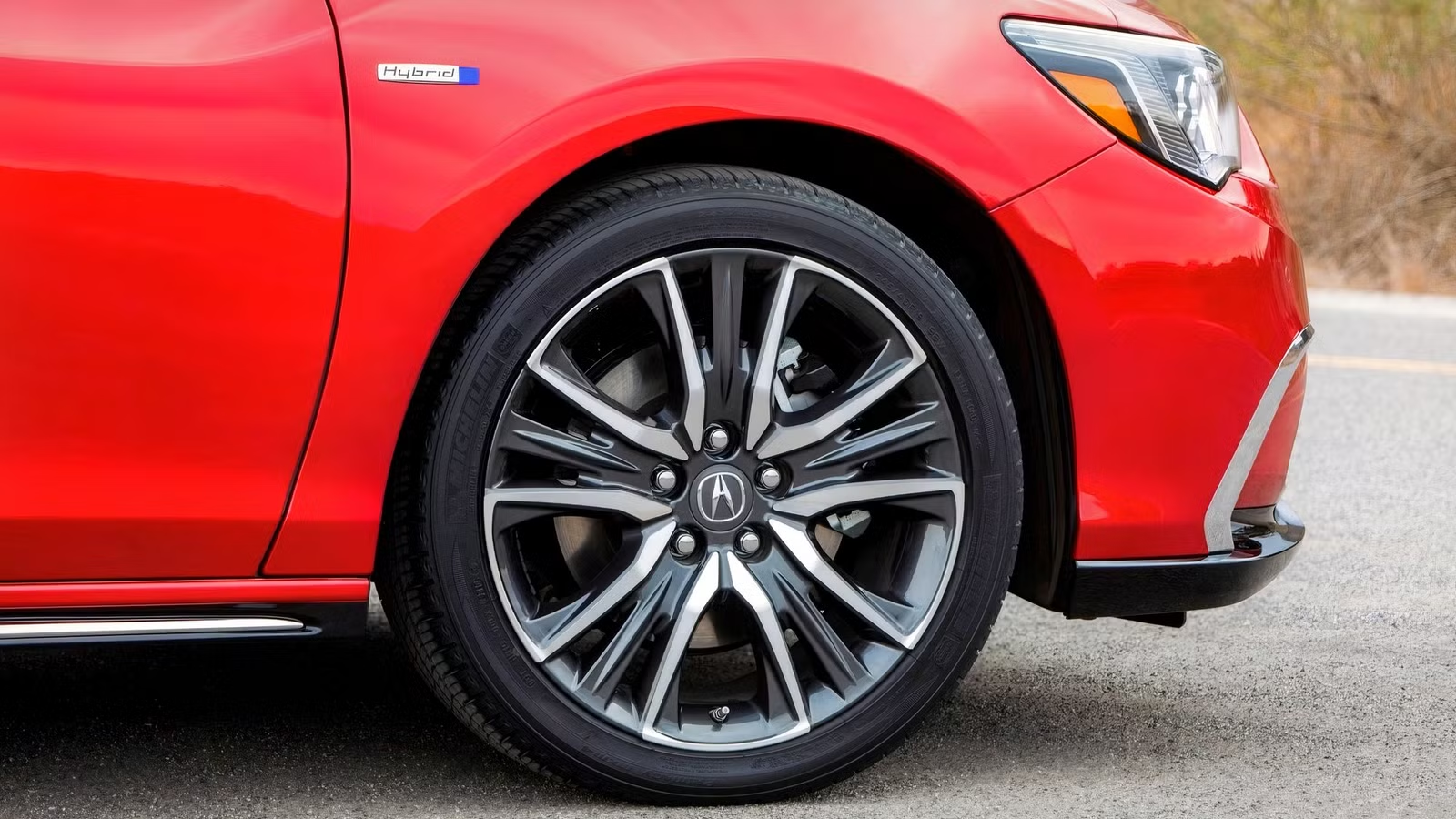
For a certain class of buyer, the absolute anonymity of the RLX Sport Hybrid is its greatest selling feature. Visually, the sedan is an exercise in extreme aesthetic restraint, closely resembling a standard, front-wheel-drive Acura TLX or a contemporary Honda Accord from a distance. Aside from subtle “Sport Hybrid” badging on the front wings and a distinct Jewel Eye LED headlight array, it blends into standard commuter traffic without drawing a second glance.
This lack of visual drama makes it a perfect choice for “stealth-wealth” enthusiasts who value high-end engineering but want to avoid the ostentatious, status-seeking image often associated with European performance badges. It allows you to park in any corporate lot or on any public street with total discretion, secure in the knowledge that you are piloting a vehicle with a powertrain layout shared with a mid-engine supercar.
The Used Market Math: Unmatched Value Retention Vs. Cost
2019 Acura RLX Sport Hybrid Rear shotAcura
The economic reality of the RLX Sport Hybrid on the used market is where the engineering arbitrage becomes impossible to ignore. When new, a late-model RLX Sport Hybrid carried a steep original MSRP of over $62,000. Today, thanks to a complete lack of public awareness, excellent used examples frequently trade for between $23,000 and $32,000 depending on mileage. This entry point matches or undercuts comparable European PHEVs while offering an EPA-estimated 28 mpg city and 29 mpg highway on standard executive commutes.
More importantly, the total cost of ownership (TCO) risk is exceptionally low. The core of this vehicle is a bulletproof, naturally aspirated Earth Dreams V6 engine, a powerplant renowned for regular, low-cost maintenance and incredible longevity. Acura’s electric motors and dual-clutch transmission are remarkably robust, meaning you can enjoy elite executive transport and supercar-derived handling dynamics without the constant, looming threat of a four-figure European repair bill.
2019 Acura RLX Sport Hybrid Rear BadgesAcura
The Acura RLX Sport Hybrid stands as a monument to a bygone era of automotive engineering, a time when a major manufacturer was willing to over-engineer a conservative flagship sedan with a complex, multi-motor powertrain simply because it could. By packing 377 horsepower and true, supercar-derived torque vectoring into a completely unassuming executive shape, Acura created a sleeper vehicle that defied the standard luxury hybrid playbook.
As modern automotive production leans heavily toward highly standardized, cost-cut electric platforms, this forgotten Japanese hybrid represents a highly intelligent, time-limited insider buy on the used market. For the enthusiast driver who understands mechanical value and rejects badge-snob premiums, the Acura RLX Sport Hybrid is the ultimate automotive bargain: a vehicle that lets you quietly out-engineer everyone else on the road for a fraction of the cost.












No Comments