
The First Production Bike To Deliver Sub-3-Second 0–60 Times
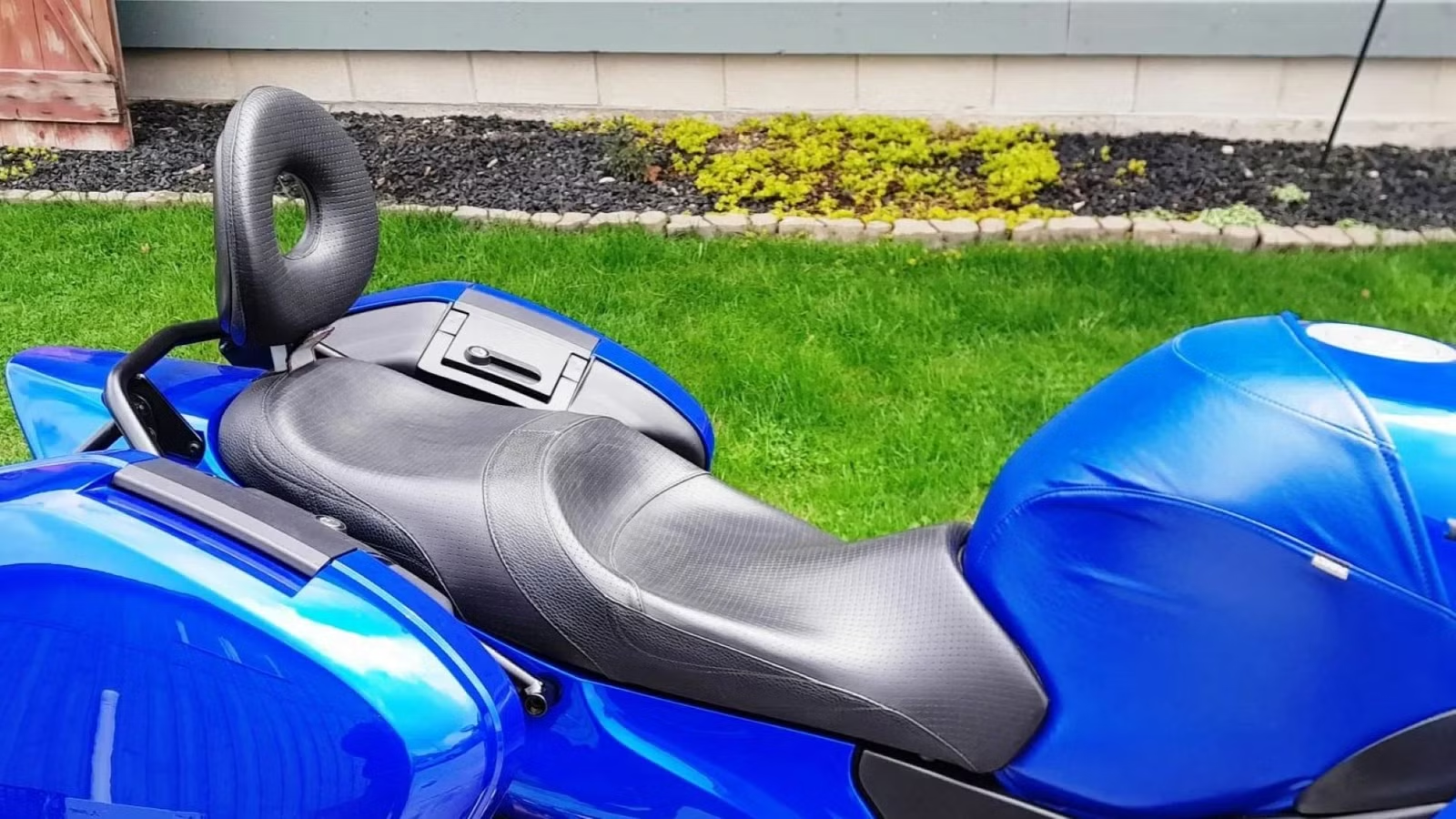
For decades, motorcycles have held a trump card over cars: staggering performance at a fraction of the price. But there’s one benchmark that separates the truly elite machines from everything else — a 0–60 mph run in under three seconds. Most enthusiasts know the Bugatti Veyron 16.4 as the car that first cracked that barrier in the four-wheeled world when it arrived in 2005, becoming the first production car to offer 1,000 hp and a sub-3-second sprint in one package. What’s less well known is that a motorcycle beat it there — and it didn’t take long. The story of how that happened runs through one of the most competitive speed wars the two-wheeled world has ever seen.
A Speed War Was Developing In The ’90s

Both cars and Motorcycles were getting faster and faster in the ’90s. At the same time that the McLaren F1 arrived in 1992, sprinting to 60 mph in 3.2 seconds, the world of motorcycles was heating up. The ’80s and ’90s were arguably the golden age of motorcycle development, with Japanese brands pushing the envelope of what was possible from a bike.
Suddenly, for the price of a hatchback, you could buy an outrageously quick motorcycle that looked just like the ones on the track. The Yamaha RD500 YPVS referenced the newly launched V4 racer, the Honda NS400R was built to celebrate Freddie Spencer’s 1983 World Championship, and the Suzuki RG500 Gamma was as close to a race bike with a license plate as you could get. The Superbike World Championship was founded in 1988, bringing lightly modified road machines to the track, too.
Motorbikes Had To Stay One Step Ahead Of Supercars

It wouldn’t make much sense if a motorbike couldn’t outrun a car — that was one of the selling points. So, with the McLaren F1 closing in on the three-second mark to 60 mph, bike manufacturers realized they needed to go one better to capture the public’s imagination. Kawasaki had stunned the world in 1990 with the 145 bhp, 175 mph ZX-11 — a bike that dispatched the quarter mile in 10.52 seconds at 132 mph, with a theoretical top end of 188 mph. Back-of-the-envelope math suggests the ZX-11 may well have been capable of a sub-3-second 0–60 run, but no documented test ever confirmed it. When Honda answered the ZX-11 at the end of the decade, however, the sprint to 60 mph was finally logged — and the result was mind-blowing.

The Honda CBR1100XX Super Blackbird Was Designed To Be The Fastest Bike The World Had Ever Seen

Launched in 1996 and named after the Lockheed SR-71 Blackbird — the world’s fastest spy plane — the CBR1100XX Super Blackbird was a bold statement of intent. Its official top speed was 178.5 mph, with recorded top speeds approaching a whopping 188 mph. There was no question: this was the fastest production motorcycle in the world.
But what made the Super Blackbird so revolutionary was not just the speed — it was the ease with which it could achieve it. Sophisticated aerodynamics meant it was just as comfortable at cruising speeds as it was at a velocity that would see your license hit the shredder. No wonder the original sales plan of 7,500 units per year was quickly abandoned; sales of the 1997 model, the first full year of production, reached approximately 18,000 units.
The Super Blackbird Had A Monster Spec

At the heart of the Blackbird, Honda fitted a water-cooled, four-stroke, 4-valve, inline four-cylinder DOHC engine mounted on a highly rigid twin-tube frame. The 1,137 cc unit produced 164 hp and 91.5 lb-ft of torque. The engine is famed for being smooth and willing across the rev range, thanks in part to twin balance shafts. For stopping power, the Blackbird features Honda’s D-CBS linked braking system, which utilizes three-piston calipers on large discs at both the front and rear. To aid top speed, the bodywork was developed in a wind tunnel to reduce drag and manage airflow around the rider.
The Super Blackbird Wasn’t Just About Top End, However

Despite weighing a sturdy 492 lbs, the Blackbird accelerated like it had been fired from a cannon. When a respected motorcycle magazine tested the Blackbird against its new arch rival, the Suzuki GSX1300R Hayabusa, the acceleration figures were staggering. Both bikes were reported to have hit 60 mph in 2.6 seconds. This was 1999, and the Blackbird had gained a new fuel-injection and ram-air system, though output remained largely unchanged. With the Blackbird having been released before the Hayabusa, it appears the Honda was the first production motorcycle to officially crack 60 mph in under three seconds — arriving less than a decade before the Bugatti Veyron, with its W16 and quad turbos, achieved the same feat on four wheels.
The Engineering Behind The Blackbird’s Record Launches

Honda knew that building one of the quickest motorcycles of the 1990s required more than a powerful engine. While the Blackbird’s 164-hp 1,137cc inline-four supplied the muscle, the real breakthrough was ensuring that power reached the pavement. Its long wheelbase delivered exceptional stability under hard launches, while the bike’s extra mass — normally a drawback — helped keep the front wheel planted instead of reaching for the sky. Unlike shorter, lighter superbikes that demanded restraint to avoid wheelies, the Blackbird was engineered to convert every bit of that horsepower into forward motion. Honda reinforced that philosophy by bolting the engine directly to the aluminum twin-tube frame without rubber mounts, allowing it to act as a stressed chassis member that minimized flex when the throttle was pinned.
Just as important was the way the Blackbird sliced through the air. After spending countless hours in the wind tunnel, Honda’s engineers created a remarkably narrow, bullet-shaped nose using an innovative vertically stacked “piggyback” headlight design, reducing frontal area and drag while improving wind protection with a taller screen and carefully managed airflow around the rider. Integrated mirrors, flush body panels, and sculpted airflow reduced turbulence around both rider and passenger while maintaining impressive wind protection.
Stabilizing A Sub-3-Second Machine

A motorcycle capable of sprinting to 60 mph in well under three seconds is only impressive if the rider can exploit that performance with confidence — and that’s where the Blackbird truly excelled. Following the international launch at France’s Circuit Paul Ricard, many testers praised its high-speed stability and how surprisingly approachable it was to ride quickly, which is exactly what Honda had set out to achieve. The long, stable chassis, rigid aluminum frame, and carefully developed aerodynamics all contributed, but the braking system was equally important.
Honda equipped the Blackbird with its sophisticated Dual Combined Brake System (D-CBS), which was years ahead of many contemporary superbikes. Instead of treating the front and rear brakes independently, D-CBS linked them through two hydraulic circuits, automatically distributing braking force between both wheels regardless of whether the rider used the hand lever or foot pedal. The result was stronger, more predictable stopping with less rider effort, giving the Blackbird the composure to match its blistering straight-line speed.
The Super Blackbird Couldn’t Quite Match The Hayabusa In Other Areas

In 1999, the Hayabusa arrived to take the crown as the fastest bike, even inventing a new category — Ultimate Sport, according to Suzuki. The 1,298cc machine not only looked like something from another world, but it went like it too. The 550-pound rocket cruised past the Blackbird’s top speed and kept pulling until it maxed out at 194 mph. That is mighty fast to be clinging on to a pair of handlebars. In an instant, the Hayabusa eclipsed the Blackbird in an all-out top speed run, but it couldn’t shake off the Honda in a sprint to 60 mph. No wonder the Hayabusa now lends its engine to all sorts of car projects.
Suzuki wasn’t looking for an incremental win when it developed the Hayabusa. It wanted to leave the Blackbird in its wake. Beyond the larger 1,299cc engine, higher power output, and stronger top-end pull, the Hayabusa was shaped with one goal in mind: slicing through the air with as little resistance as possible. The distinctive bulbous fairing, vertically stacked headlights, low windscreen, and carefully sculpted bodywork were all engineered in the wind tunnel to reduce drag and improve stability at speeds approaching 200 mph.

Another key advantage was Suzuki’s SRAD (Suzuki Ram Air Direct) system, whose large intake ducts helped the engine breathe more efficiently and sustain power at the top end where it mattered most. The system offered little benefit off the line but became increasingly effective at very high speeds, helping the Hayabusa claim the top speed crown. Even so, many riders remained loyal to the Blackbird.
Why Riders Still Choose The Blackbird Over The Hayabusa

Despite the Hayabusa clinching the top speed crown, many riders still consider the Blackbird the better all-round motorcycle. Honda prioritized refinement as much as performance, resulting in a more relaxed riding position, superior wind protection, and an exceptionally smooth inline-four that delivered its power with less drama. Reduced vibration and minimal mechanical harshness made long days in the saddle surprisingly effortless for such a powerhouse, while its stable highway manners inspired confidence mile after mile. The Hayabusa may have won the speed war, but the Blackbird’s balanced character, touring comfort, and polished road manners are why so many owners still wouldn’t trade it for Suzuki’s faster flagship.
The Blackbird Proved Speed And Reliability Could Coexist

Building one of the world’s fastest production motorcycles often meant sacrificing longevity, but Honda was determined to shift that narrative. Rather than chasing performance by pushing every component to its limit, Honda engineered a machine built to thrive at high speeds for years. Its conservatively tuned oversquare inline-four, robust liquid cooling system, high-quality internal components, twin balance shafts, and exceptional fit and finish all reflected a philosophy that valued durability just as much as outright speed.
The result was a motorcycle that earned praise not only for its speed but also for its durability. Cycle World‘s long-term test described the Blackbird as “nearly bulletproof” after thousands of hard-ridden miles, and decades later it’s common to find owners reporting well over 100,000 miles with the original engine still running strong. That kind of longevity is a rare achievement for any performance motorcycle, let alone one that once held the production speed crown.
The Super Blackbird Remains Ridiculously Good Value On The Used Market

If you’re used to window shopping for fast cars online (who isn’t?), you’ll be constantly reminded that anything exotic tends to require a second mortgage. In the world of bikes, it’s a different story. Big-selling, genuinely capable sports and hyperbikes can be had for the kind of money that makes them a no-brainer. The Blackbird is no different. As previously mentioned, the CBR1100XX sold in strong numbers, and there is a steady flow of clean examples onto the used market. Prices vary by condition, mileage, and market, but well-maintained examples can regularly be found for a few thousand dollars — representing extraordinary performance per pound spent for what was once the fastest production motorcycle on the planet.
A Good Blackbird Should Be Trouble-Free Biking

The Blackbird has the kind of reliability we’ve come to expect from Honda, with excellent fit and finish throughout. Motorcyclenews.com notes that the rear shock can lose its damping properties over time, so it’s worth confirming the bike has been properly maintained. The publication adds: “Problems with the Honda CBR1100XX Super Blackbird are almost non-existent even at huge mileages.”
Of course, with any bike capable of serious speed, it’s even more important to verify that everything works as it should. Ultimately, if you can forgo a roof and four wheels, the Blackbird offers the performance of a multi-million-dollar Bugatti for less than the cost of a replacement turbocharger for that car.
Sources: Bring a Trailer, Honda, Cycle World

Related posts

Latest Post


No Comments