
The First-Ever Twin-Turbocharged Car Is Now A Bargain
Twin turbochargers now show up in everything from six-figure supercars to workaday diesel saloons — but there was a time when the technology was genuinely revolutionary. Today, the car that started it all can be yours for less than the price of a decent used hatchback, and it still carries one of the most evocative badges in automotive history. BMW M3 Back in the early 1980s, turbocharging itself was still considered exotic, reserved for high-performance models from Audi, Porsche, BMW, and Saab. Twin-turbo setups were virtually nonexistent. One manufacturer defied convention by introducing a twin-turbocharged car in 1981, years before any competitor adopted similar technology.

The brand responsible was obscure to many, and the car paired angular styling with genuine supercar engineering. Today, these pioneering machines sell for remarkably little — often comparable to a used Ford Focus. Ownership, however, demands a tolerance for the challenges that accompany rare and complex vintage machinery.
The Maserati Biturbo Was The First-Ever Twin-Turbocharged Production Car
Specs
|
Engine |
 68 autotech Horsepower |
0-60 MPH |
Top Speed |
|---|---|---|---|
|
2.0-Liter V-6 |
180 HP |
6.5 Seconds |
134 MPH |
In the ’60s and ’70s, the Italian firm Maserati carefully made its name by producing exquisite sports cars. Thanks to models such as the Merak, Bora, and Ghibli, the brand stood alongside Ferrari and Porsche as a quintessential performance car manufacturer. Some would argue the name ‘Maserati’ sounded even more evocative. It was a name you could mutter down the Casino de Monte-Carlo in between hands of blackjack, and people would know you had discerning taste rather than being one of the nouveau riche.
Maserati Decided It Didn’t Need Its Exotic Reputation In The ’80s

As the 1980s began, Maserati owner Alejandro De Tomaso shifted the company’s direction. Rather than concentrate solely on exotic supercars, he aimed to broaden the customer base with a more accessible model. Designer Pierangelo Andreani, known for the Fiat Ritmo and later the Fiat Chroma wagon, was tasked with creating the Biturbo.

The new car abandoned flowing curves and wedge profiles in favor of a boxy three-box shape. Its angular styling bore some resemblance to the contemporary E30 3 Series, which would eventually produce the celebrated M3. The Biturbo marked a turning point for Maserati and remained central to the lineup in various forms until 1994.
Boxy Styling Meets Pioneering Tech

The boxy body style was perhaps very much of its era — not that different from Audi Coupes and Lancia Deltas — and while not unattractive, it didn’t really live up to the haute couture supercar image that Maserati’s brand had cultivated for years. That is, until you looked under the bonnet.

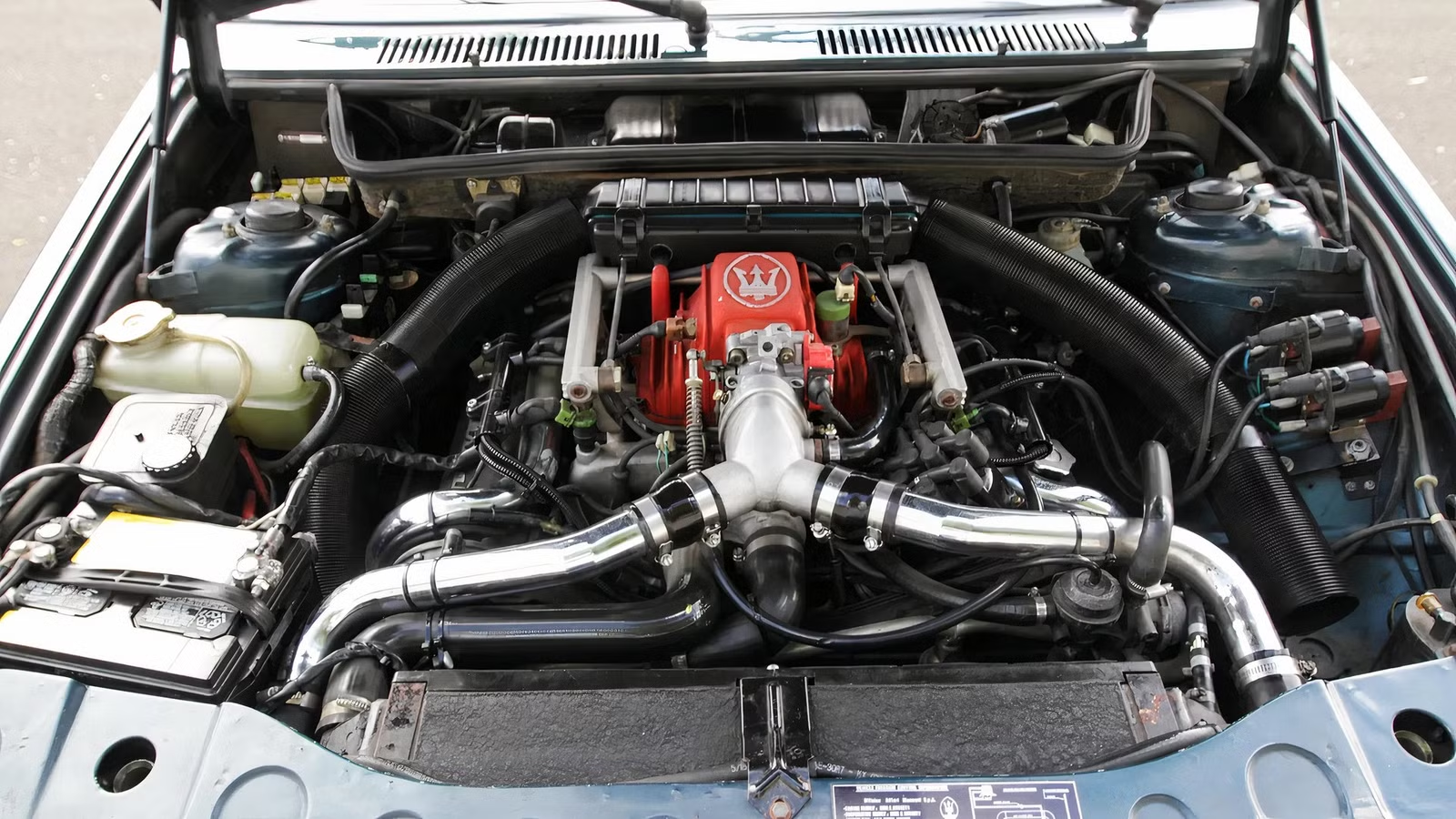
Here was an engine as cutting-edge as it was exotic: a compact 1,996cc V6 with not one but two turbochargers, at a time when Audi had just wowed the world with its groundbreaking Quattro, which itself featured only a single turbocharger. The Biturbo’s pioneering powertrain was matched to a luxurious interior to create what Maserati hoped would be an everyday car.
A Closer Look At The Biturbo’s Unique Engine

The Maserati Biturbowas launched in December 1981. The Biturbo’s engine was a new, compact 90-degree V6 that drew breath through two small turbochargers. Maserati’s decision to fit twin turbos was a world first on a production car and well ahead of its time.
The original Biturbo used a 2.0-liter six-cylinder with three valves per cylinder (two intake, one exhaust), a single overhead camshaft, and two turbos. The parallel twin-turbo arrangement meant both units worked together, with each serving its own cylinder bank. The thinking was straightforward: two smaller turbochargers spool up faster than one larger unit, reducing the turbo lag that plagued many early forced-induction cars.
The Biturbo Doesn’t Have Much Power, But It’s Still Quick

At this point, you might assume that — much like today’s downsized turbocharged engines — this was a clever way to generate both power and fuel efficiency. You’d be slightly wrong on both counts. The V6 twin-turbo produced 180 horsepower at 6,000 rpm, but with just 2,394 lbs to haul around, that was enough to reach 60 mph in 6.5 seconds and hit a top speed of 134 mph. Official economy figures are hard to pin down, but when one well-known magazine tested a later 2.5-liter Biturbo in 1986, it managed just 11 mpg.
In 1983, the more powerful Biturbo S arrived, featuring twin intercoolers made visible by two NACA air ducts on the hood. By 1986 and 1987, both models gained fuel injection, becoming the 187-horsepower Biturbo i and the 220-horsepower Biturbo Si. Two displacement variants were offered: a 1,996cc version for the domestic Italian market — which sidestepped a VAT surcharge on engines over 2.0 liters — and a 2.5-liter, and later 2.8-liter, version for export.
The Maserati Biturbo Was A Hit

The Biturbo steered Maserati away from exotic grand tourers and toward something closer to BMW’s market segment. Contemporary reviewers flagged handling challenges, yet the model sold well and introduced the brand to an entirely new audience. Its inviting interior appointments helped draw in customers who had never previously considered the marque.
A Spyder variant followed, developed by Zagato on a shortened wheelbase — Maserati’s first convertible since the Ghibli Spyder more than a decade earlier. The platform later evolved into performance-focused derivatives including the Ghibli and Shamal during the 1990s.
Production reached approximately 38,000 units over twelve years, with more than 5,000 sold in the United States. Maserati spent subsequent decades rebuilding its sporting reputation through models including the Coupé, GranTurismo, GranCabrio, and the MC20.
The Maserati Biturbo Is A Twin-Turbo Bargain Today

Maserati Biturbo Prices In 2025 (Good Condition)
- 1984 Maserati Biturbo Base – $4,900
- 1985 Maserati Biturbo – $4,900
- 1987 Maserati Biturbo – $5,200
- 1989 Maserati Zagato (Spyder) – $13,800
- 1991 Maserati Biturbo – $13,800
- 1992 Maserati Zagato (Spyder) – $15,000
Given its groundbreaking engineering and prestigious badge, it may come as a surprise that the Biturbo is a genuine used-car bargain. An early 1984 Maserati Biturbo in good condition is valued by Hagerty Valuation Tools at just $4,900 — roughly the same as a well-worn economy car.
We found this 1987 Biturbo Spyder with just 27,000 miles on the clock, which sold in December 2024 for just $7,500. Not a lot of money for a pretty car. It’s also worth bearing in mind that a BMW 325i Convertible of the same vintage will set you back an average of $16,300 according to Hagerty — and it doesn’t sound anywhere near as good in the casino.
Sources: Hagerty.com; Hemmings.com; Maserati.com

Related posts
Latest Post



No Comments