
The Big-Bore Motorcycle That Doesn’t Know When It’s Supposed To Quit

Motorcycle showrooms run on constant reinvention. Every few seasons, manufacturers push out fresh paint codes, revised digital dashes, and electronic rider modes to convince buyers that last year’s machinery is obsolete. Yet long-term riders know that digital novelties wear thin when the warranty expires. What truly counts across decades is mechanical resilience: heavy-duty engine castings, stress-free highway gearing, and unstrained power. Tucked away from trend-chasing brochures sits one anonymous heavyweight cruiser that quietly commands a cult following. It completely ignores modern retirement schedules simply because its core mechanical foundation refuses to wear out.

Designing a large-displacement cruiser engine usually means accepting a severe dynamic compromise. The segment’s standard formula relies on massive flywheel inertia, long-stroke architecture, and low-RPM tuning to deliver that signature off-the-line thump. While that configuration pulls like a locomotive and passes traffic without needing a downshift, it extracts a heavy mechanical toll at sustained speed.
Short Strokes And Oversized Valves Deliver Immense Torque Without High-RPM Wear

The engineering solution bypasses complex digital fixes in favor of pure combustion physics: large-bore volumetric efficiency. By utilizing a big bore and short stroke, an engine can breathe freely through oversized valves and generate immense torque without revving into high-stress territory. Liquid cooling can manage the thermal expansion of such large combustion chambers, preventing the heat soak that degrades oil and distorts cylinder walls.
Suzuki holds an unmatched track record in executing this specific layout. From high-stress multi-cylinder engines to heavy road platforms, the company has consistently mastered the art of designing a bulletproof motorcycle. By avoiding finicky by-wire throttles and delicate electronics, Suzuki leaned on proven mechanical strength to deliver massive power with zero stress on the valvetrain.


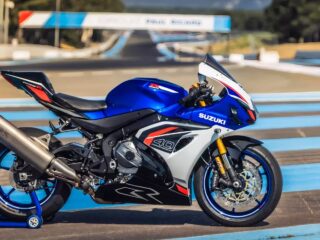
That bulletproof durability defines the Suzuki Boulevard M109R. Armed with massive 112 mm forged pistons—among the largest in the automotive world—and a stout, enclosed shaft drive, it delivers effortless muscle without needing modern digital crutches to stay intact.
A massive 240 mm rear tire puts its broad powerband straight into the pavement, maintaining straight-line highway stability under heavy loads. It is a machine engineered with so much mechanical headroom that ordinary road use cannot wear it down. Decades after its introduction, the M109R remains on the road simply because its unstressed engine and industrial-grade drivetrain will last a lifetime.
The Engine Is One Of The Greats Of The Motorcycle World

The Boulevard was conceived in a time when bigger was most definitely better, and as a result, it has some of the largest pistons ever seen in the automotive world. This is also one of the largest displacement engines that Suzuki has put into one of its two-wheelers, and remains its biggest motorcycle engine today. It is a 54-degree V-twin with liquid cooling, a DOHC head, and four valves per cylinder. It displaces 1,783 cc, has a short-stroke design, and has a compression ratio of 10.5:1. It generates 123 horsepower at 6,200 RPM and 118 pound-feet at a shockingly low 3,200 RPM without the assistance of things like a by-wire throttle and variable valve timing.
The surprisingly torque-rich engine feeds its performance through a five-speed wide-ratio gearbox and a driveshaft to the wheel. To reiterate, this is a 20-year-old engine with immense power and torque and a cable throttle; you really need to know what you are doing with it, or it will get you into trouble quickly. At the same time, over the 20 years it has been around, Suzuki has perfected its reliability, and unlike other high-performance engines, this one will last no matter how much abuse you throw at it.
Inverted 46mm GSX-R Forks And Radial Calipers Are Matched With A Monster 240 mm Rear Tire

The Boulevard M109R has a traditional steel double-cradle frame, but 20 years ago, its suspension and brakes would have given many people quite the shock. Even today, its chassis components make it far better than the price tag suggests. The front suspension has been taken from an old GSX-R1000: these are 46 mm inverted cartridge-type front forks. At the rear, there is a linkage-type monoshock hidden under the seat that makes it look like a hardtail design. They offer 5.1 inches and 4.7 inches of travel, respectively, and preload adjustment is available at the rear.
The front brakes have also been lifted from that same GSX-R: dual 310 mm floating discs with radial four-piston fixed calipers help harness the engine’s performance. At the rear, there is a 275 mm disc with a two-piston floating caliper. Surprisingly for a cruiser of the time, it uses 18-inch alloy wheels; they are shod with tubeless radial tires. The 240 mm wide rear tire was the widest on a production motorcycle at the time of its launch. The Boulevard might be big and heavy, but it rides and handles much better than one would expect from a 20-year-old cruiser, and that is a large part of why it still feels like a relevant motorcycle today.
Stretched 67.3-Inch Wheelbase And 764 Wet Pounds Demand Absolute Rider Focus

The big Boulevard is exactly that: it is 96.5 inches long, 34.4 inches wide, and has a massively long 67.3-inch wheelbase. Despite the cradle frame, it has a very decent ground clearance of 5.1 inches; that is mostly due to the semi-dry sump engine design. This is also a contributor to the fairly low seat height of 27.8 inches, but it weighs a mighty 764 pounds. This is a big, heavy cruiser that offers Harley presence with Japanese dependability, and riders really need to know what they are doing with it, not just in the parking lot but out on the highway, given the sheer heft and performance involved.
Split Dials And Zero Rider Assists Demand An Experienced Throttle Hand

Suzuki launched the Boulevard M109R two decades ago, and its feature list reads well for a motorcycle launched then. Over the years, Suzuki has made exactly zero updates to it, so expecting it to have the kind of features riders have come to expect from modern full-size cruisers will be an exercise in futility. Still, this is a smart choice if you want a long-term cruiser. It has a split instrument cluster: the main gauges are tank-mounted, featuring an analog speedometer, a fuel gauge, a clock, an odometer, and twin trip meters.
The Best Price-To-Performance Ratio In A Cruiser Under $20,000

The big Boulevard is known as a performance cruiser, but a pleasant surprise is that its $15,799 retail price makes it quite a bargain. It was the most powerful cruiser under $20,000 a couple of years ago, and that still hasn’t changed today. Another thing working in its favor is that it is extremely reliable and running costs are low compared to other power cruisers in its category, making it a unique combination of reliability, performance, and value.
Source: Suzuki Cycles

Related posts



Latest Post


No Comments