
The Ford That Outsold The Mustang But Disappeared From History
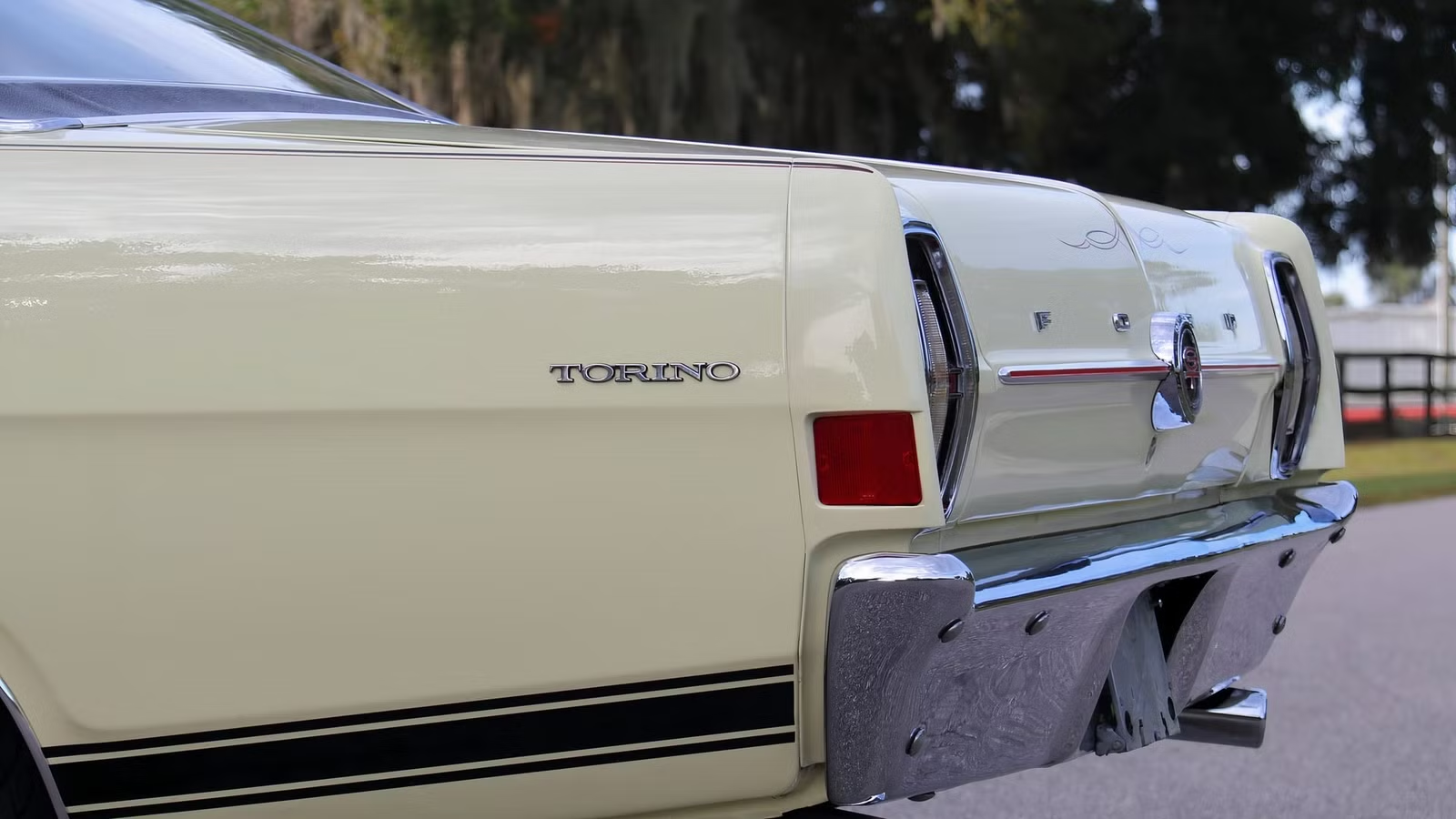
The Ford Mustang has long been a symbol of American performance, but it has never been the only Ford capable of turning heads — or moving metal. While the Mustang continues to dominate the conversation around Blue Oval performance cars, history tells a more complicated story. Long before the debate over electric versus gasoline-powered pony cars took center stage, another Ford was quietly outselling the Mustang and winning over buyers who wanted something a little more versatile. That car was the Ford Torino, and it deserves far more recognition than it typically receives.

Combining style, performance, and versatility, the Torino appealed to a diverse spectrum of buyers. Its availability in several body configurations — hardtop, fastback, and convertible — further broadened its reach. Nevertheless, Ford ended production in 1970, after which the model’s presence within the Blue Oval portfolio disappeared. We’re here to recognize it for its achievements and appreciate it for the performance it offered as a mid-size Ford muscle car.
The Ford Torino Even Outsold The Mustang
Although the Mustang gets most of the spotlight when it comes to discussions of classic Ford performance vehicles the Torino actually surpassed its sales numbers starting in 1970. From that point on, Ford’s Torino production all but eclipsed that of the Mustang. Factoring in the sedan, hardtop, fastback, Brougham, GT, Cobra, and wagon variants, Ford’s midsize lineup outsold the pony car by more than 2 to 1 in 1971. By 1972, the gap had widened even further, with the Torino achieving nearly four times the sales of its Mustang stablemate.
Ford Torino Vs. Ford Mustang Production By Year
 51 autotech Model Year |
Ford Torino Production |
Ford Mustang Production |
|---|---|---|
|
1968 |
172,083 |
317,404 |
|
1969 |
129,049 |
299,824 |
|
1970 |
232,411 |
191,239 |
|
1971 |
326,463 |
151,484 |
|
1972 |
496,645 |
125,813 |
Of course, even with engine options ranging from a pedestrian 145-horsepower inline-six to a fire-breathing 375-horsepower Cobra Jet V8, the Mustang was a much more specialized vehicle. Ford offered just three main body styles — coupe, fastback, and convertible — compared to the Torino, which came in two-door, four-door, hardtop, fastback, station wagon, convertible, and pickup guises. The model debuted as a premium variant of the Ford Fairlane in 1968, but it was so well-received that it replaced the Fairlane nameplate altogether, taking over its trim, powertrain, and accessory options after 1970.
A Ford Mid-Size To Rival The Chevelle

Beyond its sales performance relative to the Mustang, the Torino — named for Turin, the Italian city often called the Detroit of Italy — is significant because it finally allowed Ford to bring the fight to the Chevrolet Chevelle Chevrolet’s mid-size muscle car was an absolute sensation among the American public, as sales had grown from 387,119 cars in 1964 to a staggering 633,944 by 1970 — even the Mustang’s best year (1966) trailed that figure at 607,568 units. By 1972, however, Ford’s redesigned Torino turned the tide, outselling the Chevelle 496,645 units to 450,842. As muscle car power waned and insurance rates climbed, the Blue Oval’s mid-size had pulled off a genuine upset.
The Torino Offered Mid-Size Ford Performance

If you want an economical daily driver, you could spec a Torino with an inline-six — but the real story is in the V8s. The 1970 model year represented the pinnacle of output for the Blue Oval’s mid-size: the base 429-cubic-inch 385 Series V8 produced a stump-pulling 480 lb-ft of torque, while the top-spec Super Cobra Jet 429 was rated at 370 horsepower. Ford’s Cobra Jet engine is widely known for being underrated from the factory — it’s entirely possible that some Torinos were making 400 horsepower or more.
In a 1970 road test, Motor Trend evaluated everything from the Torino 351 up to the Torino Cobra awarding the Ford its Car of the Year honor. The 351-equipped car turned in a respectable 8.7-second 0–60 mph time and a 16.5-second quarter-mile — solid, if unspectacular. The Cobra, however, was a different animal entirely, sprinting to 60 mph in just 5.8 seconds and covering the quarter-mile in 13.99 seconds at 101 mph.
Ford Designed The Talladega To Cheat The Wind

In addition to the more commonplace base Torino GTs and Cobras, Ford offered several desirable special-edition variants, including the Talladega, the Twister Special and the Type N/W. While each of those models received powerful engine upgrades and eye-catching graphics packages, the Talladega stands apart because of its distinctive design and race-bred specialization.
A Ford Born From The Aero Wars
Back in the 1960s, Ford and Chrysler were locked in fierce competition on the oval for NASCAR supremacy, each searching for any available edge. For 1969, Dodge fired the first shot in the aero wars with the introduction of its wind-refined Charger 500 Not long after, Ford responded with the Torino Talladega a model that improved the aerodynamics of the standard Torino body with a considerably elongated front nose, unique rocker panels, and slippery bumpers. The car proved a dominant force during that season, winning 11 races in a row. Ford reportedly named the car in an attempt to win over NASCAR founder Bill France, who had opened a new track in 1969 that we know today as the Talladega Superspeedway.
Ford Torino Talladega Performance Specs
However, as was the case with the Dodge Daytona and Plymouth Superbird, NASCAR took notice of the Torino’s wind-cheating abilities. A ban in 1970 effectively prohibited aero cars from competition, ending the Talladega’s racing eligibility. To homologate the model for the 1969 season, Ford built approximately 754 cars, making surviving examples highly sought-after among dedicated Torino collectors. Thanks to their Cobra Jet powerplants and limited production numbers, they have fetched well over six figures at auction.
Ford Almost Made A Beaked NASCAR Competitor
In an attempt to field an even more aerodynamic challenger against the Dodge Daytona and Plymouth Superbird, Ford took a 1970 Torino Sportsroof and fitted it with a large single-piece nose cone, dubbing it the King Cobra Three prototypes were built — featuring a Boss 429, a 429 Super Cobra Jet, and a 429 Cobra Jet — and tested at Daytona to verify their 200-mph capabilities. Despite the King Cobra’s immense potential, it was plagued by handling problems stemming from an imbalance of front-end downforce and rear-end lift. The project was ultimately scrapped when NASCAR raised its homologation requirement from 500 to 3,000 cars, and Ford simultaneously cut its factory racing programs due to budget constraints.
How Much A Ford Torino GT Costs Today

If you’re looking to get your hands on one of Ford’s performance-oriented Torinos, the good news is that they were produced in large numbers. During the Torino GT’s four-year run, just under 350,000 examples rolled off the line. In practice, this means they make for attainable American classics and more common base engine options like the 302 and 351 can often be found for under $50,000. We’ve included values below for GTs equipped with those powerplants, as they offer a more representative picture of Torino value compared to rarer upgrades like the 390 and 429.
Ford Torino GT Valuations
|
Condition |
1968 Fastback (302) |
1969 Sportsroof (351) |
1970 Sportsroof (351) |
1971 Sportsroof (351) |
|---|---|---|---|---|
|
Fair |
$12,700 |
$16,500 |
$17,600 |
$17,200 |
|
Good |
$13,800 |
$25,200 |
$26,100 |
$25,100 |
|
Excellent |
$27,300 |
$36,900 |
$40,200 |
$37,800 |
|
Concours |
$38,000 |
$50,400 |
$50,900 |
$51,500 |
Hagerty
Values are fairly consistent for Torino GTs from year to year, though the 1970 model commands a slight premium. Ford restyled the car for the second generation after 1969, and tightening emissions regulations combined with rising insurance rates caused power outputs to drop off beginning in 1971. For a GT equipped with a Cobra Jet V8, Hagerty’s Valuation Tool has estimated a 1970 example in “Good” condition at around $45,800, while a comparable 1971 comes in around $37,100. That makes Cobra Jet cars worth noticeably more than 351-engined examples, though they still undercut a full-fledged Torino Cobra.
Hagerty’s valuations tend to be conservative, and with patience, deals can be found on the Ford Torino. Recent auction results on Bring a Trailer have occasionally come in below those estimates, particularly for cars needing some attention. Being less celebrated than the Ford Mustang, the Torino remains a genuine insider’s choice — though strong auction interest has the potential to close that gap over time.
Sources: CJ Pony Parts, Ford-Torino.de, Hagerty, Hemmings.

Related posts




Latest Post


No Comments