
The First American Bike To Hit 150 MPH From The Factory
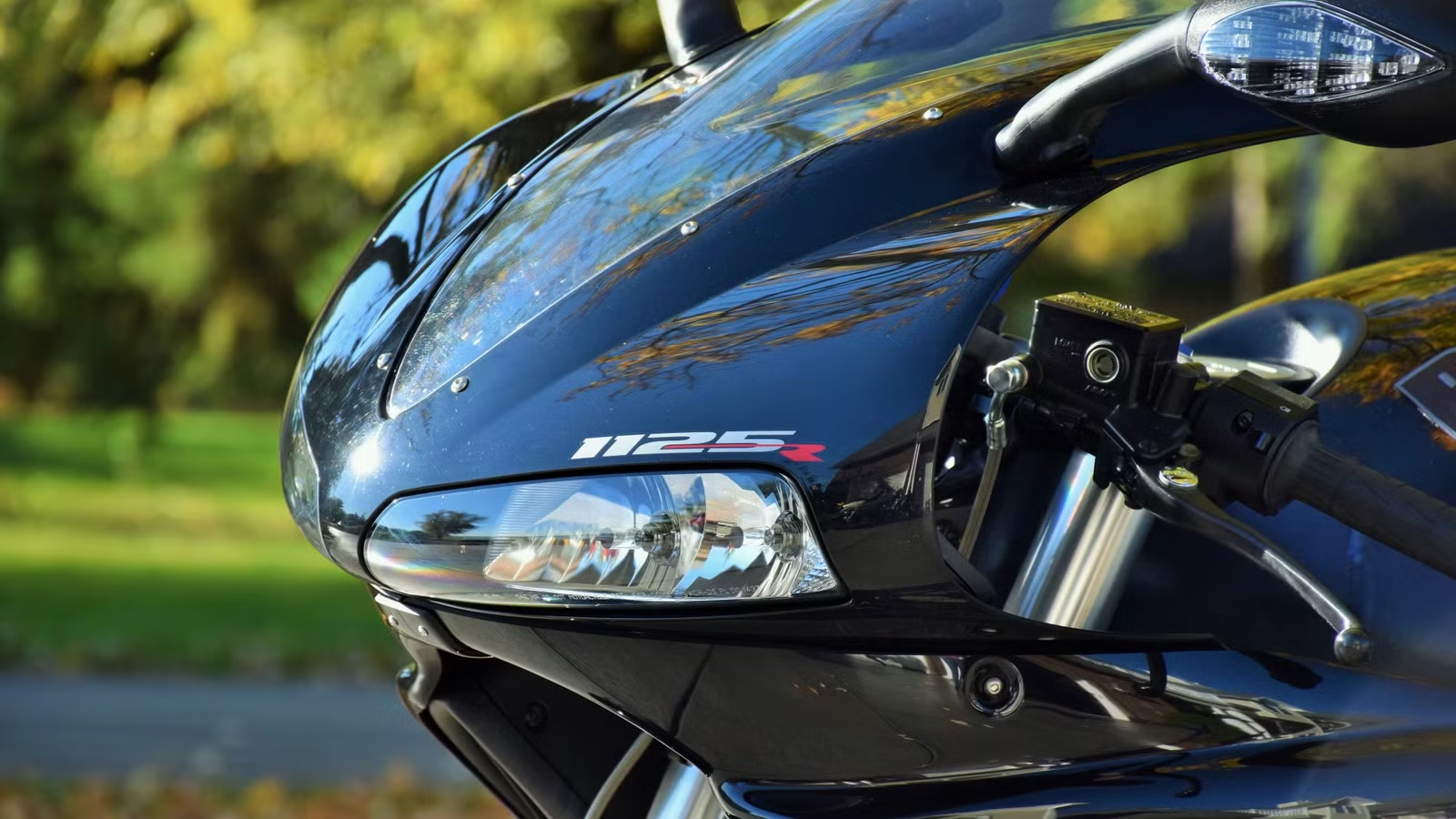
For decades, the American motorcycle industry seemed content to leave top-speed glory to the Europeans and Japanese. While Kawasaki, Suzuki, and Ducati were locked in an arms race toward 180 mph and beyond, US manufacturers were busy perfecting the art of the torque-heavy cruiser — bikes built for the long haul, not the speed trap. That began to change in 2007, when a scrappy Wisconsin company with deep Harley-Davidson roots did something no American production motorcycle had ever done: cracked 150 mph straight from the factory floor.
A Country Built On Power, Not Speed

The US has long had a fascination with big displacements that create torque rather than outright speed. The drag strip and the quarter mile are far more common than in any other country, as is the grid layout of cities, which means quick acceleration is arguably more useful than top-end velocity. Factor in cheap gasoline, a culture of hauling, and long highway drives where smoothness matters most, and you have a recipe for big engines tuned for low-end pull rather than peak power.
It led to cars like the 1975–76 Cadillac Eldorado — an 8.2-liter V8 that made around 200 hp — and the Lincoln Continental Mark IV, which could be specced with a 7.5-liter V8 producing the same output. There was also the 1977–78 Plymouth Volaré, whose 5.7-liter V8 managed just 140 hp.
It extends to motorcycles, too. Harley-Davidson is obviously the biggest bike manufacturer in the US and, while some of their bikes have big engines, they’re not always the most powerful. The 1993–94 Electra Glide made just 50 hp from its 1.3-liter engine, while the 2025 Road Glide has a 1.9-liter engine and makes a comparatively modest 107 hp — something most modern bikes can clear with an engine half that size. That’s not to say that all American-made vehicles forgo speed, though, as one bike manufacturer proved.

Buell Becomes The Anti-Harley

Created by former Harley-Davidson engineer Erik Buell in 1983, Buell was initially formed to support its founder’s privateer motorcycle racing ambitions. He built his first bike, the RW750, to compete in the AMA Formula One class. However, when the series was canceled, Buell shifted his focus to road-going motorcycles instead.
Buell’s road bikes used Harley-Davidson engines in innovative ways, including treating the engine as a stressed chassis member to improve rigidity and reduce weight. This, along with Buell’s growing success, led to Harley-Davidson acquiring a 49% stake in the company in 1993. Buell continued developing performance-oriented motorcycles powered by Harley-derived V-twins until Harley took full ownership in 2003.
While the bikes had always been pioneering in their own way, they still had their ties to the cruiser company. Buell wanted to create a bike that could be a genuine contender in the sportbike world, and in 2007, they released the 1125R.
The Barrier-Breaking Buell 1125R

Buell had already been experimenting with fast sportbikes by the mid-2000s. Its XB Series bikes, like the XB9R Firebolt and XB9S Lightning, had proved that it could make successful road bikes, and subsequent iterations pushed them further. But it had plans to go much faster and, in 2007, it released the Buell 1125R.
The bike did things a little differently. To start with, there’s the frame: far from being merely the structure that the parts attach to, it actually housed the 5.6-gallon fuel tank, while the oil was held in the swingarm. The space the tank usually occupied was replaced by an air intake. This had a few benefits, the first of which was a lower center of gravity, making the bike more agile and improving its cornering.
|
Engine |
Power |
Torque |
Top Speed |
Weight |
|
1,124.9 cc liquid-cooled V-twin |
146 hp |
82 lb-ft |
161 mph |
375 lbs dry / 466 lbs wet |
Keeping the weight down, and centralized within the bike, was something that Buell focused on — and fluids in the frame wasn’t the only example of it. The bike’s front brake used a massive single perimeter rotor: rather than a conventional disc mounted at the hub, the rotor was a much larger circle nearly as wide as the rim itself. Far from being different for the sake of it, this has sound engineering behind it. The rotor’s position closer to the tire provides greater leverage, reduces unsprung weight, and improves cooling.

The mass centralization also saw the exhaust placed underneath the bike rather than to the side, and the belt drive instead of a chain offered both improved durability and smoother power delivery. It was the bike Buell had always wanted to make but, unfortunately, it came at exactly the wrong time.
The 2007 launch for the 2008 model year meant it arrived at the start of the financial crisis, with Harley dropping Buell in 2009 to cut costs and refocus on its core lineup. This ended the bike’s run just as it was gaining momentum, though the launch itself had also been rocky. The styling was controversial, with the two large air intakes flanking the front suspension earning the nickname “lobster claws” from detractors. Early bikes also suffered teething issues with quality control, excessive heat around the rider, and stiff suspension. Still, for all the problems at launch, it had one thing firmly on its side: speed.
The European Heart That Changed American Sportbikes Forever

Until the 1125R arrived, all Buell road bikes relied on modified Harley-Davidson V-twins. Those air-cooled, 45-degree pushrod engines delivered the low-end torque, character, and unmistakable rumble American riders loved, but they were never designed to rev high enough to compete with the 180-hp superbikes pouring out of Japan and Europe. To hit that 150 mph target, Buell needed an entirely different approach.
The breakthrough came when Buell teamed up with Austria’s BRP-Rotax, whose résumé included high-performance motorcycle, ATV, and aircraft engines. Together, they developed the Helicon from the ground up exclusively for the 1125R. The new engine kept the V-twin layout but adopted a modern liquid-cooled, 72-degree design with dual overhead cams, four valves per cylinder, and a large ram-air intake. Buell also stretched displacement to 1,125cc instead of following the 1,000cc superbike formula, prioritizing a wide, usable torque band over racing regulations. It still delivered the punch of a big V-twin, but finally had the breathing capacity and rev range to push an American production sportbike beyond 150 mph.
Buell Breaks 150 MPH And Keeps Going

150 mph might not sound like much in today’s motorcycle market, and to be fair, it wasn’t a huge accolade for bikes in 2007, either. The Vincent Black Lightning, a British bike, had hit 150 mph in the hands of Rollie Free back in 1948. Japanese and European bikes had been routinely breaking 180 mph for years. The Hayabusa had effectively ended the top-speed wars in 1999. But US production bikes had largely focused on torque over speed, and were lagging well behind.
The 1125R aimed to remedy that. It had 146 hp, low weight, and a clear goal. It achieved that goal — and not by a small margin. Period road tests put the bike at 158 mph and 161 mph, comprehensively surpassing the 150 mph mark.
How The 1125R Stacked Up Against The Competition

|
Buell 1125R |
Honda CBR1000RR |
Suzuki GSX-R1000 |
Ducati 1098 |
|
|
Engine |
1125cc liquid-cooled 72° V-twin |
998cc liquid-cooled inline-four |
999cc liquid-cooled inline-four |
1099cc liquid-cooled L-twin |
|
Horsepower |
146 hp |
175–176 hp |
185 hp |
160 hp |
|
Torque |
82 lb-ft (Crank/Brake Torque), 75.9 lb-ft (Rear-Wheel Torque) |
85 lb-ft |
86 lb-ft |
90.4 lb-ft |
|
Top Speed |
158–161 mph |
180 mph |
180–186 mph |
173 mph |
|
Weight |
375 lbs dry / 466 lbs wet |
438 lbs wet |
379 lbs dry |
381 lbs dry |
The Buell 1125R arrived at a time when the sportbike class was dominated by absolute giants, including Japanese inline-four-powered models like the Honda CBR1000RR and Suzuki GSX-R1000, and European machines like the Ducati 1098. Smooth, refined, and brutally fast, the Honda CBR1000RR was the benchmark all-rounder of the era and objectively the better motorcycle for most riders, but the Buell still held advantages: stronger mid-range punch, quicker steering characteristics, and distinctive chassis innovation.
The 1125R also struggled against the Suzuki GSX-R1000, which was arguably the king of outright performance at the time and known for ferocious acceleration and incredible top-end speed. Compared to the GSX-R1000, the Buell simply lacked the same explosive peak performance, but it fought back with compact dimensions and a more distinctive, arguably more engaging character at real-world road speeds. The 1125R’s most direct rival was the Ducati 1098.
Buell 1125R Vs. Ducati 1098

This was a fascinating comparison because both bikes approached performance with a big V-twin philosophy rather than inline-four power, and surprisingly, the Buell came closer than many expected — even though the Ducati was the more premium option. While the Ducati was a high-strung masterpiece with around 160 hp and a higher top speed, it was a demanding bike on the street and more race-focused than the more street-friendly 1125R. The Rotax engine also provided a thick torque curve that made the 1125R feel fast in real-world riding. The Buell had a more agile feel and could genuinely keep pace with the Ducati and other big-name rivals on tight roads.
While the Ducati 1098 was faster, more polished, more exotic, and ultimately a superior sportbike, the 1125R was a serious, budget-friendly contender that proved an American sportbike could stand in the same conversation as Ducati and other top manufacturers of the day.
The 1125R Sparked One Of AMA Racing’s Biggest Controversies

Buell didn’t build the 1125R just to post impressive top-speed numbers. It wanted to prove the bike was just as fast on the racetrack. That opportunity came in the inaugural 2009 AMA Pro Daytona SportBike Championship, where Danny Eslick lined up against Japanese favorites like the Yamaha YZF-R6, Honda CBR600RR, Suzuki GSX-R600, and Kawasaki ZX-6R, as well as the Ducati 848 and Triumph Daytona 675. Its inclusion immediately divided the paddock because the 1,125cc V-twin looked oversized on paper, even though the class was built around performance-balancing rules rather than displacement alone.
Eslick answered the criticism the best way possible, winning six races and clinching the inaugural championship. While the triumph helped validate the Helicon-powered sportbike, it also prompted adjustments to the class rules. Sadly, Buell’s breakthrough came at the worst possible time, with Harley-Davidson closing the brand before it could build on its newfound momentum.
Outside Of Mass Production, The American Motorcycle Has Gone Far Faster

Other US-made bikes had broken the 150 mph mark before the Buell 1125R, but these were either homologation specials like the Harley-Davidson VR1000 or boutique machines like the MTT turbine series. There’s also the Lightning LS-218, an American-made electric bike capable of 218 mph.
Buell themselves would break 150 mph again in later years, with the Hammerhead 1190 (around 183 mph) and the Erik Buell Racing (EBR) 1190RX, which can approach 190 mph. But the Buell 1125R will forever stand as a “what if” of motorcycling — a high-performance, high-speed American sportbike that, while not without its issues, was cut down by factors outside its control before it reached its prime. How far it could have gone will forever remain a mystery, but the 2009 AMA Pro Racing Daytona Superbike Championship title it secured suggests it could have gone a long way. It just needed the chance to prove it.
Harley Killed Buell, But It Couldn’t Kill The 1125R’s Legacy

Harley-Davidson pulled the plug on Buell in October 2009 as part of its post-recession restructuring, ending production of the 1125R after just two model years. Its naked sibling, the 1125CR, survived only briefly before the factory closed, making the Helicon-powered bikes some of Buell’s shortest-lived models.
Erik Buell wasted no time starting over. Within weeks, he founded Erik Buell Racing (EBR), initially building race-prepped 1125Rs before reworking the Helicon into a larger 1,190cc V-twin. Output climbed from 146 horsepower to around 185 hp, powering the 1190RR, 1190RS, and later the 1190RX. Even today’s Buell Hammerhead 1190 traces its lineage directly back to the 1125R, retaining that evolved engine architecture and many of the same engineering principles. The 1125R didn’t mark the end of America’s first 150-mph sportbike — it laid the foundation for every Buell superbike that followed.
The Buell 1125R Is One Of The Most Underrated Collectibles

The Buell 1125R checks nearly every box collectors look for. As the final and most advanced motorcycle developed under Harley-Davidson ownership, it introduced a liquid-cooled Rotax Helicon V-twin alongside signature Buell innovations that made it one of the most distinctive sportbikes of its era. Yet despite its short production run and championship-winning pedigree, the market has yet to fully recognize its significance.
The 1125R debuted at $11,995 before climbing to $12,499 for its final model year, but solid rider-quality examples can still be found in the $3,500 to $5,000 range, with exceptional low-mileage bikes breaking the $6,500 mark. Considering that many Japanese and European superbikes from the same era were produced in far greater numbers and often sell for considerably more, the Buell looks seriously undervalued. However, there are lingering concerns that keep prices in check.
Why Buyers Still Think Twice About The 1125R

The 1125R’s low prices have less to do with performance than perception. Early bikes earned a reputation for jerky fuel injection, excessive heat around the rider, and polarizing “lobster claw” radiator pods, while many later bikes became notorious for charging-system failures caused by overheating stators.
Then there’s the orphan-brand factor. Harley-Davidson shut Buell down in 2009, leaving many buyers worried about long-term parts support. While common service items and many engine components are still obtainable, finding replacement body panels, electronics, or other Buell-specific parts can take time and usually means relying on specialist suppliers or the used-parts market.
Those concerns are enough to keep cautious buyers away, even though many of the bike’s original weaknesses have well-documented fixes. For enthusiasts willing to do their homework, that’s exactly what makes the 1125R such an overlooked value.
Sources: Motorcycle Consumer News, Bring a Trailer

Related posts
Latest Post


No Comments