
This Slippery Suzuki Changed Motorcycle Design Forever
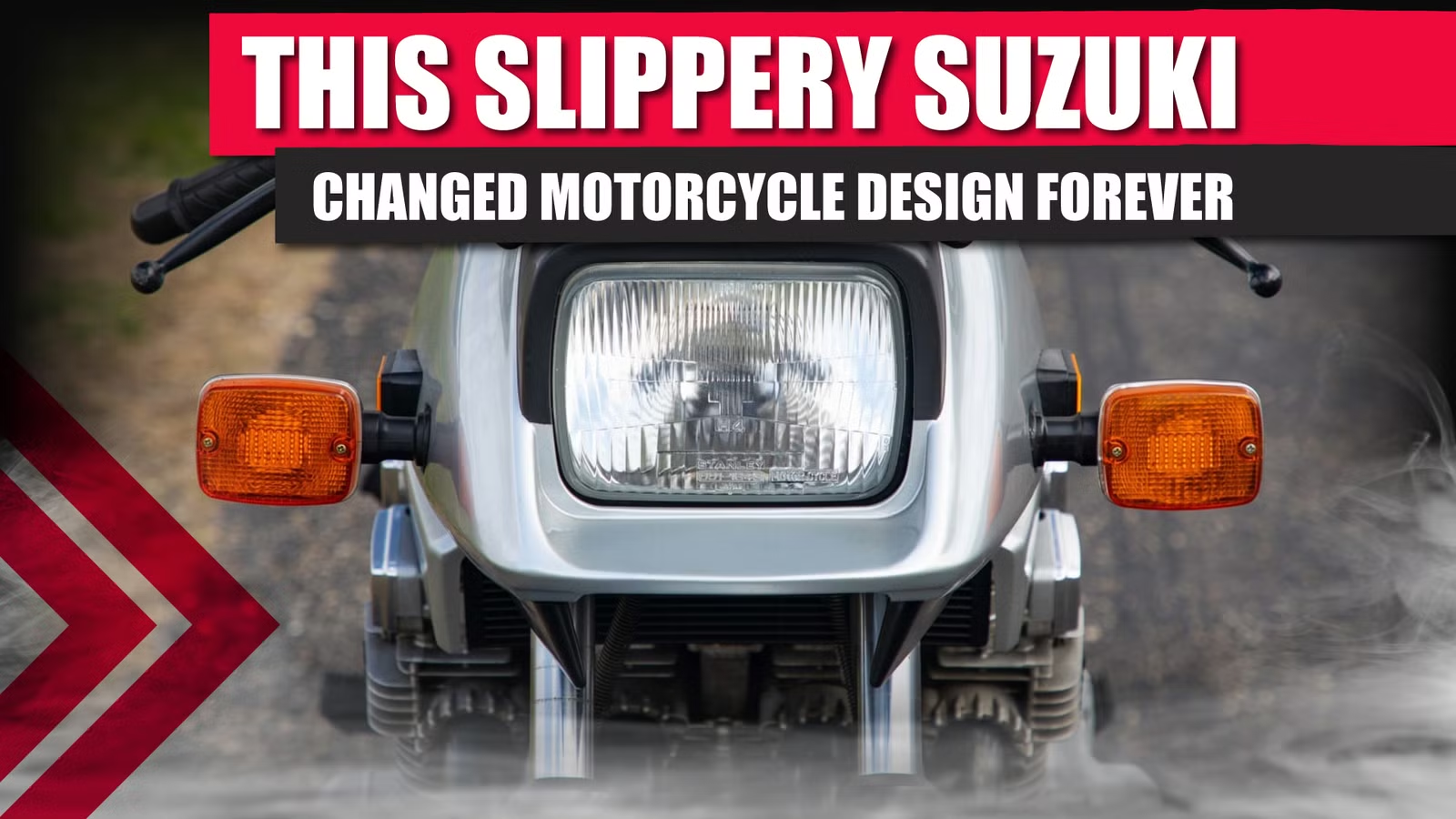
Few motorcycles have left a mark on two-wheeled design as deep and lasting as the Suzuki Katana. Decades after its debut, the blade-like silhouette it introduced still shapes the way sport bikes look — proof that genuinely revolutionary styling doesn’t age, it just becomes iconic. Yet the Katana’s origin story is surprisingly unconventional: a conservative Japanese manufacturer, a German design firm, and a brief window in the early 1980s when everything clicked. If you’ve ever wondered why modern sport bikes look the way they do, this is where the answer begins.

It’s a theme that can be traced back to one groundbreaking Suzuki from the early 1980s. Boasting blade-like angles and a presence that demanded a double take, it was a bike that sliced through convention with silent precision. The fact that it came from such a conservative Japanese manufacturer made its exotic German design all the more of a statement. Without this game-changing motorcycle, there’s no telling what our sport bikes might look like today. Read on to see how Suzuki managed to change motorcycle design forever.
The Katana Brought 80s Wedge To Two Wheels
By the early 1980s, the allure of the Universal Japanese Motorcycle (UJM) was starting to fade. Though the class of bikes had been built in huge numbers since the first CBs rolled off the line in the late 1960s, the conservative designs had shown little evolution throughout that time. Consumers wanted more from their motorcycles, and Japanese manufacturers needed something that could entice buyers into showrooms. While each of the Big Four responded to shifting market tastes by releasing exciting performance models, it was Suzuki that shocked the world with its slippery Katana. Designed in Germany and honed to an edge in Japan, it may have started as a bold styling exercise, but it ushered in a new era of motorcycle aesthetics.
Target Design Took Suzuki Styling To New Heights

To give Suzuki’s lineup an impactful refresh, Germany manager Manfred Becker contracted a firm by the name of Target Design and requested a European-styled model. Led by BMW’s ex-styling chief Hans Muth, the agency also comprised other former BMW heavyweights in Hans Georg Kasten and Jan Olof Fellström. Together, the three designers put together a proposal for an update to the smaller GS650 that they dubbed the ED 1. With an aggressively sloped tank and a stubby seat, it allowed the rider to sit ‘in’ the bike rather than on top, as in past UJM designs. If you look at any of today’s sport bikes, you’ll find similar elements in the rounded tank and riding position.
After seeing the positive reactions to Target Design’s angular MV Agusta concept, Suzuki requested a second, similar design for its larger GS750 and GS1100 models. The following April, Muth, Kasten, and Fellström introduced the ED 2 concept, adding a sharp, pointed half-fairing and a short, raked windshield. Suzuki gave the design the green light, and the Katana went into production starting in mid-1981. Underneath its futuristic bodywork, the bike was heavily based on the GSX1100E, and it was sold as the GSX1100S abroad before landing in the United States as the 1982 Katana GS1000S.
Suzuki Even Gave The Katana A Pop-Up Headlight
- The 1984 GSX750S3 featured a pop-up headlight
- Its engine was based heavily on the GSX750EFE
- They were not available stateside, making them rare sights
With the later GSX750S3 variants, Suzuki refined the Katana’s styling to be even more streamlined. Along with integrated turn signals in the front fairing, this meant revising the cockpit with sleeker gauges and updating the design with a very period-correct pop-up headlight. The vintage Japanese sport bike benefited from ergonomic changes, too, as the bars were raised and the seat was lowered for a more relaxed riding position.
The Katana Had The Speed To Match Its Looks

Suzuki Homologated The Katana For Superbike Racing
For its hot new bike to be legal for American Superbike racing, Suzuki had to downsize its displacement to meet the 1,025cc limit. Accordingly, the Katana was initially sold in the United States as a 998cc model (compared to 1,074cc in other markets), incorporating a GS1100 engine with bore reduced by 2mm and stroke reduced by 1.2mm. To keep power comparable, Suzuki modified the cam timing, tweaked the combustion chambers, and added beefier con-rods, a revised airbox, and a smaller-diameter alternator rotor.
Though the bike was down on displacement, magazines at the time were quick to praise its performance. Cycle World called the Katana the “quickest and fastest 1,000cc production motorcycle we’ve tested” on account of its 11.32-second quarter-mile at 120 mph, also highlighting its impressive braking distance and fuel economy relative to its class. Hot Rod only reinforced those findings in its own review, concluding that “the Katana’s blistering quarter-mile of 11.25 seconds at 120.64 mph makes it the quickest 1000 ever, and awesome out of a corner.”
1983 Suzuki Katana GS1100S Specs
|
Engine |
Air-cooled DOHC 4-stroke 4-cylinder |
|---|---|
|
Displacement |
1,074cc |
|
Bore x Stroke |
72.0mm × 66.0mm |
|
Compression Ratio |
9.5:1 |
|
Transmission |
5-Speed |
|
Power |
111 hp |
|
Torque |
70.9 lb-ft |
|
Curb Weight |
535 lbs |
Suzuki
With an AMA rule change, displacement limits no longer applied, and Suzuki was able to bring the 1,100 to the United States in 1983. The extra displacement made for an additional three horsepower, and the added grunt allowed the Katana to claim the title of “the quickest motorcycle Cycle World has tested” at the time of review. Building on its 1981 benchmark, the magazine recorded a blistering 11.05-second quarter mile at 123.64 mph.
After 1983, the GS1100S/GSX1100S was discontinued, and the Katana name was applied to a series of smaller variants including the GSX750, the GS550G, and later 400 and 250 replicas. For most of the world, the eventual arrival of the GSX-R in 1985 meant that the Target-designed Katana was no longer required, but the nameplate was later applied to GSX-F models like the GSX600F, the GSX750F, and the GSX1100F. Because of their rounded styling and mid-range engine tuning, they were far different machines compared to the ED 2.
Suzuki Revived The Original Katana
- Suzuki revived the original GSX1100S for the Japanese market in 1990
- The limited run of 200 bikes celebrated the company’s 70th anniversary
- Each one was built to original 1980 standards and specifications
Suzuki did revive the original GSX1100S for a brief release of 200 bikes in 1990, and the run proved so successful that they brought it back for the following year as well. The Japanese market even saw some versions of the Target-designed bike available until 2001.
How Much A Suzuki Katana Costs Today

Seeing as the later Katanas represented a significant departure in design, we’ll be focusing on those ED 2 models available in the United States between 1982 and 1983: the GS1000S, GS1100S, and GS750S. If you happen to prefer the later GSX-F bikes, the good news is that they tend to be significantly cheaper, as their styling isn’t nearly as distinctive.
1982–1983 Suzuki Katana Valuations
|
1982 GS1000S |
1983 GS1100S |
1983 GS705S |
|
|---|---|---|---|
|
Fair |
$4,100 |
$4,100 |
$1,800 |
|
Good |
$6,000 |
$6,000 |
$3,000 |
|
Excellent |
$10,100 |
$10,100 |
$5,300 |
|
Concours |
$16,400 |
$16,400 |
$8,000 |
Hagerty
By Hagerty’s estimations, a 1982 GS1000S or a 1983 GS1100S will run you anywhere from roughly four grand to over $16k. It’s worth noting that values on these models have trended upward in recent years, a clear sign that collectors are appreciating how Target Design’s creation has aged. The same can’t be said for the smaller 750, however — it’s valued at roughly half that of a comparable 1,000 or 1,100, and its estimates have remained stagnant or declined.
Suzuki Katana Past Sale Results
- Bring a Trailer High $9,900
- Bring a Trailer Low: $5,500
- Iconic Motorbikes High: $10,700
- Iconic Motorbikes Low: $2,851
Looking at past results on Bring a Trailer and Iconic Motorbikes, you’ll find that Suzuki Katanas don’t often come up for sale. Between the two auction sites, there are just 13 completed transactions for ED 2 bikes. On Bring a Trailer, the highest result came in the form of a 1982 GS1000SZ restomod at $9,900, with the lowest still fetching $5,500. Iconic Motorbikes shows an even greater spread, as the nicest 1982 SZ cleared $10,000 after the buyer’s fee, and someone managed to snag a project for a mere $2,851.
Suzuki Reintroduced The Nameplate In 2019

In 2019, the Suzuki Katana made its return in name and styling, built around the existing GSX-S1000 platform. In addition to a distinctive fairing inspired by the original 1980s GSX1100S, it boasted a 999cc four-cylinder engine derived from the legendary K5 GSX-R1000. Re-tuned for more torque, it was wrapped in a lightweight aluminum frame and paired with modern electronics including the Suzuki Traction Control System (SCTS), the Easy Start System, and Low RPM Assist.
2025 Suzuki Katana Specs
|
Engine |
Liquid-cooled DOHC 4-stroke 4-cylinder |
|---|---|
|
Displacement |
999cc |
|
Bore x Stroke |
73.4mm × 59.0mm |
|
Compression ratio |
12.2:1 |
|
Transmission |
6-Speed |
|
Power |
150 hp |
|
Torque |
78 lb-ft |
|
Curb Weight |
474 lbs |
Suzuki
Since the model’s reintroduction, the Suzuki Katana has remained in regular — albeit limited — production each year, gaining increasingly advanced features along the way. Thanks to the Suzuki Intelligent Ride System, it incorporates ride-by-wire throttle, a bidirectional quickshifter, and Suzuki Clutch Assist. With 150 horsepower and 78 lb-ft of torque on tap, the modern Katana is a fitting tribute that honors the spirit of the original while delivering the technology today’s riders expect.
Sources: Cycle World, Katana Central, Nippon Classic, Suzuki, Target Design

Related posts


Latest Post


No Comments