
The Finned Dodge Pickup Built By Sawing Station Wagons In Half
In 1955, Dodge held just 7% of the American pickup market, trailing Chevrolet, Ford, International, and GMC. With rivals selling pickups dressed up like passenger cars, Dodge’s answer came not from its design studio but from a truck-modification shop that borrowed the tailfins off one of its own station wagons.

The improvised pickup cost more than a regular truck, found few buyers, and disappeared by January 1959, yet one example sold for $150,000 at a 2017 auction. No factory production records survive, so nobody can say for certain how many Dodge built or how many are left today.
Dodge Had No Answer For The Chevy Cameo Or Ford Ranchero
Chevrolet set the tone in 1955 with the Cameo Carrier, a half-ton pickup whose fiberglass-clad bed gave it the smooth flanks of a passenger car. It cost $1,835, about 30% more than a standard Chevy pickup, and 5,220 buyers still signed up in that first year. That was a modest figure, but it proved some truck buyers wanted style along with payload.

Ford raised the stakes in December 1956 with the Ranchero, a pickup built from the two-door Ranch Wagon, which sold 21,696 units in its launch year. The Ranchero caught both GM and Chrysler off guard, and Ford’s redesigned 1957 F-Series added the flush-sided Styleside bed, which ditched the old pontoon rear fenders for a cleaner look.

Dodge’s 1957 trucks did gain Forward Look styling up front, with hooded headlights, a new grille, and a rear-hinged hood. The updates never reached the rear of the truck, and Chrysler design chief Virgil Exner reportedly had no interest in restyling pickups. Next to a two-tone Cameo or a car-based Ranchero, Dodge’s pickups were starting to look dated.
Dodge needed a halo pickup to compete with Chevy and Ford, but it lacked the money to design one from scratch. The solution would come from an unlikely corner of the company, where workers spent their days modifying trucks for individual business customers.
Dodge Built The Sweptside By Slicing Station Wagon Fins Onto A Pickup

The Dodge Sweptside came from Joe Berr, who managed special equipment sales at Dodge Truck and knew there was little money for a glamour truck. Rather than wait for a design studio, he reused the finned rear quarter panels and rear bumper from Dodge’s 1957 Suburban two-door station wagon. The swap also brought over the wagon’s Signal Tower taillights, so the truck wore the same jet-age rear end as Dodge’s station wagons.
Berr’s Special Equipment Group, or SEG, was an in-house shop that customized Dodge trucks for specific customers, much like a modern upfitter. It had no ties to Chrysler’s styling department, so the Sweptside was shaped by truck people rather than car stylists in Exner’s studio.
For the prototype, Berr had the quarter panels and bumper sawed off a two-door wagon, then cut the sides out of a long-wheelbase D100’s cargo box. SEG employee Burt Nagos welded the wagon pieces onto what remained of the bed, and the tailgate was trimmed so it would clear the new fenders. Extra chrome trim on the cab tied the front half of the truck to its flashy new tail, and two-tone paint finished the look.

On production trucks, the wagon parts went on in a separate operation after final assembly. One restorer who has owned at least 15 Sweptsides says the beds match standard Dodge beds except for four extra holes for the bolts that hold the fins in place.
Dodge dealers loved the finished prototype, and the truck was approved as a factory custom that SEG converted away from the main production line. The Sweptside went on sale in mid-1957 as Dodge’s direct rival to the Ranchero and Cameo Carrier, and Dodge’s advertising promised a pickup “straight out of tomorrow.”
Hand-Built Fins Made The Sweptside A Tough Sell

Every Sweptside came with two-tone paint, chrome bumpers, whitewall tires, and full wheel covers, and it offered more color combinations than the Cameo. Buyers could pick a standard or deluxe-trimmed cab, with the deluxe version adding a wraparound rear window. Power steering and power brakes were also on the options list.
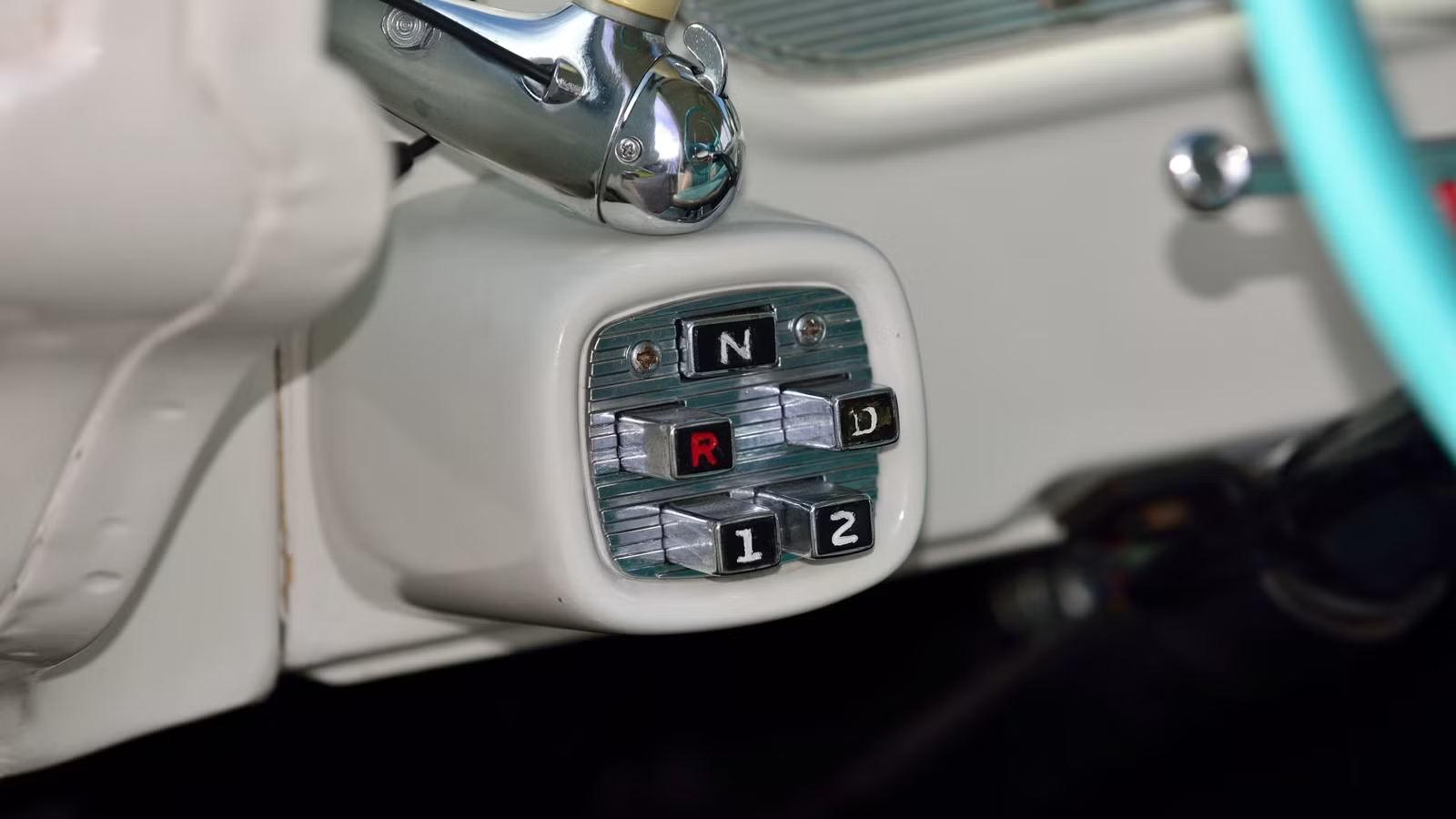
The base engine was a 230-cubic-inch (3.8-liter) flathead inline-six making 120 horsepower. Buyers who wanted more could order a 315-cubic-inch (5.2-liter) V8 with 204 hp, which could be paired with a three-speed push-button automatic. That V8 gave Dodge the most powerful engine in the light-truck field, so the Sweptside backed up its looks with real muscle.

A new Sweptside cost roughly $2,200 in 1957, several hundred dollars more than a basic Dodge half-ton. That premium bought no extra capability, since a standard D100 cargo box sat underneath the fins.
Each Sweptside box was modified by hand in a dedicated area of the factory, a slow and labor-intensive process that made the trucks expensive to build. Few late-1950s truck buyers were ready to pay extra for a flashy workhorse, so sales trickled in rather than taking off. Farmers and tradesmen in particular struggled to justify chrome fins on a truck meant for hauling.

Dodge refreshed the Sweptside twice, giving the 1958 model quad headlights and new front fenders and the 1959 version a redesigned grille and instrument panel.
In January 1959, Dodge made its factory-built Sweptline bed available on all two-wheel-drive light-duty pickups and dropped the Sweptside at the same time. The Sweptline gave buyers flush, cab-wide bedsides without the expensive handwork, which made the finned truck hard to justify. Dodge’s glamour-truck experiment had lasted roughly a year and a half.
Nobody Knows How Many Sweptsides Exist, But Collectors Know What They’re Worth

Because Dodge’s Sweptside production records don’t exist, every count of how many were built is an estimate. The most widely cited figure is roughly 1,200 trucks across all three model years, with fewer than 200 of them built in 1957.
That number lines up with a year-by-year tally from one Sweptside owner, who put production at 180 in 1957, 975 in 1958, and 100 in 1959. Those figures add up to 1,255, close to the 1,260 total that many enthusiast sites and forums repeat.

Hagerty’s research suggests Dodge built 1,050 Sweptsides in 1957 alone, nearly six times the usual estimate for that year. Barrett-Jackson used that figure when it auctioned one in 2018, while other sources push the three-year total as high as 2,500.
The same owner believes fewer than 75 of the 1957 trucks remain, along with under 60 from 1958 and fewer than 30 from 1959, while other estimates put total survivors below 200.

Scarcity has made the Sweptside a genuine collectible, and one sold for $150,000 at Mecum’s Kissimmee auction in 2017. The Barrett-Jackson truck brought $90,200 a year later. Hagerty’s 2023 values for a 1957 Sweptside were more modest, at $55,000 in concours condition and just over $40,000 in excellent shape.
Originality counts, too, since a modified 1957 Sweptside with a 360-cubic-inch (5.9-liter) V8 swap sold for just $23,100 at Mecum Kansas City in December 2024. Collectors are paying for the history, and a Sweptside without its factory drivetrain gives up much of that history.
Truckmakers Keep Relearning The Sweptside’s Lesson

Dodge wasn’t alone in struggling to sell style, since the Cameo Carrier sold barely more than 10,000 units over four years while Chevrolet moved more than 300,000 trucks and commercial vehicles a year. Glamour pickups drew attention in the 1950s, but most truck buyers still shopped with a work budget in mind and saw little reason to pay for style.
Chevy’s retro SSR repeated the gamble in the 2000s, costing over $40,000 and ending at about 24,000 units because it was too pricey and impractical for truck buyers, which led to its spectacular downfall.

The Tesla Cybertruck is being called the modern version of the Edsel. It recorded an estimated 20,237 sales in 2025 against a promised 250,000 a year, and just 3,519 US deliveries in the first quarter of 2026. GMC’s Hummer EV follows the same playbook, putting bold, attention-grabbing design first.
Dodge built the Sweptside for less than two years with borrowed wagon parts and hand labor, and that same short, improvised run is what makes surviving trucks so sought after today. Its fins never won over 1950s truck buyers, but they turned a desperate parts-bin fix into one of the most memorable pickups Dodge ever sold.
Sources: Dodge, Hagerty

Related posts


Latest Post


No Comments