
The Hand-Built German Hypercar From 1987 That Almost Nobody Remembers
Switch on TikTok or Instagram on your phone, and you would be forgiven for thinking that everyone drives a bespoke hypercar to the shops in 2026. Of course, the algorithm is partly to blame, but the fact that the US is home to 989 billionaires, with rapidly increasing wealth, not to mention accessible finance and leasing options for the not-so-rich, means that supercars are becoming a more common sight.

Add to the mix that supercars and hypercars are easier to drive every day, along with the myriad factory customization programs to make them even more tempting. All this means that it has never been easier to drive around in an ultra-rare, bespoke supercar. But it wasn’t always like that — and one tiny boutique manufacturer blazed the trail for the rest.
The Supercar Was In Its Infancy In The ’80s
A couple of cars can lay claim to being the first supercar. The competition Ford GT40 of 1964, and the rare street versions that followed, certainly pioneered the now-accepted recipe of mid-engine layout and huge power that generally make up a supercar. The Lamborghini Miura, however, which debuted at the Geneva Motor Show on 10 March 1966, was a true street model (inspired by motorsport), with a V12 engine transversely mounted behind the driver.

The Miura was dramatic, at times scary, and achingly gorgeous, setting the direction for not just Lamborghini but the supercar genre in general. By the ’80s, other factories were creating their own supercars, in particular the Ferrari F40 — the first street car to hit 200 mph — and Porsche with the left-field and technically sophisticated 959. But in comparison to some of the bespoke, tailor-made supercars we see today, the F40 is pretty mass-produced. Ferrari produced 1,315 F40s, and almost all of them are Rosso Corsa.
The Most Underrated Supercar Of The Last Decade
There is an almost new Bonefide supercar out there that costs the same as a Toyota Camry. Get it while you can.
Isdera Was Born When Its Creator Walked Out Of Mercedes

The story goes that the Isdera company was founded when former Porsche designer Eberhard Schulz discovered that Mercedes would not be putting the 1978 CW311 concept car he had developed into production. Schulz clearly thought it would make a viable product, so decided to build it himself, setting up Isdera (short for Ingenieurbüro für Styling, Design und Racing) in 1984 and producing the V8-powered Imperator 108i. The gullwing doors were designed to reference the iconic Mercedes-Benz 300SL. Just 30 examples would be produced over nine years, with V8s sourced from Mercedes-Benz. But while Isderas were made in tiny numbers, the thinking behind them would go on to have a huge impact.
The Spyder 036i Is The Blueprint For Every German Boutique Hypercar

While it would have been easy to ignore Isdera and its miniscule production numbers, the company was actually extremely forward-thinking. Following the Imperator 108i, the firm rolled out the Spyder, a lower-powered model that featured an open roof echoing the spartan Porsche 550 Spyder of the ’50s. The Spyder, like the Imperator, cleverly used an OEM cocktail of parts for reliability and usability in all conditions, even daily driving. This meant that Isdera was one of the first companies to combine exotic design principles with tried-and-tested parts designed for larger, heavier vehicles, to great effect.
The original 033i had a 1.8-liter unit, but in 1985, the 033-16 was revealed, borrowing a 2.3-liter engine with a 16v Cosworth head from the Mercedes 190E 2.3 16. Two years later, the Spyder 036i was launched with a 3.0-liter Mercedes ‘M103’ inline six. With OEM parts being used throughout to make an exotic supercar, Isdera had come up with the idea long before Audi Quattro engineer Roland Gumpert had used a C5 RS6 4.2-liter V8 to make the 2005 Apollo. Pagani also launched the Zonda C12 in 1999, utilizing an AMG V12.
The Spyder Was A Group C Racer for The Road

1989 Isdera Spyder 036i Specs
|
Engine |
AMG 3.6-liter six |
|
Power |
220 hp |
|
Top Speed |
162 mph |
Under the Spyder 036i’s body was a tubular steel spaceframe chassis, much like that of a Porsche 962 Group C endurance racer, with power driving the rear wheels. The body itself was made of lightweight fiberglass panels, with the aim of minimizing drag and frontal area while creating a low, wide, track-ready stance. Even the minimalist cockpit, with its straightforward, easy-to-read gauges and dials, was clearly inspired by the Group C racers of the time. With an open roof and driver-focused environment, the Spyder was every inch the race car for the road.
The Rarest 6-Second Supercar Built By A Scooter Company
Rather than using high-revving V12s, this Italian wedge-shaped prototype supercar relied on the raw horsepower from an American V8.
The Spyder Was An Exclusive Supercar Before They Were Even A Thing

The Isdera Spyder was hand built and designed for true enthusiasts who would spec the cars to their tastes. Each example was made to order and took up to a year to build. These days we are used to carmakers like Pagani offering discerning customers a break from more mainstream supercars, but Isdera was there first. These were cars for people who likely had other exotics in their garage but wanted something more special, with a deeper connection to the company.
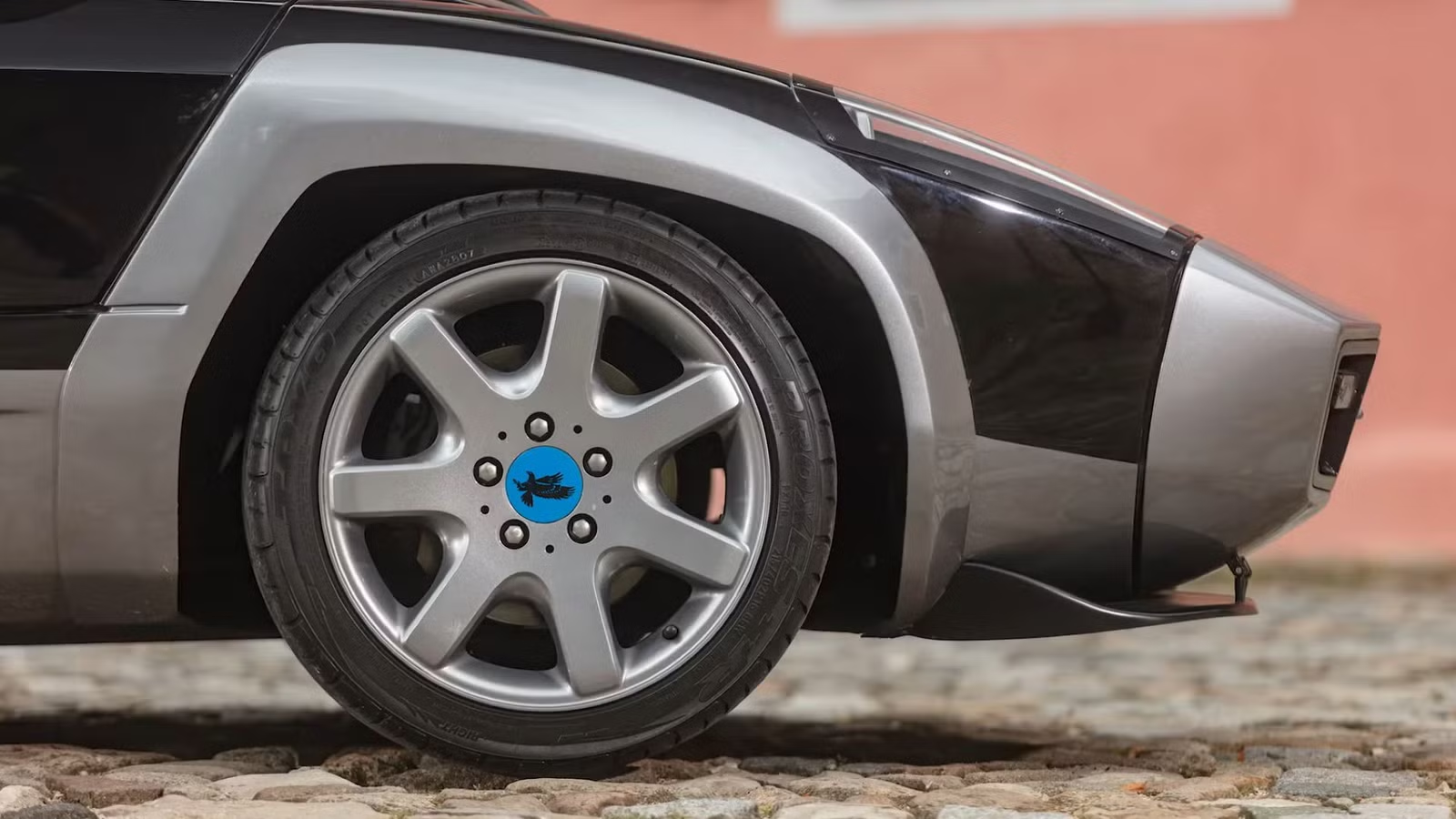
These days, Pagani offers a service where customers can bring their cars back to be completely overhauled and upgraded, but Isdera was doing this in 2011. Isdera only hand built 14 Spyders, says Hagerty, and one 1989 car was taken back to the factory 15 years ago for a program of upgrades. The original M103 six was swapped out for a 3.6-liter, 276-hp ‘M104’ unit used in the AMG C36, E36, and G36. The bodywork was given flared arches, and 16-inch SLK-sourced wheels were fitted. Even the bespoke violet leather interior chosen by the original owner was swapped out at this stage with blue leather and Recaro Sportster seats.
The Most Iconic Supercars Ever Made
These supercars are the ultimate performance machines that set the benchmark for everyone else and changed our world.
The Isdera Spyder Is A Forgotten Rarity
Not many people will know what the Isdera Spyder is these days, while the Ferrari F40 and Porsche 959 are poster cars from the era. To be fair, the Spyder won’t win many races against either. With a 5.6-second sprint to 60 mph and a top speed of 168 mph, it will be behind the roughly 4.0 seconds and 200 mph top end of the other two. But with so few made, it is far rarer and way less documented. That said, the F40 has a good-condition price of $2.7M, and the 959 from $1.5M. When an Isdera Spyder 036i went up for sale via Gallery Aaldering, complete with the later AMG upgrade it only sold for €324,500 ($370,000). So while the Spyder has the rarity and depth of character to make it a true exotic, the prices say otherwise. It did do its bit to pioneer the bespoke hypercar, however, and that is a big achievement for a little car.
Sources: Auto-data.net; Hagerty.com

Related posts



Latest Post


No Comments