
The Failed Kawasaki GP Racer That Secretly Became The First Ninja
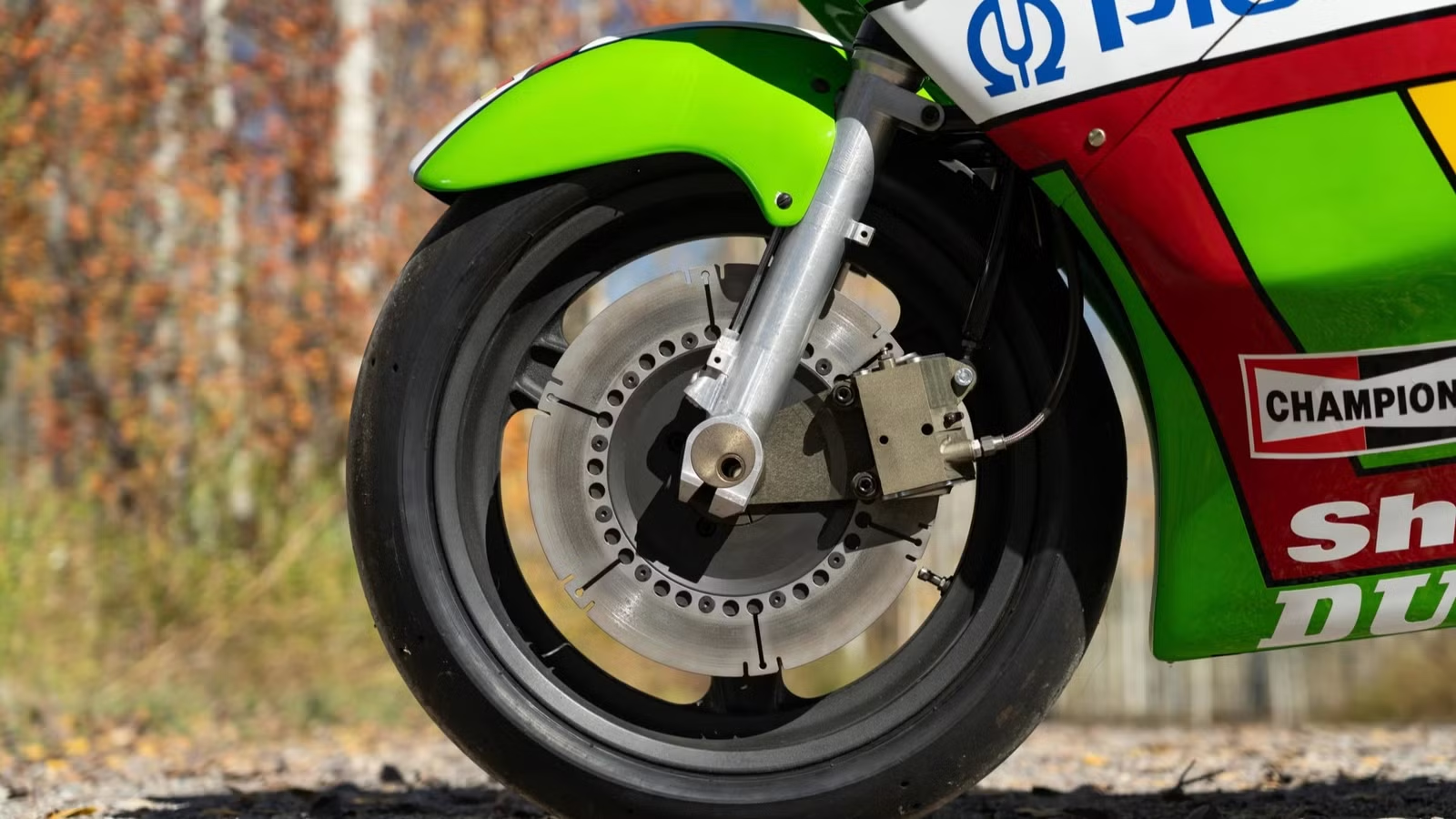
Some racing programs get remembered for winning. Others get remembered for what they quietly taught the engineers who built them. Kawasaki ran a factory Grand Prix effort in the early 1980s that never won a championship, finished mid-pack at best, and got shut down after two disappointing seasons. On paper, it looks like a footnote. Look closer, and the fingerprints of that failed program show up two years later on the machine that redefined what a Kawasaki sportbike could be.
The Grand Prix Arms Race Nobody Talks About Anymore

By 1980, the 500cc Grand Prix class had become the most technically demanding proving ground in motorcycle racing. Two-stroke square-four engines were making well over 100 horsepower from barely 500cc of displacement, and every major Japanese manufacturer wanted a factory presence on the grid, both for the prestige and for the engineering lessons that only racing at that level could teach. Suzuki and Yamaha had spent years refining their approach and had the championships to show for it. A factory effort in this class was less about selling motorcycles directly and more about proving a manufacturer belonged at the absolute front of engineering capability.
One manufacturer decided the only way to catch up was to skip incremental improvement entirely and try something nobody else on the grid was attempting. Rather than refine a conventional tube-frame chassis the way its rivals had for years, this manufacturer bet an entire factory racing program on a completely different structural idea, one borrowed from aerospace thinking rather than motorcycle convention. It was a genuine gamble, the kind of move a manufacturer only makes when playing catch-up leaves conventional thinking looking too slow. The bet did not pay off on the scoreboard. It paid off somewhere else entirely.
A Racing Program Built Around One Radical Idea


The core idea was structural. Instead of building a traditional steel or aluminum tube frame and then hanging a separate fuel tank on top of it, engineers designed a single aluminum shell that served as both the chassis and the fuel tank at once, a true monocoque structure more familiar from aircraft or Formula 1 cars than motorcycles. The approach promised a smaller frontal area, better aerodynamics, and genuine weight savings if it worked. It also meant solving problems nobody in motorcycle racing had fully solved before, from fuel slosh affecting handling to the sheer difficulty of servicing an engine buried inside what amounted to a structural fuel cell.
The engine matched the chassis for ambition. A liquid-cooled square-four two-stroke sat at the heart of the package, a genuinely exotic layout for the era, built to rev hard and make serious power from a small displacement. On paper, the combination looked like it should have been unbeatable. In practice, the bike arrived heavier than the more conventional machines it needed to beat, and a shoestring testing budget meant engineers rarely got the track time needed to sort out a genuinely novel design before showing up to race it against rivals who had spent years refining theirs.
The Kawasaki KR500 Finally Gets Its Due

That machine was the Kawasaki KR500, a factory 500cc Grand Prix racer campaigned from 1980 through 1982 and ridden primarily by Kork Ballington, a four-time world champion in the smaller classes who was brought in specifically to develop it. The liquid-cooled square-four two-stroke made roughly 120 hp at 11,000 rpm, enough to push the bike to a claimed top speed of 180 mph, genuinely serious numbers for any motorcycle in 1981.
Ballington finished 8th in the championship that year and 9th the following season, respectable results for a genuinely experimental machine but nowhere near what Kawasaki needed to justify the program’s cost. Kawasaki pulled the plug after 1982, and today only four original examples are known to survive, one in a UK collection, one at Kawasaki’s own museum in Japan, one in the United States, and Ballington’s own chassis, later sold into a French collection.
The Fuel Tank That Was Also The Chassis

What made the KR500 genuinely radical was not the engine—it was the aluminum monocoque chassis wrapped around it, a structure that eliminated the separate fuel tank entirely by making the chassis itself hold the fuel. Only a handful of racing motorcycles had ever attempted anything similar, and none had done it in the 500cc class at this level of factory commitment. The approach gave the KR500 a slim frontal profile and a low center of gravity that should have been a genuine advantage on faster circuits. It also added complexity Kawasaki’s rivals simply did not have to manage, and combined with a limited testing budget, that complexity meant the bike never fully realized the advantage its unconventional structure promised on paper.
How The KR500 Stacks Up Against The Bikes That Beat It

Judging the KR500 purely on results misses what actually made it significant, but the results still matter for understanding why Kawasaki walked away when it did. The bikes that finished ahead of Ballington throughout 1981 and 1982 were built by manufacturers that had already spent years refining a more conventional approach to the same problem, and comparing the two philosophies side by side explains both why Kawasaki lost on the track and why collectors still care about the bike that lost.
The Rivals That Ruled The 500cc Class Instead

Suzuki’s factory square-four, the machine that carried Marco Lucchinelli to the 1981 title and Franco Uncini to the 1982 title, ran on a conventional aluminum frame its engineers had already spent years refining, and weighed closer to 260 pounds, roughly 33 pounds lighter than the Kawasaki’s 293-pound dry weight, per period weight comparisons. Yamaha’s own square-four works racer competed at a similarly high level throughout the same seasons. Neither rival needed a radical new chassis concept to win consistently, proving that a well-sorted conventional approach beat an underdeveloped one, at least on the stopwatch.
That underdog status is exactly what drives collector interest in surviving KR500s today, though the auction record needs careful reading. A high-end replica built by former Grand Prix engineer Nigel Everett using genuine 1981 KR500 crankcases as a pattern carried an official estimate of £60,000 to £80,000 at auction, according to the auction house’s own listing, a figure some outlets have since converted into dollar terms, roughly $76,000 to $100,000, without always clarifying that the bike in question was a replica rather than an original chassis.
A separate example, stamped frame No. 82-02 and finished in period-correct Kawasaki livery, is headed to Mecum’s Monterey sale in August 2026, with no estimate published at the time of writing. That listing describes the bike plainly as a replica of the machine Ballington rode to 9th in the 1982 championship rather than a genuine factory chassis, even though one earlier feature piece on the same bike’s prior auction appearance speculated that it might incorporate genuine period components. With only four original chassis believed to exist and none of them regularly changing hands, a clean sale price for a verified genuine KR500 simply does not exist yet, which only adds to the mystique.
The Failed Racer That Built Kawasaki’s Future

Kawasaki walked away from Grand Prix racing after the 1982 season, and the KR500 program officially ended having never delivered the championship it was built to win. What happened next tells a different story about whether the program actually failed. Two years later, Kawasaki released the GPZ900R, the bike the world would come to know as the Ninja, and it arrived featuring the company’s first liquid-cooled production engine, developed in secret over roughly six years—a timeline that overlaps directly with the KR500’s own development and racing seasons. The engineers who had just spent two years wrestling with liquid cooling and advanced chassis thinking at the absolute limit of what racing allowed did not simply disappear when the racing program ended.
That connection has never been the official story, and Kawasaki has never marketed the Ninja as a direct descendant of a racer most people have forgotten. But the timeline speaks for itself, and so does the engineering. A factory team spent two years pushing liquid cooling and unconventional chassis thinking to the absolute limit under racing pressure, then watched that same manufacturer redefine its entire performance identity within two years of walking away. The KR500 never won a championship, and it never needed to. It won the argument that mattered more, and Kawasaki has been building on it ever since.
Sources: Kawasaki, Bonham’s, Bike EXIF

Related posts

Latest Post


No Comments