
Hyundai Is Building A Ladder-Frame To Rival Toyota By 2030
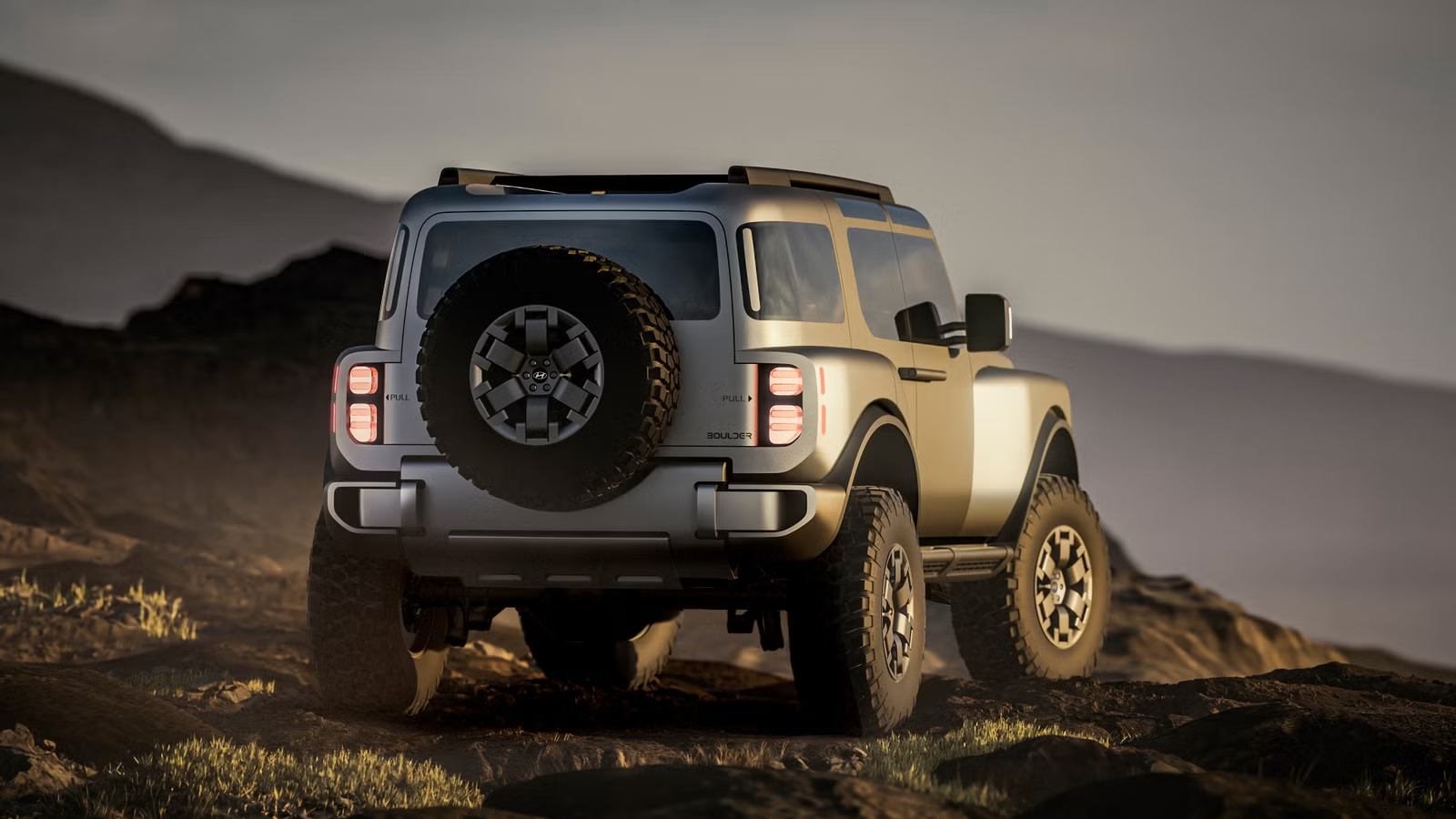
Hyundai isn’t just building a pickup truck. The Korean automaker is laying the foundation for an entire family of body-on-frame vehicles — pickups, SUVs, and potentially models spanning Kia and Genesis — designed to capture half of the brand’s targeted 35% global sales growth through 2030. CEO Jose Munoz made that ambition explicit at the company’s Investor Day event this week, and the scale of what he described goes well beyond anything Hyundai has attempted in its 60-year history.

For truck and SUV loyalists who’ve spent decades watching Toyota, Ford, and Jeep carve up the body-on-frame segment, this is worth paying attention to. Hyundai is compressing what took Toyota generations to build — rugged-vehicle credibility, platform depth, and global truck-market presence — into a four-year sprint ending in 2030. Whether it can actually pull that off is the question worth asking.
A Platform Built For Volume, Not Just One Model
The centerpiece of the strategy is a new ladder-frame architecture that Munoz described in platform-family terms, not as a one-off entry. “We want to develop a family of products capitalizing on platforms,” he confirmed. “You would typically see several models derived from the same platform and will try to maximize the volume.”

The first model to ride that architecture will be a mid-size pickup truck, expected to arrive around 2029. Beyond that, Hyundai has previewed its design direction with two concepts: the Boulder and the Crater. The Boulder drew the most attention, targeting the Ford Bronco directly with Hyundai’s Art of Steel design philosophy — angular, purposeful, and clearly aimed at buyers who care about trail credibility as much as towing capacity. How many additional production models are confirmed beyond the pickup and a Boulder-style SUV remains officially unspecified, but Munoz’s platform-family language strongly implies more than two.
Georgia Could Become Hyundai’s Truck Export Hub

2026 Hyundai Ioniq 9 Calligraphy Design
One of the more strategically significant details from Investor Day is where these vehicles will be built — and who they’ll be built for. Hyundai is eyeing US production, with the Metaplant in Georgia emerging as the likely candidate. The facility already assembles the Ioniq 5, Ioniq 9, and Kia Sportage Hybrid, and is slated to add several Genesis models.
Critically, Munoz made clear that domestic production doesn’t mean domestic-only sales. “Definitely the United States could be not only the place to produce for domestic but also for export, as we see definitely other regions benefiting from these new segments,” he said. “We’re working on the economics, the sourcing, on which markets could be part of that expansion.” Specific export markets haven’t been named publicly, but the framing signals ambitions across multiple regions — not just filling a gap in the US truck market.
Kia and Genesis Could Get Ladder-Frame Variants, Too

The platform-sharing potential extends beyond the Hyundai badge. Munoz indicated that Kia and Genesis could receive their own ladder-frame derivatives — a logical move given that the Metaplant already produces vehicles for all three brands. No concrete timelines have been announced for either sub-brand, and this remains speculative territory for now. But the precedent exists: Kia and Genesis have shared unibody platforms with Hyundai for years, and extending that approach to a truck architecture would be consistent with how the group operates.
As for powertrains, the mid-size pickup is expected to launch as either a traditional hybrid or a range-extender configuration — the same extended-range EV approach Hyundai is applying to the Santa Fe EREV, which targets a combined range exceeding 600 miles when it arrives in the first half of 2027. A pure battery-electric truck variant hasn’t been confirmed for the ladder-frame lineup at this stage.
Why This Is a Direct Challenge to Toyota’s 70-Year Head Start

Toyota has built its truck and SUV reputation over seven decades — the Land Cruiser, Tacoma, 4Runner, and Tundra represent a lineage that competitors have chipped away at but never seriously threatened at the brand level. Hyundai is betting it can shortcut that credibility curve by entering multiple body-on-frame segments simultaneously rather than proving itself with a single model first.
It’s a high-stakes approach. Body-on-frame loyalty is earned slowly — buyers who spec a Tacoma TRD Pro or a 4Runner Trail Edition aren’t switching on specs alone. Hyundai will need the Boulder concept to become a production vehicle that actually performs off-road, and the pickup will need to hold its own against the Tacoma and Ranger before the broader family earns trust. The 2029 target for the first model gives Hyundai roughly three years of runway after that to build the rest of the lineup before 2030. That’s a tight window, but Munoz’s Investor Day presentation suggests the company is treating it as a structural growth pillar, not a side bet.
For enthusiasts who’ve watched Hyundai evolve from budget econoboxes to genuine performance contenders with the N lineup and Genesis, the body-on-frame push feels like the next logical step. The Boulder concept alone was enough to turn heads. Now the question is whether the production hardware — and the off-road credibility that comes with proving it in the real world — can match the ambition of the platform underneath it.
Sources: Carscoops

Related posts

Latest Post


No Comments