
BMW X5 M E70: The First 12-Second SUV for Under $18K
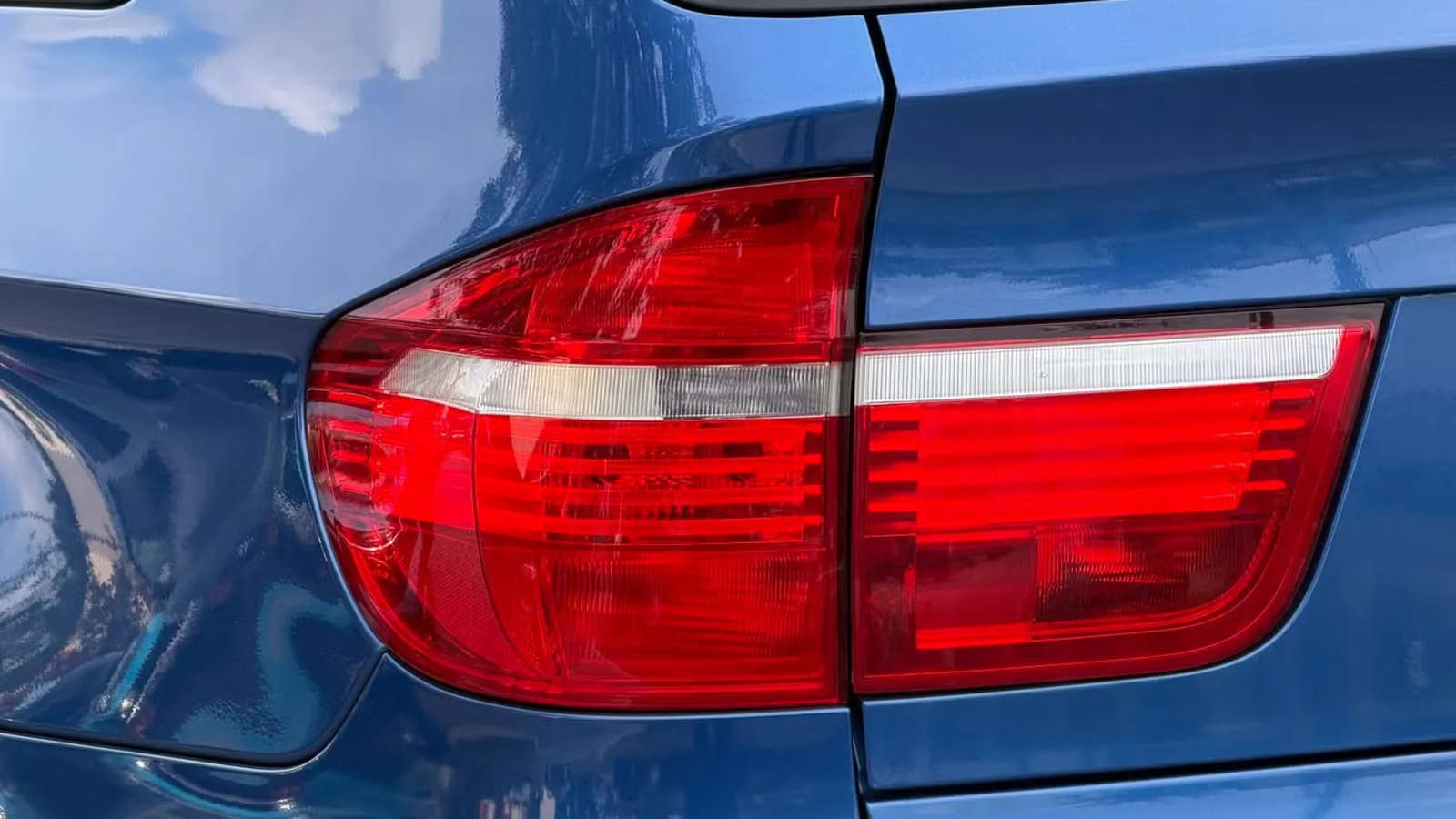
A quarter-mile in the 12-second bracket once belonged to sports cars, not to 5,300-lb family haulers with an optional third row. That changed between 2009 and 2010, when German luxury brands started building SUVs aimed squarely at the timing gear rather than the school run.

One of those machines now trades for less money than a mid-trim commuter sedan, with more than 550 hp still sitting under the hood and a factory sticker that once cleared $89,000. So why does something this quick cost so little today, and does that make it a bargain or a very expensive mistake?
Porsche Spent Six Years And Six Figures Breaking Into The 12-Second Bracket
The Jeep Grand Cherokee SRT8 was the American opening shot in 2006, dropping a 420-hp 6.1-liter Hemi V8 into a mid-size SUV for around $40,000. Car and Driver clocked it at 13.2 seconds through the quarter-mile with a 4.5-second run to 60 mph.

Mid-13s stayed the practical ceiling for the segment for several years after that, even at four times the money. The 2006 Cayenne Turbo S needed 13.50 seconds at 107 mph despite 520 hp, and the 2008 Cayenne Turbo marginally improved to 13.30 seconds at 107 mph. Both carried more than 5,500 lbs, which is where a good deal of that output disappeared.

Porsche broke into the 12s first with the Cayenne Turbo S in 2009 when it measured 12.60 seconds at 112 mph and 4.10 seconds to 60 mph from its 550-hp 4.8-liter twin-turbo V8. The catch was a 5,556-lbs curb weight and a six-figure window sticker that put it well outside the reach of the SRT8 crowd.
Twelve seconds mattered because it placed a school-run vehicle on level terms with contemporary sports cars rather than merely quick sedans. For scale, the average across 70 verified Cayenne tests spanning two decades sits at 13.09 seconds, which shows how far outside the norm that 2009 run really was.
Then, within months, a manufacturer that had never built an all-wheel-drive performance SUV beat the Porsche on its first attempt.
The 2010 BMW X5 M Went 12.50 At 112 MPH, Embarrassing The Porsche

The 2010 BMW X5 M ran the quarter-mile in 12.50 seconds at 112 mph and reached 60 mph in 4.00 seconds in Car and Driver testing. Those figures came from 555 hp and 500 lb-ft, routed through a six-speed automatic and all-wheel drive, in a vehicle hauling 5,300 lbs. It was a tenth quicker than the Cayenne Turbo S while weighing roughly 250 lbs less.
Car and Driver put it directly against its key rivals like the Porsche, the Jeep Grand Cherokee SRT8, and the supercharged Range Rover Sport in a four-way comparison test. The X5 M won the acceleration fight outright, the more meaningful result, as it did so against a Porsche that had held the segment record for a full year.

BMW quoted 0 to 62 mph in 4.7 seconds at launch, with peak torque arriving from just 1,500 rpm. Every magazine that strapped timing gear to one beat that acceleration claim comfortably, and Car and Driver’s 4.00-second run to 60 mph landed well clear of it. Factory numbers rarely undersell by that kind of margin, but today this seems more common among German automakers.
The X5 M and its X6 M twin were also the first all-wheel-drive vehicles ever signed off by the M Division. Until 2009, M had built rear-drive sedans, coupes, and roadsters, and nothing else. Handing the division an SUV was treated as heresy at the time, and the reception from purists was frosty enough that BMW spent years defending the decision.

None of that came cheap, as the 2010 X5 M’s original MSRP was $89,625, which bought a vehicle with 12 mpg city fuel economy and consumable costs to match. That number is worth holding onto for what follows.
Only Three Cars Ever Got This Version Of BMW’s V8

Two twin-scroll turbochargers sit in the valley between the cylinder banks in the S63, an arrangement BMW calls a “hot-V,” making it one of the most important innovations in forced induction engines. Placing the turbos and exhaust manifolds inside the V, with the intakes moved outboard, reverses the traditional V8 layout. It narrows the engine and shortens the path exhaust gas travels before it reaches the turbine, which cuts lag.
A pulse-tuned, cross-engine exhaust manifold feeds the turbochargers a continuous flow of exhaust pulses with every 180 degrees of crankshaft rotation, according to BMWBlog. Rather than each bank feeding its own turbo, the runners cross over so the pulses arrive evenly spaced. Both turbos then spin consistently instead of in surges, which is the harder half of the lag problem to solve.

Boost climbed sharply over the N63 the S63 was derived from, with compression reduced to suit. The result was an engine making more torque at 1,500 rpm than the outgoing S85 V10 produced at its peak, and holding it flat to 5,750 rpm.
That torque curve is why the X5 M felt unlike anything else in the class. The S85 needed 8,250 rpm and a lot of commitment to give up its best work, while the S63 delivered everything from just above idle, in a vehicle with a tailgate.
Only the E70 X5 M, the E71 X6 M and the Wiesmann GT MF5 ever used this specific version, coded S63B44O0. Later technical updates added Valvetronic and raised compression, so the engine in these 2010 to 2013 cars is a distinct, earlier specification rather than the one found in an F10 M5.
Clean Examples Now Trade Between $10,000 And $18,000

Classic.com’s market benchmark for the E70 X5 M sits at $15,006 as of August 2026, with an average recorded sale price of $16,921. That benchmark is worth comparing against the 2026 Toyota Camry, which opens at $29,000 for the LE grade before a mandatory $1,195 destination charge. A 555-hp performance SUV now costs roughly half as much as a base hybrid family sedan.

Recent auction results support the benchmark rather than contradict it. A 91,000-mile 2012 example sold for $14,750 on Bring a Trailer in January 2026. A 78,000-mile 2012 car brought $18,000 on the same platform that April.
A 113,000-mile 2012 sold for $11,700 on Cars & Bids in May 2026, and an 88,000-mile 2011 went for $10,600 two days earlier. Mileage moves the needle here, but not as violently as it does on most 15-year-old German performance cars.

The lowest recorded sale is $5,000 for a 157,000-mile 2011 in November 2025, and the highest is $34,000 for a 2013 in July 2023. The F85 X5 M that replaced this car benchmarks at $36,651, and a G05-generation X5 M50i sits at $50,547. Neither is more than three tenths quicker over a quarter-mile. Buyers are paying more than double for the follow-up act, and roughly three times for the one after that.
Series Of Issues With The S63 V8 Explain The Depreciation

Rod bearing wear is the failure that keeps values suppressed, and BMWBlog identifies it as a known issue on early S63 engines, particularly under repeated high-RPM use. Turbocharger failure is the second concern, driven by oil starvation or contamination in engines with neglected oil change histories. Valve stem seal wear, cooling system weaknesses and ignition coil failures round out the list.
Reaching the rod bearings means dropping the subframe, and getting to the valve stem seals means removing the turbochargers first. These are two entirely separate jobs with no shared labor, so a shop cannot bundle them into one bill. Parts are rarely the problem on an S63 quote, but access to them is.
The related N63 became notorious for excessive oil consumption caused by piston ring failure and leaking turbo seals. BMWBlog notes those specific problems were addressed in later designs and are less common on the S63. Buyers routinely price the two engines as though they are the same thing, which is part of why this car sits where it does.
Running costs do the rest of the damage, with EPA ratings of 12 mpg city and 17 mpg highway, and 14 mpg observed in real-world testing. What the market has effectively done is price every X5 M as though it needs a worst-case engine bill tomorrow. A documented service file is worth more here than a low odometer reading.
Sources: BMW, BMW Blog, Classic, Car and Driver, Cars and Bids

Related posts



Latest Post


No Comments