
The Forgotten American-Italian GT That Beat Shelby And Ford To The Formula
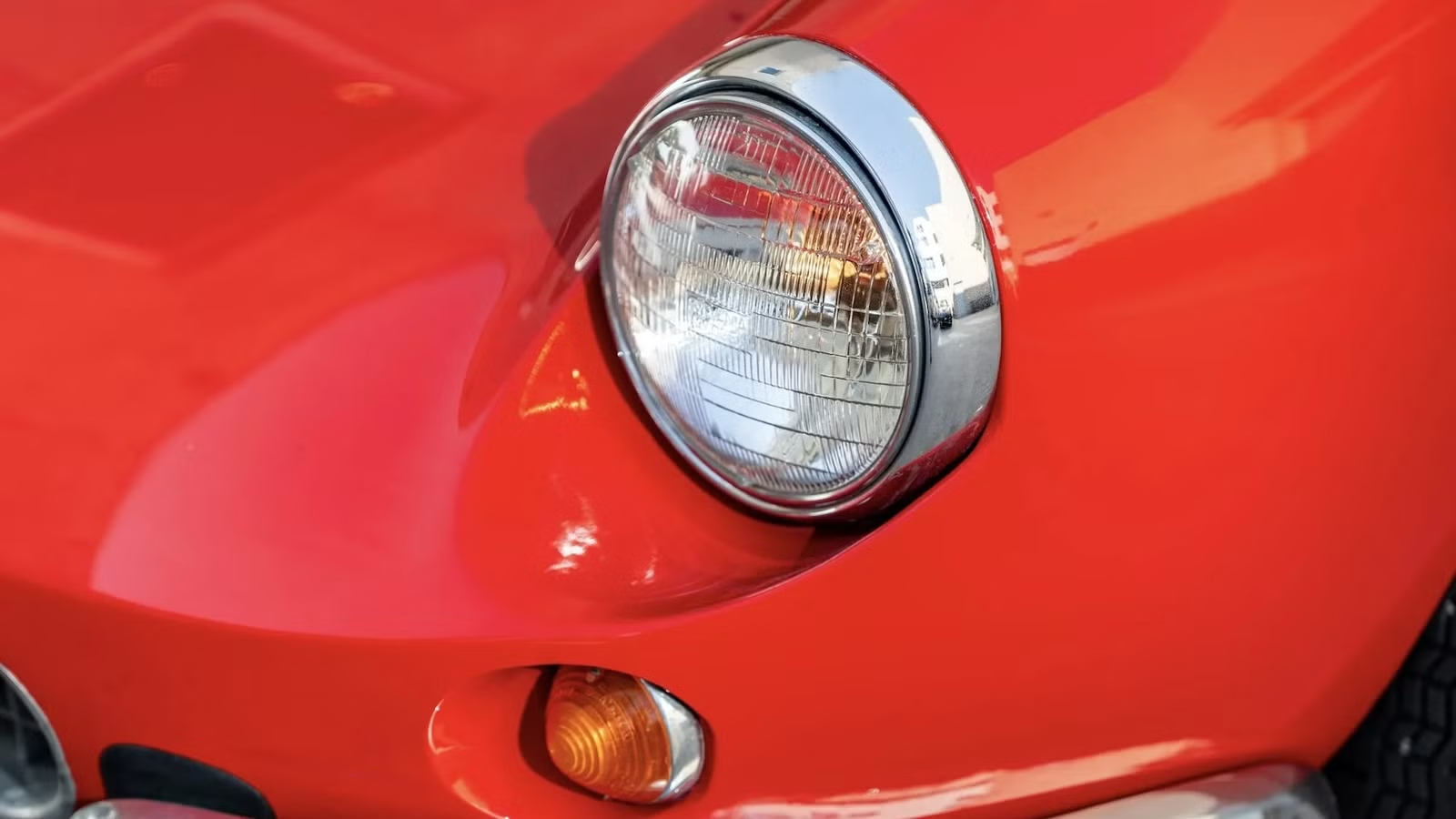
It’s a little unfair that Shelby gets all the credit for perfecting the grand touring movement in America. In reality, another car beat the Shelby Cobra and Ford to the GT formula that dominated the track. An Italian-American GT model launched with expert engineering a few years earlier. However, it lives in the shadow of other cars and unfairly became a villain. Now it’s tragically undervalued compared to the later GT models it is responsible for inspiring, despite having true racing heritage with immense V8 power.
The Shelby Cobra Arrived Later…

I won’t dunk on the 1964 Shelby Cobra as it is a true icon in automotive racing history. It just has an early model to thank for perfecting its race-winning formula. The Shelby Cobra was built with an extremely specific goal in mind, and it was to beat the Ferrari in international GT racing. It completed the goal by beating the Ferrari 250 GTO in its class during the 1964 24 Hours of Le Mans to end the Ferrari’s streak with European style and American muscle.
It has a Ford 289 cubic-inch (4.7-liter) small-block V8 engine with up to 385 horsepower and 340 lb-ft of torque. This engine helps the 2,000-pound car accelerate from 0 to 60 mph in about 4.4 seconds with a 13.8-second quarter mile time and top speed of roughly 135 mph. But the Daytona Coupe model was clocked at 196 mph on the track.
The 1964 Cobra has a lightweight, aerodynamic body and ladder-tube chassis that allows it to achieve blistering acceleration times with an enhanced power-to-weight ratio. The car also features rack-and-pinion steering and a transverse leaf-spring independent suspension with tubular shock absorbers on each corner.

The Apollo GT Proved That The Formula Could Work

A few years earlier, the 1962 Apollo GT entered the scene and proved that its lightweight formula would work to take grand touring racing by storm. It’s known as the American Ferrari, and it remains in the shadow of the Shelby Cobra despite arriving years before Ford started the GT40 program. It started the trend of stuffing V8 power into lightweight, European bodies.
It has an all-aluminum 215 cubic-inch (3.5-liter) Buick V8 engine under the hood that produces 200 hp and 240 lb-ft of torque. This engine helps propel the 2,300-pound car from 0 to 60 mph in around 7.1 seconds and cover a quarter mile in roughly 15.5 seconds with a top speed of about 150 mph.

The car was engineered by Milt Brown with the help of designer Ron Plescia and financier Ned Davis. It was handcrafted with an aluminum and steel body coach built by Intermeccanica in Turin, Italy. Then it was assembled in Oakland, California. The 315-pound engine is paired with a Borg-Warner T-10 four-speed transmission. The car rides on a steel ladder frame and custom tubular chassis. It excelled with an exceptional power-to-weight ratio.
The solid rear axle has a four-link trailing arm built with coil springs, and the front subframe was sourced from the Buick Special and modified for a lower center of gravity to enhance its aerodynamic shape. It weighs 500 lbs less than the Jaguar E-Type and has better handling. The Apollo GT started at $6,000, making it more affordable than the $18,500 Ferrari 250 GTO. Also, the Jaguar E-Type originally started at $5,890.
Then Apollo GT Ran Into Trouble

Despite kickstarting the European-body V8 movement and inspiring Shelby, Iso, and Bizzarini to borrow or outright copy its race-winning GT formula, the Apollo GT faced a few significant problems. For example, it was priced too low despite being expensive to build. International Motor Cars sold the Apollo GT below the cost of production as international supply chain and shipping costs increased.
There was no dealer network and this, combined with a lack of initial capital, drove the project to bankruptcy. The founders never ran a true cost analysis, and scaling production from two to eight cars led to rapid losses. Only 88 models were produced during its entire production run. Vanguard Industries purchased and assembled leftover body shells and marketed them as the Vetta Ventura until 1966.
It didn’t help that General Motors made the 1963 Apollo Buick and dropped the hammer on International Motor Cars by telling it to drop the Apollo name, or it would lose the Buick franchise that provided its V8 engine. All ties were cut, forcing the struggling automaker to lose its primary sales outlet.
On top of that, the Apollo GT became a famous villain and gained a cult following. It was portrayed as the evil Thorndyke Special in Disney’s 1968 film, The Love Bug. The rare car was the main rival of the beloved Herbie. There’s a celebrated scene where antagonist Peter Thorndyke tries to sell the car before Herbie enters the showroom.
Now The Apollo GT Is Tragically Undervalued

Unfortunately, the Apollo GT didn’t survive long enough to become a historical icon with a massive cultural legacy like the Shelby Cobra or Ferrari brand. It stands out more due to being a movie villain than for its racing pedigree that inspired other GT cars that people are willing to throw insane amounts of money at.
It’s still a rare and highly collectible car. Models in good driving condition can be found for about $130,000 to over $150,000. Models in pristine condition can fetch over $175,000. But the first production coupe hovers around $242,000 as the ultra-rare first production spider commands pricing around $506,000.
Meanwhile, the 1964 Shelby Cobra 289 crosses the auction block for between $850,000 and $1.2 million dollars. Even replica models tend to push $150,000, outselling original Apollo GT models by the thousands. The massive price difference occurs even though the Shelby Cobra is a bit more widely available, with between 800 and 900 surviving examples today.

The 1962 Jaguar E-Type is a bit closer in value, as pricing ranges from $50,000 to over $275,000 depending on quality, condition, and mileage. But the 1962 Ferrari 250 GTO leaves all of these race cars behind with a value that routinely ranges from $38.5 million to over $70 million, as only 36 models were ever made.
Source: Zero to 60 Times, Automobile Catalog, Hagerty

Related posts


Latest Post


No Comments