
The Cheapest Way To Own A Maserati-Badged Car Hits 60 In 6.9 Seconds
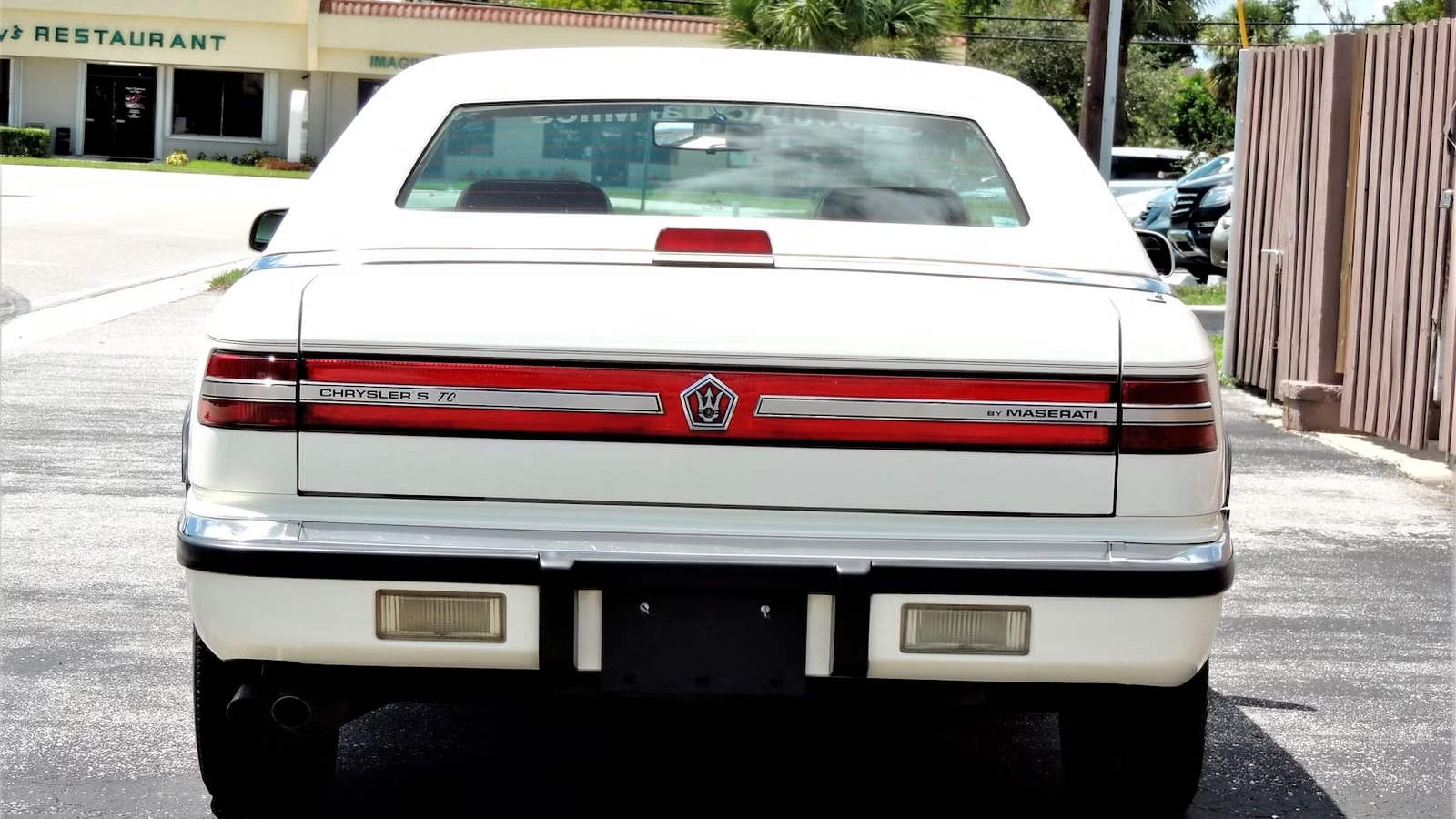
A car can spend decades as a punchline and still hide one very good secret. In this case, the secret involves 200 horsepower, a hand-finished 16-valve cylinder head, a German five-speed manual, and a 0–60 mph run of 6.9 seconds. That was serious speed for a front-wheel-drive luxury convertible in 1989. Better yet, survivors can still trade for surprisingly little money.
A $33,000 Exotic Badge Was A Hard Sell In A Chrysler Showroom

Chrysler entered the late 1980s with something to prove. The company had survived its near-death experience earlier in the decade, and the practical cars that helped rescue it did not exactly make posters fall off bedroom walls. Lee Iacocca wanted a halo machine that could add some European shine to the company, and the resulting two-seat convertible promised Italian craftsmanship, rich leather, special hardware, and an exotic connection. Then came the sticker shock: when it reached American showrooms for the 1989 model year, its base price sat at about $33,000.
That number became harder to defend because another convertible sat in the same corporate family for far less money. A 1989 Highline version of Chrysler’s regular four-seat drop-top carried an original MSRP of roughly $14,400 to $14,500 before extra options. Even the much sportier turbo version came in well below the exotic-badged car. Depending on the exact trim being compared, the fancy two-seater could cost close to twice as much as the Chrysler convertible that ordinary buyers already recognized. That created the sort of showroom math no amount of Italian leather could make disappear.
Worse, the expensive car looked far too much like its cheaper showroom neighbor. The resemblance mattered more than the parts the two did not share, because prestige depends heavily on what buyers think they see. Chrysler wanted the costly convertible to lend glamour to the cheaper car, but development delays reversed the order. The affordable convertible arrived first, so the public saw the later halo car as an expensive variation on something familiar.

The Version Everyone Remembers Wasn’t The One Enthusiasts Care About

Its reputation also suffered because most examples were not especially fast. Early cars commonly used Chrysler’s turbocharged and intercooled 2.2-liter four-cylinder, rated at 160 hp, and Chrysler paired that engine with a three-speed automatic. Later examples could use Mitsubishi‘s 3.0-liter V6, which made just 141 hp and worked with a four-speed automatic. Those engines suited relaxed top-down driving reasonably well, but neither specification screamed exotic performance. A pricey Italian-linked roadster with 141 hp gave road testers plenty of ammunition.
Those more common versions explain much of the car’s lasting image. They had front-wheel drive, plenty of leather, automatic transmissions, and engines connected closely to ordinary Chrysler products. The formula made more sense as a personal luxury cruiser than as a serious driver’s car. That distinction is important because people often talk about the entire production run as though every example shared the same mechanical personality. They did not.
Around 500 cars went in a very different direction. Their engine still traced its roots to Chrysler’s turbo four, but engineers built a far more specialized version around it. The cylinder head came from Britain before receiving work in Italy. Other components came from Germany and Japan, while Chrysler supplied the American foundation. Power jumped to 200 hp, and the only transmission offered with that engine was a German five-speed manual. Suddenly, the soft luxury cruiser had a specification sheet that looked like several countries had met in an airport lounge and decided to build a sports car.
The Chrysler TC By Maserati Hid A 200-HP Surprise

That strange machine was the Chrysler TC by Maserati, born from the relationship between Chrysler chairman Lee Iacocca and Maserati owner Alejandro de Tomaso. The collaboration has become famous for the wrong reasons. The TC used front-wheel-drive Chrysler architecture, and its styling drew endless comparisons with the much cheaper Chrysler LeBaron convertible. Putting Maserati’s name on the project raised expectations that the basic layout struggled to meet. Even Bob Lutz later called the venture a costly misadventure, saying Chrysler ultimately lost close to $600 million on it.
The rare manual version deserves a separate judgment. Its 2.2-liter turbocharged four used a dual-overhead-cam, 16-valve cylinder head and produced 200 hp at 5,500 rpm, along with a stout 220 lb-ft of torque at 3,400 rpm. This was not Chrysler’s normal 2.2 with a fancy valve cover and a trident sticker applied as an afterthought. Sources describe a specially prepared block, upgraded crankshaft and rods, forged Mahle pistons, an IHI turbocharger, and specialized valvetrain hardware. Crane designed the camshafts, while Maserati manufactured them in Modena. The specification had real engineering behind the marketing.

In fact, the production process was quite interesting. Cosworth cast the aluminum head in England, and Maserati then finished it in Italy. The whole package drew components from several countries: Chrysler provided the basic turbo-four DNA, Cosworth contributed British expertise, Maserati handled Italian finishing and assembly work, Mahle supplied German forged pistons, and Japan’s IHI supplied the turbocharger. The result may have worn an identity crisis on its sleeve, but underneath it sat one of the most international four-cylinder engines of its era.
Chrysler paired that 200-hp engine exclusively with a Getrag five-speed manual, and the combination transformed the numbers. Period figures show a 0–60 mph time of 6.9 seconds, a quarter-mile run of 15.5 seconds at 92 mph, and a 135-mph top speed. For context, breaking seven seconds to 60 was genuinely quick in 1989, especially for a 3,000-plus-pound, front-wheel-drive luxury convertible descended from Chrysler’s transverse-engine family. Contemporary accounts have also described the 16-valve car as Chrysler’s quickest offering of the period. Whatever jokes followed the badge, 6.9 seconds was not one of them.
Only Around 500 Cars Got The Engine That Changes The Story

Chrysler and Maserati built roughly 7,300 TCs in total across the 1989 through 1991 model years. Production figures commonly break down to 3,764 for 1989, 1,900 for 1990, and 1,636 for 1991, although production itself ended during 1990 and the remaining cars carried 1991 model-year designations. Against that total, only about 500 received the 200-hp 16-valve engine and five-speed manual.
Put another way, fewer than one in fourteen TCs received the specification that changes the whole conversation. That rarity becomes even stranger when the hardware gets considered. In addition to a Cosworth-cast head, Maserati finishing, a Getrag transaxle, Mahle pistons, and an IHI turbo, the manual cars also combined Italian Fondmetal wheels, Teves anti-lock brakes, and specially developed Fichtel and Sachs suspension components. None of those names turn the TC into a Bora or a Ghibli, but they do make the car far more interesting than the usual “LeBaron with badges” insult suggests. Few factory cars have assembled such a multinational parts bin with such wonderfully confused purpose.

Yet prices remain modest because the badge cannot escape the story attached to it. The TC name still carries the baggage of a failed luxury project, while its resemblance to the LeBaron keeps prestige low. Traditional Maserati collectors usually chase cars developed as proper Maseratis, not a front-drive Chrysler collaboration. Just as important, many casual buyers do not know that the five-speed 16-valve car differs so much from the automatic versions. Recent results show the effect: a 39,000-mile 1989 five-speed sold on Bring a Trailer for $11,750 in July 2026, while another 200-hp example brought $12,025 in September 2025. Earlier manual cars have traded below $10,000.
That creates the paradox behind the TC’s appeal. A buyer can own a genuinely rare, Maserati-badged car with a hand-finished Italian engine, a Cosworth connection, a Getrag manual, and real period performance without entering normal exotic-car price territory. The broader TC market remains cheap enough that Classic.com currently places its market benchmark at roughly $6,600, although condition and the rare manual drivetrain can move individual cars well above that figure.
Calling the TC a cheap Maserati requires an asterisk large enough to see from Modena: it is not a conventional Maserati sports car. Its odd Chrysler/Maserati identity is precisely the point.
The TC By Maserati Was A Flop, But The 16-Valve Car Wasn’t A Fraud
None of this erases the reasons the TC failed: it cost too much, arrived later than planned, and looked too similar to the cheaper LeBaron that beat it to market. The Maserati name also invited buyers to judge it against genuine European luxury and performance cars instead of against Chrysler’s normal range. At $33,000 in 1989, those expectations were fair. Chrysler wanted Italian prestige without abandoning its familiar front-drive architecture, and the finished product never fully resolved that conflict.
Commercial failure and mechanical merit can still exist in the same garage. The 16-valve TC brought together Chrysler’s turbo experience, a Cosworth-cast head, Maserati’s finishing and assembly work, and a Getrag five-speed in one factory-built package. Its engine produced 200 hp, good for 0–60 mph runs in less than 7 seconds. Judging by Bob Lutz’s later cost estimate, Chrysler certainly succeeded at the spending-money part.

Time has also changed the very qualities that once hurt the TC. Its mixed parentage seemed confusing when buyers expected a clear luxury identity. Today, that same confusion makes the car fascinating – the TC does not need to become a misunderstood Italian exotic to earn a place in enthusiast history. A better case already sits under its hood – roughly 500 examples were genuine factory sleepers hiding inside one of the auto industry’s most mocked badge-engineering projects.
Source: Chrysler, Maserati, Cosworth

Related posts




Latest Post


No Comments