
The Cheap Mid-Engined Toyota Quietly Outclassed The Supra And RX-7 As An Investment
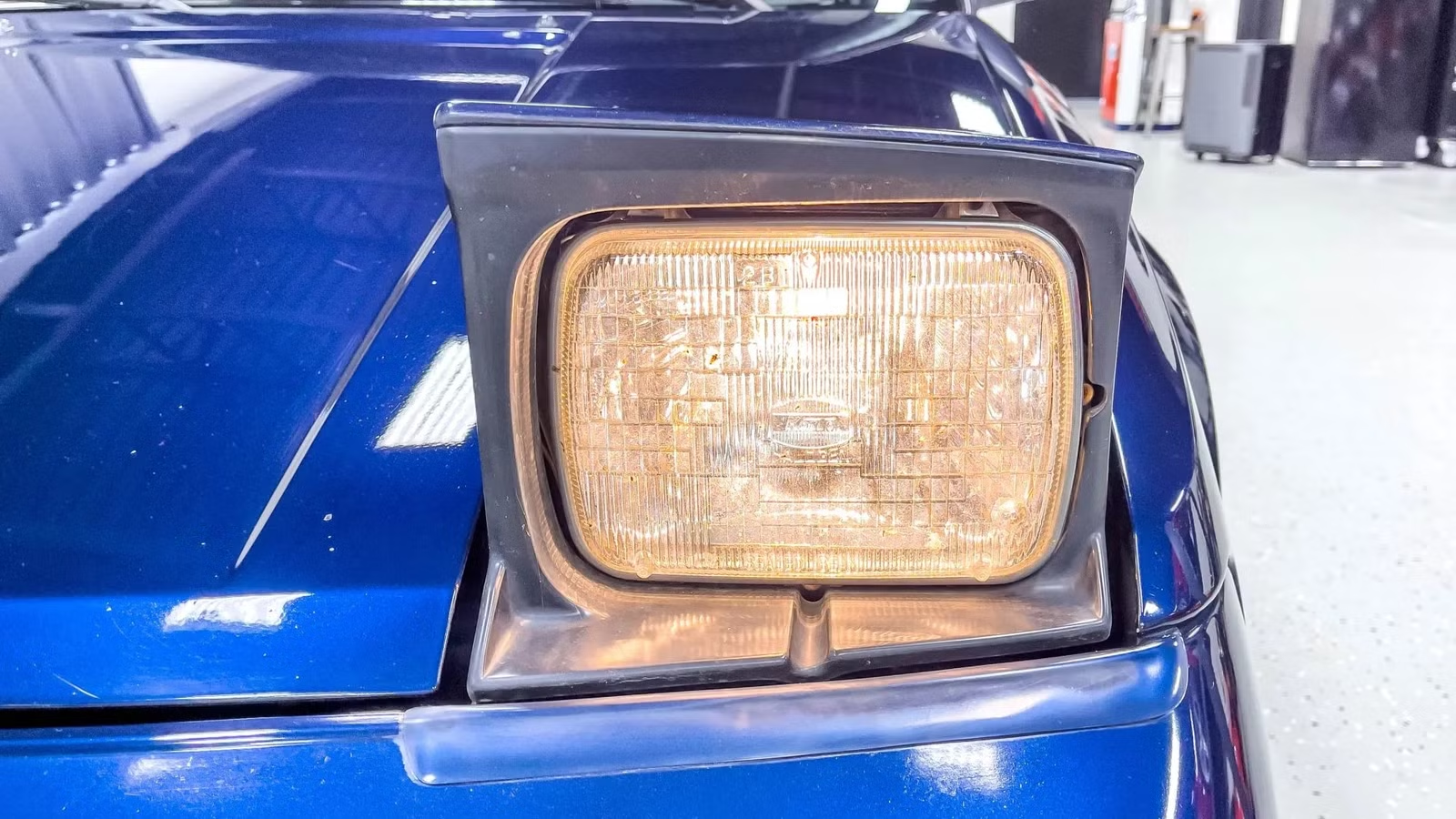
There was a time when the biggest concern about buying an old Japanese sports car was deciding whether you could live with inheriting the previous owner’s modification choices. Now you also have to factor in whether you might be purchasing a future collector’s item or paying a present-day premium for something that already became one when you weren’t looking. The Toyota Supra and Mazda RX-7 have made the leap from affordable tuner platforms into the kinds of cars where provenance, mileage, and whether or not actually driving them will upset their resale value become very real considerations. That’s a lot of responsibility for something whose enthusiast appeal used to be mainly rooted in nostalgia, an analog driving experience, and maybe pop-up headlights.
The Japanese Sports Car Boom Left One Toyota Behind

The fourth-generation Supra and the third-generation RX-7 are headlining cars in the collector market. Enthusiasts know them inside and out, and even casual car fans can understand that something special just buzzed by. They’re recognizable, desirable, and capable of attracting the kind of auction attention that makes them easy to watch slip away if you didn’t show up ready to drop big money.
Because these cars have appreciated, that means that plenty of owners have been handsomely rewarded for the splurge. Meanwhile, though, there’s another Toyota that’s much less top-of-mind in the Japanese sports car conversation, which had a lower point of entry and plenty of room to appreciate.
Maybe its buyers were looking for a budget-friendly runner-up to the Supra or maybe they were after the unique mid-engine driving experience that’s hard to come by in this segment. Whatever the path that got you there, though, if you grabbed one there’s a good chance that it worked out okay financially.

The MR2 T-Bar Is Getting Its Moment

We’re talking about the first-generation MR2 T-bar, a very specific and underrecognized variant of an already very specific and underrecognized car. The first-generation MR2 launched stateside for the 1985 model year, with the T-bar joining the lineup later. Its styling almost perfectly bridges the gap between the angular ’80s and the rounder designs that would come in the ’90s. Buyers got pop-up headlights, striking bodywork, and a 1.6-liter engine sitting behind the seats (some Japanese-market versions had a 1.5-liter). It wasn’t really something you bought to impress anybody, and it was wildly unique and pretty undeniably fun.
That was pretty much the story for a long time. Then, in March 2024, Hagerty reported that average UK guide values for the T-bar had risen by 27.5 percent over the previous three years, the biggest increase among the affordable open-air classics in its comparison. Its guide range was still just £4,500 to £12,000. The tiny car with the quirky handling and the roof that comes off was finally having its day.
Two Glass Panels Made All the Difference

The first-generation MR2 had charm to spare and a slow-car-fast driving experience with unique handling and balance that made it a fan-favorite for a certain kind of car enthusiast. And, to be sure, you can enjoy most of that experience just fine regardless of what roof configuration is hovering over your head (probably quite closely). But the MR2 that posted that increase in Hagerty’s comparison was specifically the T-bar. If that sounds odd to you, feel free to substitute T-top in your head. Toyota called it a T-bar, but really it’s the same thing you’d find on a Trans Am or a 300ZX.
Those early MR2s were available with a full fixed roof, a removable-panel sunroof, or the T-bar, which included two removable glass panels separated by a fixed center bar. There were even removable sunshades, so owners could shield themselves against the sun or let it shine, even with the glass in place. The mid-engine configuration meant storage was divided between a front trunk that also had to accommodate the spare tire and a small rear compartment on the far side of the motor. Still, storage bags and space behind the seats meant owners could bring the glass panels along, without worrying about the weather turning while most of the roof sat back home in the garage.
Lotus Had A Hand In Its Handling

Keeping the roof behind you as you drive around is cool, but having the engine back there is cooler. Except it turns out that when you take a pretty light car and start trying to put the engine in places where it typically doesn’t go, the handling can be a challenge. For this, Toyota tagged in some of the best help available when it comes to such things, with Lotus engineer Roger Becker providing chassis development input and racing driver Dan Gurney involved deeply with testing.
To be clear, this wasn’t a “handling by Lotus” project or a ground-up design partnership. Lotus mainly helped out with the rear suspension. Toyota’s finished car combined the mid-engine, rear-wheel-drive layout with independent suspension and a 44/56 front-to-rear weight distribution. In 1989, when Autocar magazine set out to find the best-handling car, the first-gen MR2 was a respectable runner-up to the Porsche 944 S2, and you can be sure it wasn’t coasting on the strength of that 1.6-liter four-cylinder.
The Later MR2 Got Some Useful Upgrades

The MR2 continued to evolve after its introduction, and the changes went beyond just giving buyers and future collectors different bits of bodywork to argue about. The updated first-generation cars are commonly called Mk1b models, and they got an improved five-speed manual and some adjustments to the rear suspension to address sometimes unforgiving handling at the limits, perhaps an unstated acknowledgment that handling was tuned for Dan Gurney but that MR2s were largely purchased by people who were not him.
Between the gearbox, the suspension adjustments, and larger disc brakes all around, it’s an unusually meaningful set of changes for a mid-generation refinement, so “Mk1b” is definitely the kind of namedrop that stands out in an auction listing or helps win an insufferable forum argument. For buyers choosing between otherwise comparable cars, snagging a Mk1b does count for something.
The Numbers Behind The Rising Prices

A 27.5 percent increase over three years is a respectable result for something you can also take out for a drive and enjoy with the benefit of circa-1980s Toyota reliability. The current price gap is worth a look, too. Earlier this year, a mostly unmodified 1987 MR2 T-bar with a five-speed manual sold for $21,500 on Cars & Bids.
That’s certainly not an insane figure, but it’s real collector money for Toyota’s little runabout. Elsewhere in the 2026 auction results, an original-owner 1993 RX-7 Touring five-speed brought $45,500 in June, while a 51,000-mile 1993 Supra Turbo six-speed sold for $108,000 in September. People can (and do) argue about how much these cars will continue to appreciate and whether there’s a ’90s performance car bubble looming, but of the three, the MR2 remains closest within reach, at least as far as today’s prices go.
Just mind the rust. On T-bars, check for clogged roof drains and corrosion around the panel openings. Rear arches and sills are also rust trouble spots, regardless of roof configuration, so do your due diligence, especially when squinting at an online listing that could hide substantive sins. Extensive metalwork can swallow any gains from appreciation. Today’s transaction prices still put the MR2 within reach of people who’ve already watched the Supra get away.
Sources: Hagerty, Toyota, Classic & Sports Car, Cars & Bids, Bring a Trailer

Related posts



Latest Post



No Comments