
The Only Mass-Produced Rotary Pickup Shared Engine DNA With The RX-7
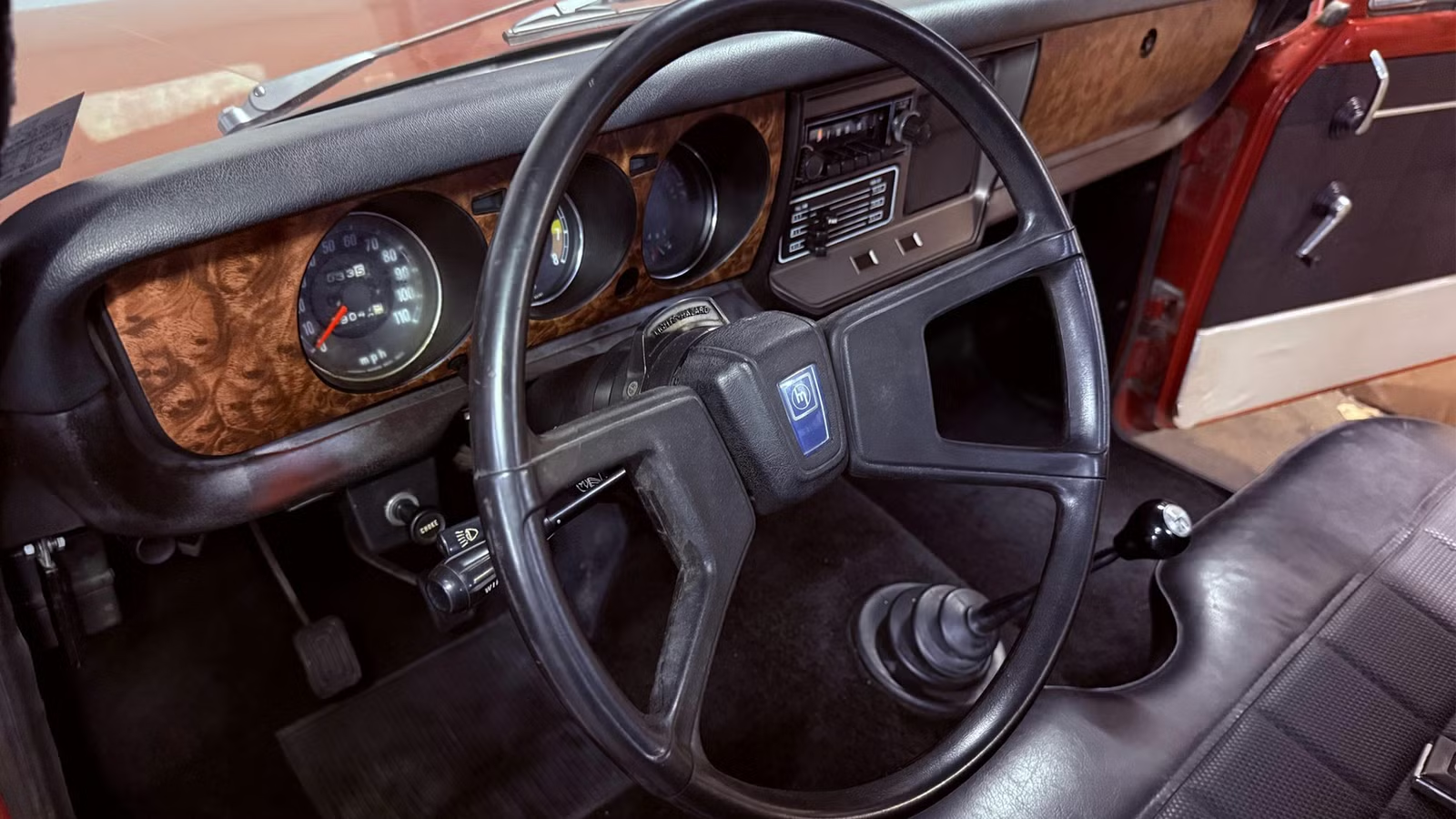
For decades, pickups have relied on engines built around one essential quality: strong low-end torque. That made sense for vehicles expected to haul heavy loads, tow trailers, and work hard at low speeds. But in the 1970s, one Japanese automaker challenged that formula by putting a high-revving rotary engine into a pickup designed to do exactly those jobs.

It sounds like a bizarre experiment, but the idea was more significant than it first appeared. Long before hybrids and range-extended electric trucks began challenging conventional powertrains, this forgotten pickup was already testing how far a truck could stray from the traditional engine formula.
When A Work Truck Gets An Unconventional Powertrain
Pickup trucks have traditionally depended on piston engines that produce their useful power and torque low in the rev range, making them well suited to carrying loads and working at modest speeds. The alternative explored here turned that formula on its head. Instead of prioritizing low rpm pulling power, its compact rotary engine delivered exceptionally smooth power across a much broader rev range, with the ability to spin to around 7,000 rpm.

That was an unusual proposition for any truck, because the rotary’s strengths were more commonly associated with performance cars than working trucks. Contemporary testing noted that the engineers did not simply install the engine in an existing chassis; they developed the truck around the rotary, incorporating changes to accommodate its character and performance.
Mazda Put A Rotary Engine In A Pickup

In 1974, Mazda introduced the REPU, short for Rotary Engine Pick-Up, creating what remains the first and only mass-produced pickup powered by a rotary engine. Built for the North American market, the unusual truck remained on sale from 1974 through 1977, giving Mazda a brief but unique place in pickup history.
At its heart was a 1.3-liter 13B twin-rotor Wankel producing 110 hp and 117 lb-ft of torque. Unlike the piston engines normally used in compact pickups, the rotary’s power delivery favored revs rather than low-speed pulling power. Its compact design also delivered more power for its size than conventional engines, helping explain why Mazda could turn a small utility truck into something considerably more performance focused.
Its Rotary Engine Gave This Pickup Sports Car DNA

The connection to Mazda’s sports car legacy runs deeper than simply sharing a badge. The 13B introduced in the early 1970s became one of the company’s most important rotary engine families, eventually powering multiple generations of the RX-7 and becoming closely associated with Mazda’s performance image. Mazda itself describes the 13B as the basis for later developments that went on to power the RX-7 and other models.
However, the connection needs some precision. The pickup used the original 1.3-liter, 654-cc-per-rotor 13B AP, introduced in 1973. The first-generation RX-7, launched in 1978, initially used the smaller 12A, although a later GSL-SE version received a 13B. The second-generation FC RX-7 then adopted further-developed 13B engines, including naturally aspirated and turbocharged versions.
The Rotary Made It Surprisingly Quick For A Pickup

On paper, 110 hp may not sound particularly impressive today, but in a lightweight pickup from 1974 it was enough to deliver genuinely lively performance. It had a 0 to 60 mph time of just 11 seconds, along with an 18.3-second quarter-mile.
More revealing was the way that performance was achieved. The rotary produced its best results when kept spinning, rather than being lugged at low rpm. Contemporary testing found the engine pulled strongly through the gears, encouraging drivers to use the rev range in a way that was unusual for a pickup. Period tests specifically noted that it produced less torque than rival trucks, meaning the revs needed to be kept up when hauling or towing.
Mazda Gave The Rotary Pickup Its Own Identity

Fitting an unusual powertrain into a compact pickup required more than simply changing what sat under the hood. Mazda gave the truck a wider stance, with pronounced flared fenders covering the increased track width and larger tires. It also received model-specific styling, including a unique front grille and distinctive round taillights, making it immediately distinguishable from the conventional B Series pickups on which it was based.
Some of the changes were considerably less obvious. The battery was moved from its conventional engine bay location to a position beneath the bed, with an access cover just ahead of the rear wheel. This was a practical packaging solution that freed up space around the compact rotary installation while contributing to the truck’s distinctive engineering layout. The result was a pickup that looked different from its piston-engined siblings because Mazda had altered both its appearance and its underlying packaging to suit the rotary.
The Oil Crisis Exposed The Rotary Pickup’s Biggest Weakness

The REPU’s biggest problem was not that its rotary engine was unconventional, but that its fuel consumption made that unconventionality particularly difficult to justify. One test put fuel economy at 15.8 mpg at the time, a figure that was difficult to reconcile with a small pickup intended to serve as practical transportation. Its rotary engine also required a different driving approach, with the temptation to use its high-revving character potentially making fuel consumption even more noticeable in everyday use.
Timing made matters considerably worse. The truck arrived in 1974, just as the 1973 oil crisis was reshaping the American car market. Fuel prices and shortages were pushing buyers towards more economical vehicles, while a pickup returning little more than 16 mpg suddenly looked like an increasingly expensive proposition. What had initially helped differentiate the REPU therefore became a major commercial disadvantage, particularly as fuel economy became a far greater concern for American buyers.
Around 15,000 Buyers Came Before The Experiment Ran Out Of Fuel
The REPU initially looked far less like a commercial gamble than its later reputation suggests. Mazda produced 14,366 examples for the North American market in 1974, meaning almost the entire eventual production run was concentrated in its first year. But demand collapsed soon afterwards. Production was paused for the 1975 model year, followed by around 630 trucks in 1976 and just over 1,100 in 1977, bringing the total to roughly 16,000 examples before the model disappeared.
Its short career nevertheless proved something important. Mazda had demonstrated that a pickup could successfully accommodate a fundamentally different type of powertrain and still deliver useful performance. The REPU never spawned a direct successor, but its willingness to challenge the conventional formula now looks remarkably prescient. Today’s hybrid and range-extended electric trucks are again proving that utility vehicles do not necessarily need to follow the traditional engine blueprint.
Sources: Mazda

Related posts





Latest Post



No Comments