
The Bike That Can Stay In Your Garage Through Every Stage Of Life
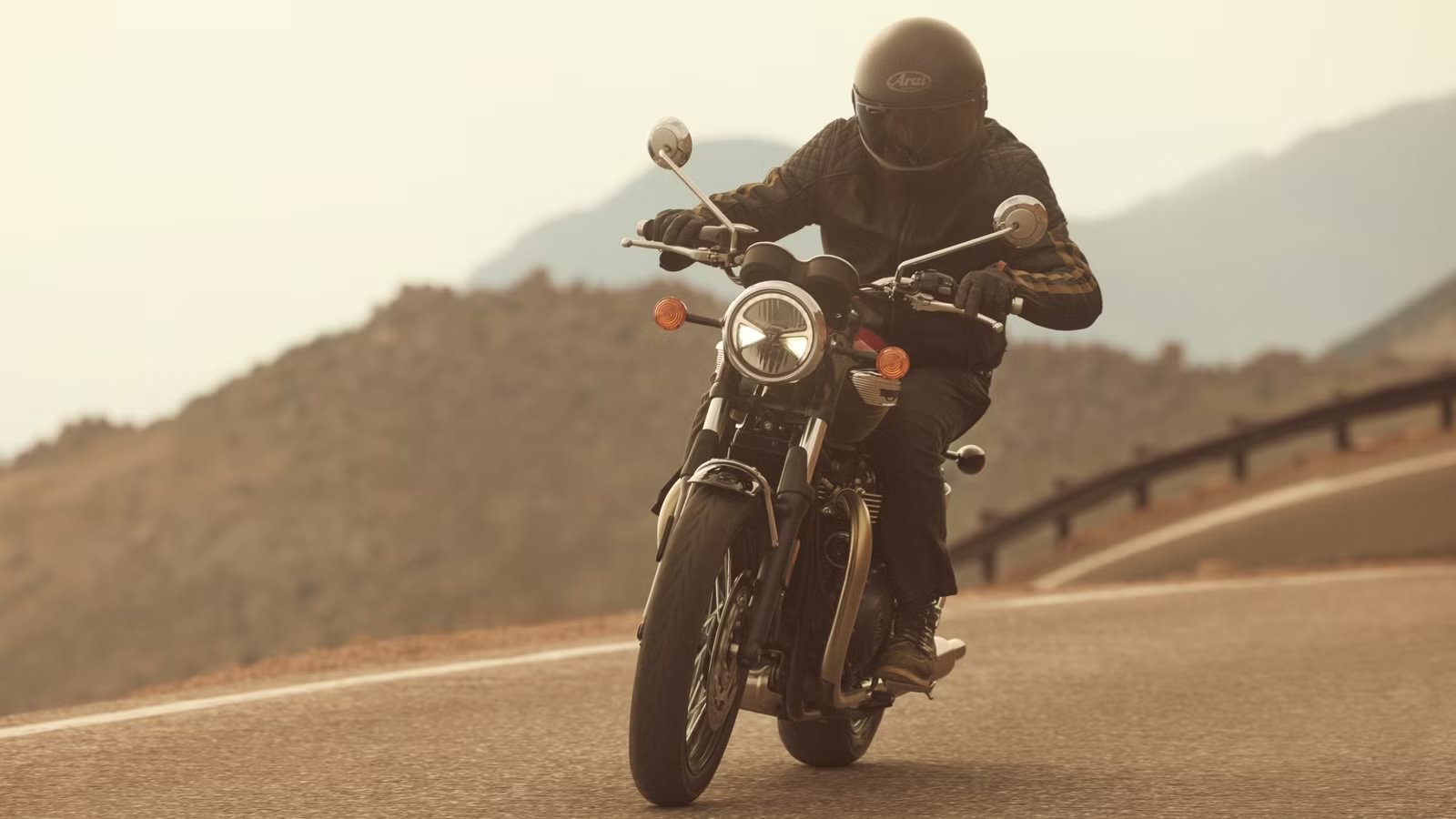
What does it really mean to have a motorcycle that can stay in your garage through every stage of life? There are two ways to answer that question, and the first might be to buy something like an adventure motorcycle. It can commute during the week, tour across the country, handle some off-road riding, and, especially in a more powerful version, give you enough performance that there is little reason to replace it.

In theory, that should be enough. Yet sometimes, even after finding a motorcycle that can do almost everything, you can still find yourself wanting to part ways. So maybe capability alone isn’t what makes you want to keep a motorcycle. Maybe it’s that harder-to-define X-factor, and that X-factor could very well be character. Few motorcycle names are as closely associated with the idea as the marque from Hinckley and its Bonneville range.
The Bonneville Has Been Many Things To Many Riders
First things first: it’s worth understanding where the Bonneville name actually comes from, because it might tell you a little something about the philosophy behind the name. Turn the clocks back to 1956, and Triumph was set on chasing one goal: outright speed. And guess where? The Bonneville Salt Flats in Utah.

That’s where Texan racer Johnny Allen took a Triumph-powered streamliner to 214.7 mph, setting a motorcycle land-speed record and, perhaps more importantly for the story we’re telling here, giving Triumph a rather spectacular name to work with. Two years later, the Bonneville T120 arrived, carrying that name onto a production motorcycle for the first time.

And from there, things got rather interesting. The Bonneville went racing, made its mark at the Isle of Man TT and became a favorite among riders who wanted to turn their road bikes into café racers. It eventually found its way into popular culture too. Triumph’s troubles eventually caught up with it, though. The Meriden factory closed in 1983, bringing the original Bonneville era to an end, and the name disappeared for years. Triumph eventually returned under new ownership, building a new range from its Hinckley factory, and the Bonneville followed in 2000.
The Bonneville T100 Has A Simple Formula That Lasts Long

Enter the Bonneville T100, the entry point into Triumph’s Bonneville range, sitting beneath the larger T120 and the other 1200cc Bonneville derivatives. It’s also the sort of motorcycle you’ll see plenty of at something like the Distinguished Gentleman’s Ride, both in its modern guise and among older examples. And gentleman it is, with a 900cc parallel twin, a classic design and an unassuming character that doesn’t try to make the motorcycle into something it isn’t. The T100 is simply a quintessential classic motorcycle, and perhaps that’s why this formula has lasted for so long.
The T100’s 900cc Twin Is Built Around Character

Since the Bonneville’s modern revival, Triumph has used a few different engines in the range. The T100 started life in 2002 with a 790cc parallel twin before moving to an 865cc version, but the current 900cc engine arrived in 2017. Today, it produces 64 horsepower at 7,400 rpm and 80 Nm of torque at 3,750 rpm, with that peak torque arriving relatively low in the rev range. The 270-degree crank also gives the parallel twin a distinct firing pulse, contributing to the sound and rhythm that have become part of the Bonneville character.
A Modern Chassis Beneath The Classic Design

The chassis follows much the same thinking. There’s a tubular steel twin-cradle frame underneath the classic-looking bodywork, with 41mm cartridge forks up front and twin rear shocks with preload adjustment. The T100 rolls on an 18-inch front and 17-inch rear wheel, while its 1,450mm wheelbase is shorter than the previous-generation bike’s. That change was part of the 2017 redesign, giving the T100 a little more agility without moving too far away from the traditional Bonneville formula.
The T100’s Dimensions Make It Easy To Live With

Then there’s the physical side of the T100, which is where its relatively approachable dimensions start to make sense. The 30.8-inch seat height should make it manageable for a broad range of riders, while the 3.8-gallon fuel tank gives it enough capacity for longer stretches between stops. At 502 pounds wet, it has some heft to it, but the 56.6-inch wheelbase keeps the overall package reasonably compact. There’s also a proper two-up seat, leaving room for a passenger when your life moves beyond solo riding.
There’s Just Enough Technology To Keep Things Current, Too

By this point, it’s pretty clear that the T100 does justice to the idea of a modern classic. It doesn’t try to hide its roots, but there are areas where it can still surprise you. Take the lean-sensitive ABS and traction control (fresh for 2026, thanks to the addition of an IMU), for example, technology you might not immediately expect to find on a motorcycle with two beautiful analogue speedometer and tachometer dials. The LCD sections between them show things like fuel range, gear position and riding mode, while a USB-C charging socket sits beneath the clocks. Cruise control is available too, although you’ll have to add it as an accessory.
No Two T100s Have To Look The Same

This is where the T100’s lack of specialization starts working in its favor. Because it isn’t trying to be a dedicated tourer, café racer or commuter, there’s plenty of room to take it in different directions, and Triumph itself gives you quite a few ways to do that. In fact, there are 117 accessories listed for the T100. Want to take longer trips? There are panniers, a top box, luggage racks and a touring screen. Prefer a more stripped-back look? Different seats, bar-end mirrors and styling parts can change the way it looks without changing what sits underneath. Even everyday comfort can be addressed with options such as heated grips and a comfort seat.
Not Many Direct Rivals Come Close, Either

Finally, at $11,645, the Bonneville T100 isn’t exactly playing in the bargain section of the modern-classic market. On paper, something like the Moto Guzzi V7 comes reasonably close to the idea, with its 853cc transverse V-twin, shaft drive, and unmistakably Italian character. The V7 Stone starts at $9,690, while the Speed Twin 900, at $9,995, is another motorcycle that sits surprisingly close to the T100’s territory. Beyond the numbers, though, heritage and taste become part of the equation.

Then comes a wild card of a motorcycle: the Royal Enfield Interceptor 650. At $6,149, it’s considerably cheaper than the T100, with a 648cc parallel twin, simpler electronics, and a much more basic overall package. Yet it follows much the same broad idea. It’s a classic-looking roadster with enough performance for everyday riding and longer trips, without being tied to any particular kind of riding or rider. It doesn’t have the T100’s refinement or technology, but it delivers perhaps 80 percent of the same overall experience for someone who doesn’t want to shell out nearly as much.
Source: Triumph Motorcycles

Related posts

Latest Post


No Comments