
The Big-Block Muscle Cars Buyers Punished For Being Too Refined
Two Detroit intermediates arrived with some of the most intimidating big-block hardware of the muscle era. One could be ordered with Chrysler’s legendary Hemi, and the other produced 510 lb-ft of torque and ran deep into the 13s in period testing. Neither was slow, nor did either lack pedigree. Yet buyers and later enthusiasts punished both for a strange offense: they had good manners.
Muscle-Car Buyers Wanted Rebellion, Not Better Manners

Straight-line speed supplied the foundation, but it did not complete the muscle-car fantasy. The right machine needed to look dangerous while parked. A teenager had to spot it from across a shopping-center lot and know that something irresponsible lived under the hood. Scoops, stripes, oversized engine callouts, bright colors, loud exhaust, and cartoonish names all helped. Muscle cars worked as rolling declarations of independence.
That theater mattered because performance remained hard to prove during an ordinary drive. Few owners spent each afternoon making timed quarter-mile passes. Everyone, however, could hear an uneven idle or see a black hood treatment. A loud visual identity turned hidden engine parts into social currency, and Detroit understood the game very well.
Refinement could scramble that message. Deep seats, thick carpet, chrome trim, sound insulation, full gauges, woodgrain panels, air conditioning, and power accessories improved daily use. They also added cost and sometimes weight. Worse, they created doubt. A performance car with a polished cabin could appear soft, even when its engine could turn the rear tires into expensive smoke. Buyers often viewed every comfort item as money that should have funded a bigger carburetor or steeper rear gears.

Plymouth And Buick Made The Same Dangerous Bet

Plymouth placed one intermediate above its cheap street fighter and built it for a buyer with a little more money and a little less interest in bare painted floors. The upscale car carried a 440-cubic-inch V8 as standard equipment. It also offered deep bucket seats, richer trim, reflective accents, extra brightwork, and a more complete cabin. Plymouth presented it as a serious performance machine with cleaner lines and adult clothes. Its showroom sibling followed the opposite plan – a standard 383, an intentionally plain personality, and enough comic-book attitude to make subtlety file a formal complaint.
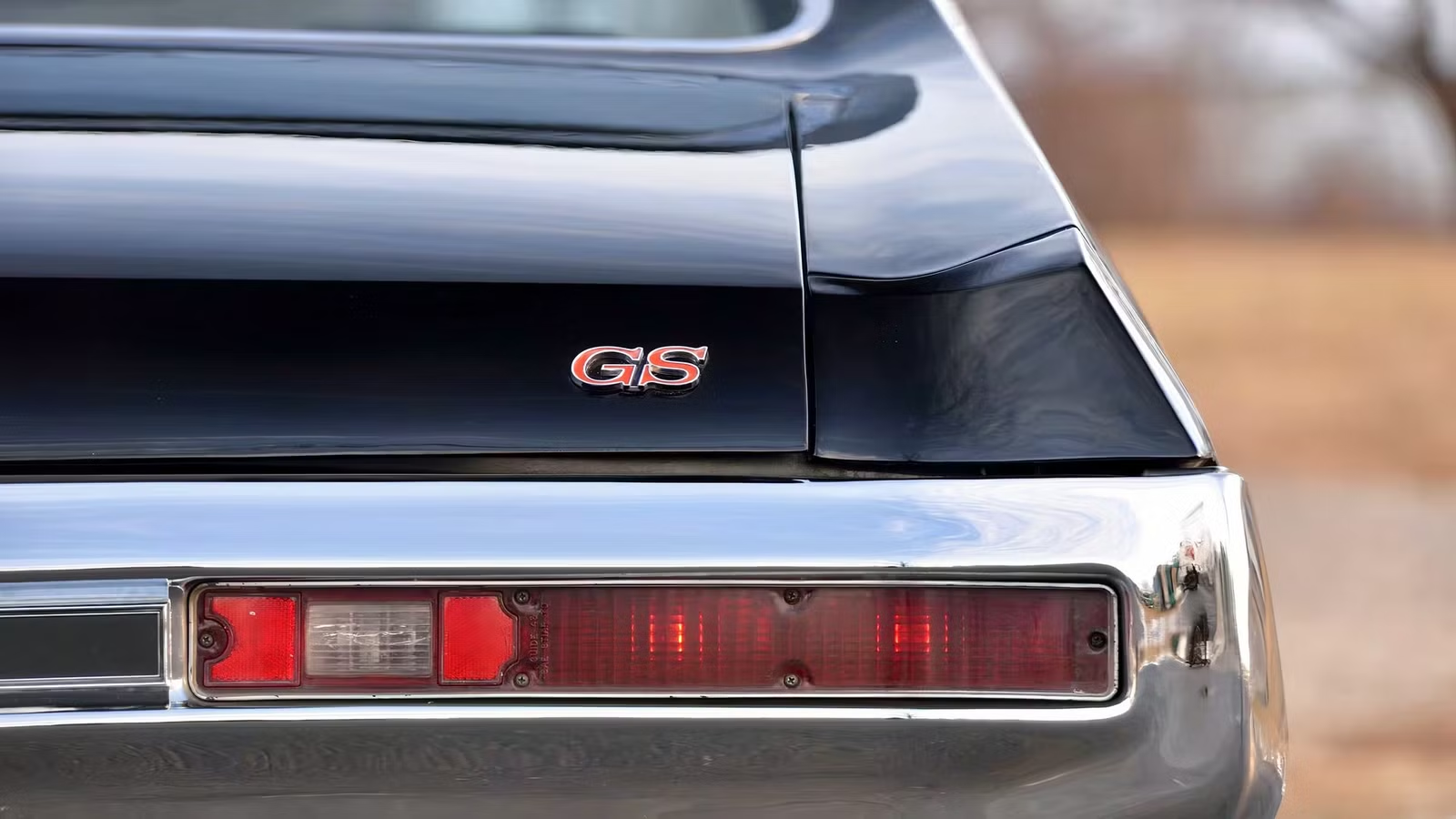
Buick took an equally risky route from another part of Detroit. The division had spent years building cars for established buyers who liked quiet cabins, formal styling, and torque that moved a large car without drama. Its performance intermediate kept much of that mature character – buyers could select bucket seats, a full console, air conditioning, power windows, power locks, a power seat, cruise control, and other conveniences. The standard body skipped the wild stripes and spoilers reserved for a more theatrical package.
The Plymouth GTX And Buick GS 455 Were Muscle Cars In Tailored Suits

The two cars were the 1969 Plymouth GTX and the 1970 Buick GS 455. Both followed a similar recipe – start with a Detroit intermediate, install enough displacement to affect local weather patterns, then surround it with a cabin that did not punish anyone for taking a long trip. Neither company created a luxury coupe and added a hopeful engine option – Plymouth and Buick designed real performance cars, then gave them better manners than the market expected.
The GTX served as Plymouth’s premium muscle car. Its standard 440 Super Commando V8 carried a 375-horsepower rating, so every buyer received serious big-block power without checking another engine box. Chrysler’s 425-hp 426 Street Hemi sat above it for customers whose financial plans included two carburetors and no fear. Bucket seats, richer materials, woodgrain details, reflective accents, extra chrome, and a more formal face separated the GTX from the cheaper brawler nearby. Those features made the GTX feel like the complete package.

The Buick delivered its own lesson in quiet violence. The regular 455 produced an advertised 350 horsepower and 510 lb-ft of torque. The Stage 1 package raised output to 360 horsepower while keeping the same huge torque rating at 2,800 rpm. It changed the camshaft, valves, cylinder-head machining, carburetor calibration, ignition tuning, and transmission behavior rather than relying on decorative magic. MotorTrend tested an automatic Stage 1 that weighed about 3,810 pounds and recorded a 13.38-second quarter-mile at 105.5 mph. The Stage 1 option cost $199.05 on that car—less than its automatic transmission—making the engine upgrade one of the more serious bargains hiding on a 1970 order sheet.
Media reaction at the time exposed the Buick’s larger problem. Many writers treated the result like a practical joke – they called the car a sleeper, repeated the old-man stereotype, and wrote as though the Buick badge and a quick quarter-mile had no business sharing a sentence. Both the GS 455 and GTX offered huge displacement without an adolescent presentation, and both paired comfortable interiors with acceleration that could humble louder rivals.
One Lost The Sales War, While The Other Lost The Mythology War

The GTX suffered the clearer showroom defeat. Plymouth produced 15,602 examples for 1969, split between 14,902 hardtops and 700 convertibles. The Road Runner reached 84,420 units during the same model year—more than five times the GTX total. It offered lower prices, plainer trim, a deliberately crude identity, and a standard engine that still delivered real performance. The gap revealed what buyers valued – Plymouth had created a premium machine with more standard displacement and more equipment, yet the public rushed toward the car that looked as though an accountant had removed everything except the engine and the horn.

Hemi production makes the result even stranger. References often place 1969 Hemi GTX output at roughly 208 or 209 cars. One commonly used breakdown lists 197 hardtops and 11 convertibles, while other summaries round the total differently. Period production math can become as slippery as a bias-ply tire, but the conclusion stays put – Hemi GTXs are exceptionally rare. The premium Plymouth could carry the era’s most famous engine, yet it never gained the same cultural weight as its supposedly lesser sibling.

The regular Buick faced a different punishment. Production records list 5,589 standard 455 hardtops and another 2,465 Stage 1 hardtops for 1970. Buick also built 1,184 regular 455 convertibles and 232 Stage 1 convertibles. Those figures prevent any fair claim that buyers rejected the car outright. Its trouble came later, when muscle-car history began selecting poster stars – Buick’s GSX package supplied the required drama with hood and body stripes, front and rear spoilers, a hood tachometer, black bucket seats, chrome wheels, and large exterior markings. It gave magazines, model companies, and future collectors an easy visual symbol for Buick performance.

Only 678 GSXs appeared in 1970, including 400 with Stage 1 power and 278 with the regular 455. The louder derivative achieved far greater visibility despite its smaller production run. It wore the same basic body and shared the standard car’s mountain of torque, but its graphics photographed better and its spoiler gave enthusiasts something obvious to remember. The plain GS 455 did most of the same work without waving its arms. That difference split the two defeats. Plymouth’s GTX lost buyers to a cheaper sibling. Buick’s regular GS 455 lost attention to a brighter version of itself. In each case, the less refined identity proved easier to sell as a myth.
These Cars Were Not Too Soft – They Were Too Early

But the truth is neither car failed the performance test. The GTX started with a 375-hp 440 and offered the 425-hp Hemi. The GS 455 Stage 1 produced 510 lb-ft at low engine speed and pushed an automatic-equipped car through the quarter-mile in 13.38 seconds. Both cars had the engines, driveline parts, and attitude required to belong among the era’s serious street machines.
Their real mistake involved timing. Late-1960s muscle culture linked authenticity with low prices, sparse cabins, loud graphics, and youthful rebellion. Refinement suggested compromise, even when the engine specifications argued otherwise. The GTX and GS 455 predicted a combination that buyers would embrace more fully in later decades – effortless torque, adult styling, real comfort, and speed that did not need a billboard on each quarter panel. They offered grand-touring character before American performance buyers had settled on a name for it.
Source: Plymouth, Buick, MotorTrend

Related posts






Latest Post


No Comments