
The Best Motorcycle For Riders Who Spend Hours On The Freeway
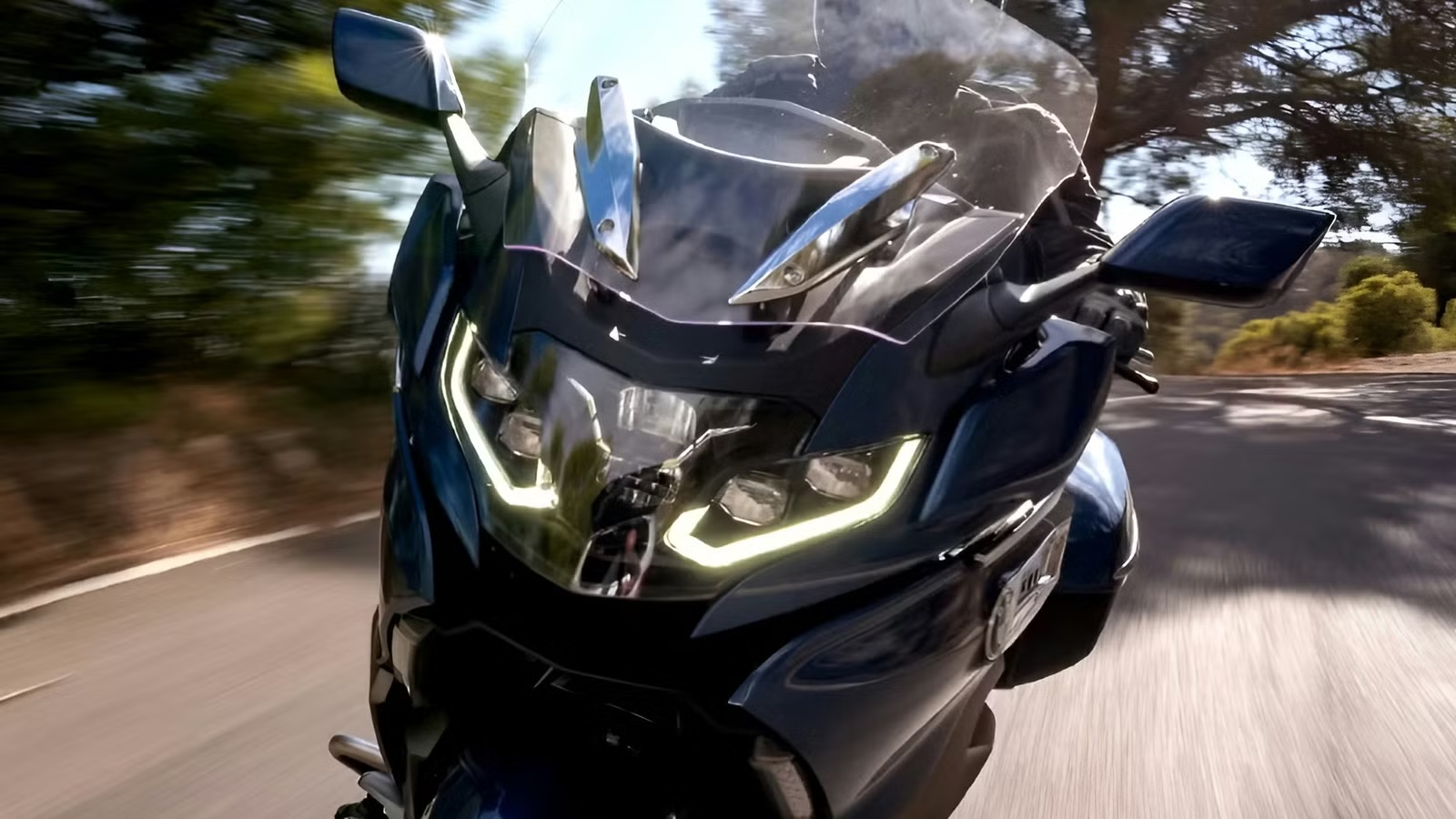
Freeway fatigue is not always about covering an intimidating distance. More often, it comes from repetition: thousands of nearly identical throttle inputs, subtle engine pulses, minor wind disturbances, and small seat-pressure points accumulating over three, four, or six hours. That is why a motorcycle that feels comfortable on a Sunday back-road ride may still become tiring on the interstate. Freeway comfort requires more than soft suspension and an upright riding position. It demands exceptional engine refinement, stable aerodynamics, relaxed ergonomics, substantial range, and technology that quietly reduces the rider’s workload.
Why Highways Require A Different Class Of Motorcycle

At 75 mph, the air isn’t just resistance—it’s a constant, buffeting force pushing against your helmet, shoulders, and chest for as long as the bike is moving. Add engine vibration transmitted through the pegs, seat, and bars, and a rider’s nervous system spends the whole day processing inputs it never gets to switch off. Cramped ergonomics make it worse: a riding position built for weekend back roads rarely holds up once the clock passes the two-hour mark.
This is where a lot of adventure bikes and cruiser-style tourers quietly fall short. They’re brilliant in short bursts—a Sunday canyon carve, a 40-mile commute—but ask them to cover 500-plus miles in a day, and they start dictating the schedule. Fuel stops arrive early, and rest breaks become more frequent. The bike simply won’t let you go much further without a pause from the vibration or the wind.
Why Most “Comfortable” Touring Bikes Still Wear You Down On The Interstate

Here’s the part most spec sheets skip: V-twins and parallel-twins aren’t naturally smooth. Counterweights on the crankshaft cancel some vibration, never all of it, and rubber mounts soak up the rest—a workaround, not a fix. Hold highway RPM for three hours, and the vibration that felt like “character” on a test ride quietly turns into fatigue in your hands and feet. Wind and seat pressure behave the same way. A mediocre fairing feels fine for twenty minutes, then starts nudging your helmet just enough to tense your neck. A seat that’s plush at a stoplight can become a pressure point by hour two. None of it shows up in a showroom — only on the road.

Some bikes manage this better. The Honda Gold Wing relies on a flat-six and sheer mass, at a steep price and weight penalty. The Harley-Davidson Road Glide counters buffeting with a frame-mounted fairing wrapped around a V-twin that still vibrates. Both are excellent, both expensive, both still a trade-off. A third option exists — from a manufacturer that treated the compromise itself as the problem.
The BMW K 1600 GTL Is Tuned Specifically For This Kind Of Riding
At $30,095, The GTL Is The K 1600 Family’s Purpose-Built Long-Haul Model

The 2027 BMW K 1600 GTL carries a base MSRP of $30,095, plus a $1,195 destination and handling fee. While it shares its silky inline-six engine with the rest of BMW’s K 1600 family, the GTL is positioned as the luxury touring model. Compared with the sportier K 1600 GT, it features a lower seat height, a more relaxed riding position, larger wind protection, an integrated top case with passenger backrest, and additional long-distance comfort features. For riders who routinely spend entire days on interstate highways, the GTL prioritizes effortless comfort over outright sporting character.
The GTL is designed specifically for riders who value comfort over aggressive handling. It comes standard with electrically adjustable wind protection, integrated side cases, a large top case, heated seats for both rider and passenger, and ergonomics intended to minimize fatigue over consecutive 500-mile days. But the GTL’s comfort advantage doesn’t come from padding and wind protection alone — it starts with a piece of engineering that most touring bikes can’t replicate.
A Transverse Inline-Six Built To Cancel Vibration, Not Just Dampen It

At the center of the GTL is a 1,649cc transverse inline-six, producing 160 horsepower at 6,750 rpm and 132.7 pound-feet of torque at 5,250 rpm—numbers that already put it ahead of most touring twins on paper, and further ahead of them in actual feel. The reason comes down to basic engine architecture, not just tuning.
An inline-six is mathematically balanced by design. Three pistons rise while the other three fall, firing at even 120-degree intervals, so the reciprocating forces cancel each other out almost perfectly. There’s no need for a counterbalance fighting an inherent imbalance, because there isn’t one to fight in the first place. It’s the same reason inline-six engines earned a reputation for buttery smoothness in cars long before anyone bolted one into a motorcycle frame.
Why Six Cylinders Feel Calmer At 4,500 RPM Than A Twin Feels At 3,000

The practical difference shows up specifically at sustained highway RPM — exactly where a freeway-bound rider spends most of the day. A twin-cylinder engine’s counterbalance reduces average vibration but doesn’t flatten the peaks; there are still moments in each combustion cycle where the shake spikes before it gets damped back down. An inline-six doesn’t have those peaks to begin with, because the forces are canceling in real time, cylinder against cylinder, rather than being corrected after the fact.
Suspension And Brakes Built To Absorb A Six-Hour Day, Not Just A Twisty Afternoon
Semi-Active Dynamic ESA Suspension With Automatic Load Leveling

Engine smoothness only solves half the fatigue equation. The other half is what happens when the road itself isn’t smooth — expansion joints, patched asphalt, the occasional pothole disguised as a shadow. The K 1600 GTL handles that with a BMW Motorrad Duolever front end that offers 4.5 inches of travel and a Paralever single-sided swingarm at the rear with 5.3 inches of travel, both managed by Dynamic ESA — BMW’s semi-active electronic suspension.
Dynamic ESA reads the road in real time and adjusts damping force accordingly — stiffening for heavy compression, softening for a small ripple, all within milliseconds and without any input from the rider. It also automatically compensates for load, whether that’s a rider alone, rider with a passenger, or rider with a fully-packed set of side cases, so the geometry doesn’t sag or wallow no matter what’s strapped to the bike. Over a six-hour day, that’s the difference between a chassis that stays composed and one that slowly telegraphs every seam in the pavement straight into your spine.
Low-Maintenance Shaft Drive And High-Speed Tracking

Because the Duolever’s geometry does double duty and the front suspension isn’t a conventional telescopic fork, braking forces don’t compress it the way they would on most motorcycles. Grab a handful of the front brake at 70 mph, and the GTL doesn’t dive and unsettle its line; rather, it just slows down, tracking straight through the maneuver. That is a significant feature to have while riding on a freeway, since sudden braking events tend to happen exactly when traffic bunches up unexpectedly.
Power reaches the rear wheel through a shaft final drive rather than a chain, which sounds like a minor detail until you’re three states into a road trip. No lubrication, no tension adjustments, no roadside inspection at a gas station — just consistent, low-maintenance power delivery that doesn’t care how many miles have piled up since the last stop.
Fuel Economy And Range: The Numbers That Matter Past Hour Three

Comfort and smoothness don’t mean much if a bike still needs fuel every 150 miles — that just moves the interruption around instead of removing it. The K 1600 GTL carries roughly seven gallons of usable fuel, with about a gallon held in reserve for a total eight-gallon tank, and returns approximately 40 mpg in mixed highway riding. That works out to somewhere around 250 to 280 miles between fill-ups — enough to outlast most riders’ backs and bladders before the fuel light even comes on.
Electronics That Take Repetitive Tasks Off The Rider’s Hands

Standard cruise control handles the most obvious repetitive task on a freeway—holding a constant throttle position for hours—freeing a rider’s right hand and forearm from a job that would otherwise never stop. Three ride modes—Rain, Road, and Dynamic—adjust throttle response and traction control intervention to match conditions, while engine brake control (MSR) and Hill Start Control Pro quietly take care of smaller mechanical decisions a rider would otherwise be making dozens of times a day.
Reverse Assist sounds like a minor convenience until you’re parking a 789-pound motorcycle after nine hours in the saddle, backing it into a tight spot on tired legs with a full tank. It’s a small thing that only matters at the exact moment fatigue has already set in, which is precisely when it helps most. Round out the package with a 10.25-inch TFT display, an adaptive cornering LED headlight, and tire pressure monitoring, and the pattern becomes clear: none of these features is dramatic on its own, but together they quietly remove dozens of small decisions a rider would otherwise be making, hour after hour, without ever consciously noticing the toll.
Source: BMW Motorrad

Related posts
Latest Post


No Comments