
The Best Bang For Your Buck V8 Crate Engine You Can Buy
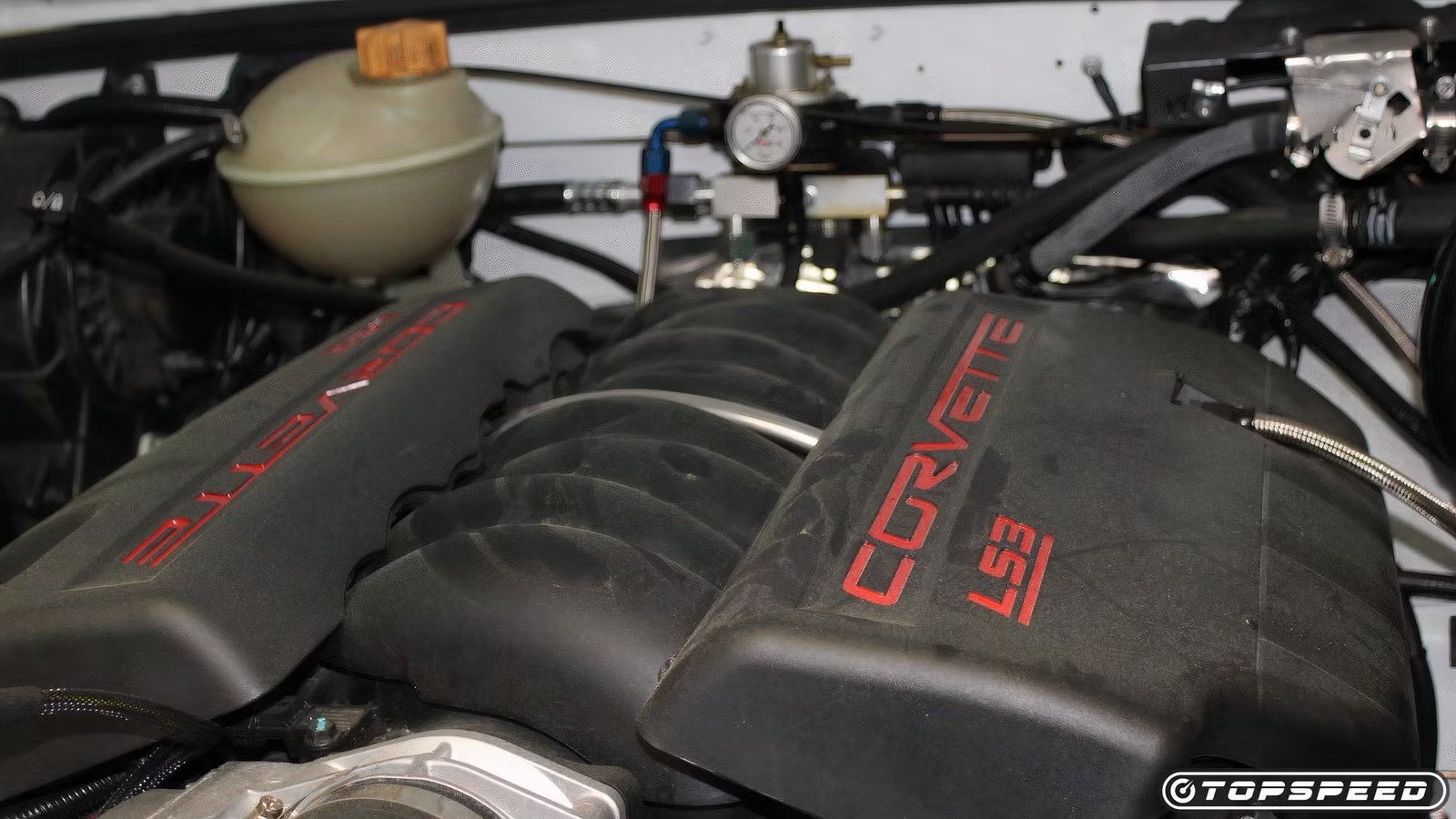
Finding the right engine for a project car has never been more exciting — or more overwhelming. The crate engine market has exploded in recent years, giving builders more choices than ever, but also more ways to waste money on the wrong powerplant. If you want to cut through the noise and put your budget where it actually counts, the answer keeps pointing back to the same family of engines it always has: the Small-Block Chevy V-8. The question isn’t whether an LS belongs in your build — it’s which one gives you the most performance per dollar spent. That’s exactly what we’re here to settle.

Thus, it’s smart to tackle the most important details first, and no detail is more critical than the engine you plan to use. If you want the best bang-for-buck possible, your crate engine of choice is almost guaranteed to be a V-8, and a Small-Block Chevy at that. Yet, which one would you choose and why? Well, stick around because we’ll be breaking down the best V-8 crate engine you can buy right now.
The Chevrolet LS3 V-8 Is Still The King Of Crate Engines
No matter the eventual application or intended donor car, the Chevy LS-based Small-Block V-8 remains the go-to power unit for builders who want to maximize performance without spending an arm and a leg. Why? Simply put, no readily available crate engine is more reliable, powerful, and versatile, which has kept the Chevy LS V-8 in a dominant position in this market for decades.

Yet, if you are looking into potential power units for your swap, the first thing you may notice is that there are about a million different iterations of the Small-Block Chevy (aka the SBC), and it has never been easier than now to get lost in the sauce trying to understand and identify the differences between individual engines.
This is why, if we had to pick an SBC-based engine to rule them all, the objective choice is always going to be the 6.2-liter “Gen IV” LS3 V-8. There are three generations of LS-based SBC engines to choose from — spanning 1997 to the present — encompassing over 40 different engine configurations among them. Let’s break down what makes the Chevy LS3 so desirable and value-packed despite the incredible diversity of available options in the aftermarket.
What Makes The Chevy LS3 Special

Introduced in 2008 as the updated base engine for the C6 generation Chevrolet Corvette, the 6.2-liter (376 cubic inches) Chevy LS3 ushered in a new era of SBC performance. With 430 horsepower and 424 pound-feet of torque in stock configuration, the aluminum block-based LS3 is a development of the earlier 6.0-liter LS2 V-8, which served as the introductory base engine for the C6 Corvette back in 2005.
The 6.0-liter Chevy LS2 was already a large step forward in performance capability compared to the first LS-based SBC engine, the 5.7-liter LS1, which was introduced as the base engine for the C5-generation Chevrolet Corvette in 1997 and produced around 350 horsepower. The LS2 broke the 400-horsepower barrier for the first time as a base Corvette engine, matching the output of the high-performance LS6 found in the previous-generation C5 Z06 Corvette.
A Durable Engine That Is As Powerful As It Is Dependable

By the time the 6.2-liter LS3 arrived in 2008, Chevy had over a decade’s worth of development time to work out most of the kinks with the LS platform. The LS3 quickly became a clear front-runner in the naturally aspirated V-8 performance segment. Compared to the LS2, the LS3 added displacement, an upgraded valvetrain, high-flow cylinder heads, a high-flow intake manifold, a more aggressive cam, and LS7 injectors — all of which allowed it to reach 430 horsepower with relative ease. Although its power and versatility were impressive from the outset, its reliability has since been cemented as legendary through decades of proven durability in performance applications.
The Best Value LS3 Engine You Can Buy

The 6.2-liter Chevy LS3 V-8 is by no means a “cheap” or even affordable engine in the grand scheme of crate engines. The truth is, nothing about building a project car from the ground up properly is cheap. Despite this being a pay-to-play game, there are still engines that offer far more value for their price than others. So while it may be far from the most affordable pick, the Chevy LS3 offers an incredible price-to-performance ratio that is hard to argue with. Now that you know you need a Chevy LS3, which one do you buy?
Well, let’s start with an LS3 Long Block directly from GM Performance. To be specific, this Long Block package includes the oil pan, heads, and valve covers, but no intake manifold, coil packs, water pump, headers, or other accessories. This LS3 crate engine is a direct replacement intended for pre-1976 street vehicles and includes the Chevy F-Body wet sump oil pan. Yet, is this OEM option the best you can get for the money? Well, for about the same price, we think you can do better.

This is where the BluePrint Engines 376 Pro Series LS3 Long Block comes into the picture. For a modest premium over the GM unit, you get 530 horsepower and 495 pound-feet of torque out of the BluePrint Pro Series LS3 — that’s 100 horsepower more than a stock LS3. The BluePrint Pro Series LS3 achieves this increased output through bespoke aluminum cylinder heads, a significantly hotter camshaft, and an LSX-style cast-iron block as opposed to the aluminum variant found in the factory LS3. The cast-iron block allows for increased deck thickness, an improved water jacket design, extended cylinder skirts, and strength webbing. The BluePrint LS3-style cylinder heads also offer a slight increase in chamber size and valve size.
Cast Iron Block Vs Aluminum Block And Other Details

A cast-iron “LSX-style” LS3 block weighs about 60 pounds more than the aluminum variant found in the factory LS3 engine. Yet, if you are considering more power or forced induction down the line, you might come to appreciate the benefits of the strengthened — and heavier — cast-iron block. For direct reference, let’s discuss the LSX376-B15 available directly from GM Performance, with which this BluePrint Engines Pro Series LS3 shares many similarities.
The GM Performance LSX376 is a 6.2-liter cast-iron LS3 variant that offers 473 horsepower and 444 pound-feet of torque. The LSX376 is advertised as being built for boost, featuring a fully forged rotating assembly — forged steel crankshaft, forged powdered metal rods, and forged aluminum pistons — that supports up to 15 pounds of boost at a 9.0:1 compression ratio on 87-octane fuel. We’d at least run 91-octane anyway for peace of mind.
Comparatively, the 530-horsepower BluePrint Pro Series LS3 does not feature a fully forged rotating assembly (only forged rods) and has a higher 10.7:1 compression ratio that requires a minimum of 91-octane fuel. The price difference between these two engines is substantial — check current GM Performance and BluePrint Engines pricing for the latest figures, as both are updated regularly. Whether the premium for the LSX376’s fully forged assembly is worth it ultimately comes down to one question: are you planning on adding boost in the near future?

Let’s see what you could get from BluePrint Engines at a comparable price point to the LSX376 Long Block from GM Performance. At the top of the BluePrint lineup sits the Pro Series LS3 in Deluxe Dressed trim, which is considered a “turn-key” powerplant. This package includes a Holley Terminator X Max EFI system — complete with an ECU and harness pre-configured with a base timing map for this specific engine. That makes tuning setup straightforward while providing expandability for nitrous, boost, or electric fan control down the line. Other included accessories are a GM plastic intake manifold, LS swap oil pan, BluePrint Engines fuel injectors and rail, DBW throttle body, throttle pedal and sensors, spark plugs, coil packs and wires, and a harmonic balancer.
However you look at it, the fully forged GM Performance LSX376 is an impressive piece of engineering, but the BluePrint Pro Series LS3 delivers more performance per dollar spent. With the BluePrint unit, you get the most important attribute of the LSX — the cast-iron block — while retaining the aggressive camshaft of the Pro Series engine. In the end, the value proposition between these two LS3 powerplants is straightforward: the LSX376 gives you a fully forged bottom end built for serious boost, while the BluePrint Pro Series delivers more peak horsepower for significantly less money. Which one is the better deal? We’ll let you decide.
Sources: Chevrolet, GM Performance, BluePrint Engines

Related posts




Latest Post


No Comments