
The Audi Five-Cylinder That Left In 1997 And Came Back Angrier
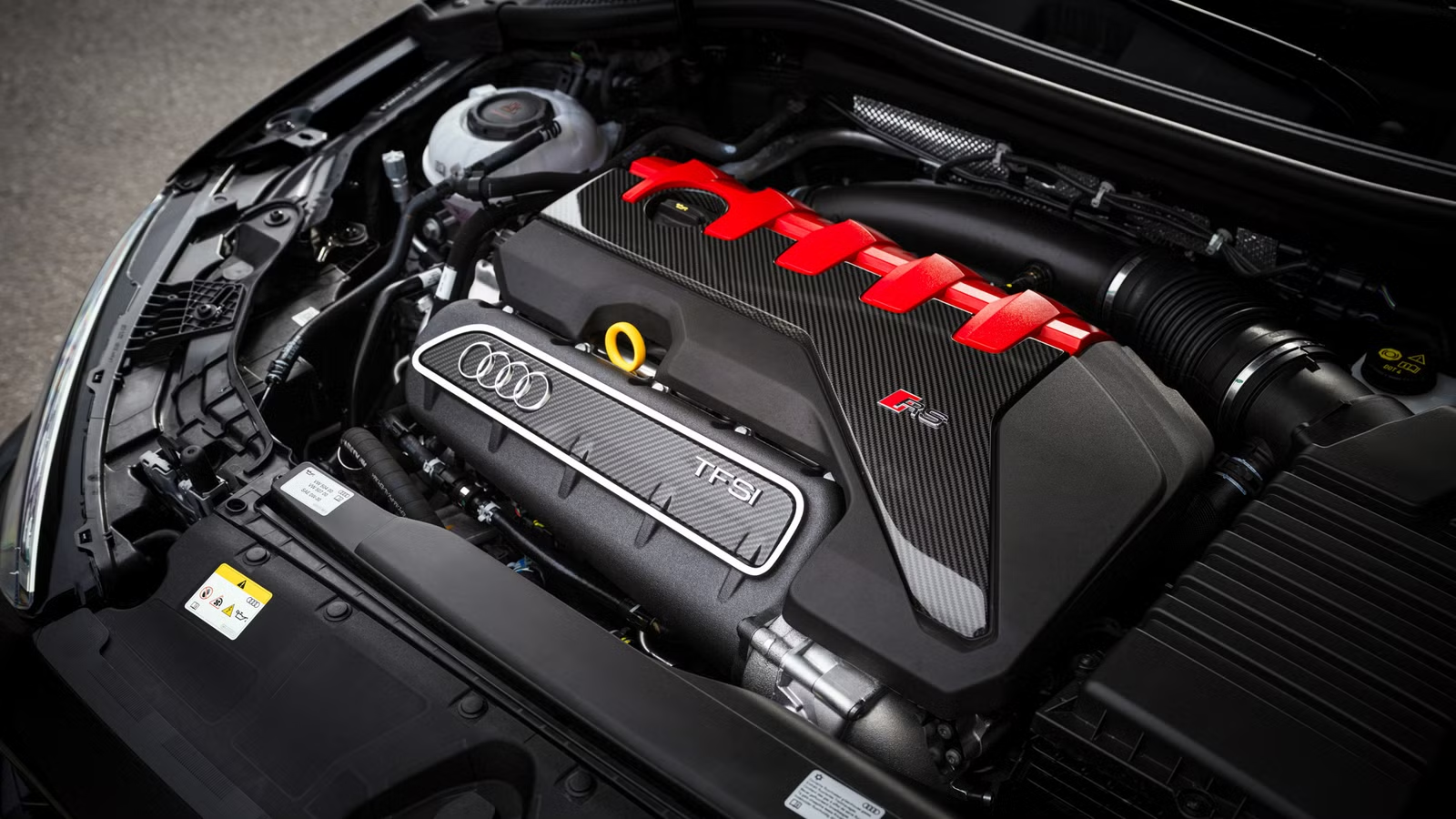
In 1976, Audi put an odd number of cylinders in a family sedan and let the rest of the industry wonder what it was thinking. The engine was an inline-five (five cylinders in a straight row, a layout that sits between a four and a six), and it debuted in the second-generation Audi 100 with 136 PS. Deliveries of the 100 5E began in March 1977. Then, in 1997, Audi walked away from it. Twelve years later, it was back, in a car with a 340 horsepower price of admission and a voice that made V6s sound like they were reading the minutes of a meeting. This is the story of an engine that got dropped for being less polished than its replacements, and then outlived a good number of the sixes that supposedly made it obsolete. Whether Audi got the trade right is for you to decide.
A Lighter Idea For A Front-Heavy Sedan

Why a five? CarBuzz‘s account is about balance. Every Audi engine sat up front, and a V6 is heavier than a five-cylinder, which pushes weight onto the nose and invites understeer, the tendency of a car to wash wide in corners. A lighter five could, in theory, tidy up the handling while keeping most of a six’s refinement and power. Audi’s own release tells it a little differently: the company wanted to move the 100 upmarket and weighed a five- or six-cylinder inline engine. Either way, the five won the job.
It did not stay quiet for long. Turbocharging arrived in 1979 in the 200 5T, with 170 hp, and then the engine found its stage.
The Quattro Gives It A Voice


In 1980, Audi launched the Quattro coupe, largely to take on the World Rally Championship. Four-wheel drive got the headlines, but the turbo five, at 197 hp in the road car, supplied the soundtrack. Its wail carried through forests across the world, and by the Group B era the engine was making 443 hp in its most potent form. The Quattro won two drivers’ and two constructors’ titles before leaving the series in 1986, and added a popular success at Pikes Peak in 1987.
The sound has a mechanical explanation: a 1-2-4-5-3 firing order, which Audi still cites as the engine’s signature. A turbodiesel followed in 1989 in the 100, and Volvo liked it enough to buy the engine for its 850 rather than develop its own diesel.
The Handover To V6s

Then the mood changed. The RS 2 Avant, a Porsche-collaborated wagon with a 2.2-liter turbo five making about 315 hp, was a glorious late flourish in 1994 and 1995. But the same year the RS 2 arrived, the five-cylinder left the A4 class with the B5 generation, and V6s began taking over.
Audi’s release says only that V6s gradually replaced the five-cylinder through the mid-1990s. The commonly cited reason, and it is CarBuzz‘s explanation rather than an Audi statement, is that V6s were more naturally refined and easier to package under the hood. That sounds sensible. It is also exactly the argument you make when you are about to trade something distinctive for something agreeable.
The Last Ones Out In 1997

The final fives, the 2.5 TDI in the A6 and the 20V turbo in the S6, were phased out in 1997. So “left in 1997” is true, but it was a slow fade rather than a slammed door. Audi turned its attention to six-cylinders, and for more than a decade the five-cylinder belonged to history, to rally nostalgia and to people who still recognized that sound from across a parking lot.
The 2009 Return, With Something To Prove

At the 2009 Geneva Motor Show, Audi showed the TT RS with a new turbocharged five, the 2.5 TFSI. It made 340 horsepower and 450 Nm from 2,480 cc, and it ran on gasoline only. CarBuzz argues that engine technology had finally advanced enough for the five to contend with sixes, and that its engine note was angrier and arguably more inspiring than most V6s. That is a judgment of character, not a lab result, but the numbers do not argue with it.
Audi Sport then spread the engine to the RS 3 and RS Q3, and Cupra put it in the Formentor. Today’s RS 3 makes 400 PS and 500 Nm, a clear step up from that 340 hp launch. KTM pulled 530 hp from it for the X-Bow GTX, and Donkervoort used it in the D8 from 2013 to 2025.
Outlasting The Sixes

Here is the twist. The Alfa Romeo Busso V6 ended production in 2005, just days after Giuseppe Busso died. The UK Ford Essex V6 was built from 1966 to 1988, with South African production running to 2000. A separate Canadian Essex ran from 1981 to 2007. The five-cylinder outlasted all of them, which is not the same as being designed to beat them, and nobody should claim it was.
It is also not forever. Audi has said it will end 2.5 TFSI production for Europe by mid-2027 at its Hungary plant, because making it comply with Euro 7 is too costly. The final European model is the RS 3 Competition Limited, a run of 750 cars marking the engine’s 50th anniversary. As of November 2026, the engine is still built, and may continue in markets outside Europe.
The lesson is not that refinement is bad. It is that smooth is easy to copy and character is not. Audi chased the first, missed the second, and spent the 2000s making up for it. If you are shopping for an RS 3, the European clock suggests not waiting too long.

Related posts



Latest Post


No Comments