
The 235-HP Lexus That Started Its Turbo Story Is Now A Smart Used Buy
As the luxury division of Toyota, Lexus was among the pioneers of the crossover SUV segment. It launched the midsize RX 300 as its first luxury crossover in 1998.

It took until 2014 for Lexus to broaden its SUV range into the compact class with a car that pioneered key innovations for the brand for the 2015 model year. Now, 12 years later, it is going the hybrid-only route, making the outgoing non-hybrid turbo model an enticing option.
Getting Into The Compact SUV Game
Lexus joined the massive upswing in demand for compact SUVs in the mid-2010s. Its new contender was based on the same platform as Toyota’s RAV4, but was aimed squarely at the BMW X3, which helped establish the compact premium SUV segment with its original E83 model in 2003.

When Lexus arrived with its aggressively styled NX in 2014 for the 2015 model year, BMW was already four years into its F25 second generation X3. At the same time, the class exploded with the addition of the Volvo XC60, Audi Q5, Mercedes-Benz GLK, Acura RDX, Lincoln MKC and Infiniti QX50.
At a starting MSRP of $35,420, the Lexus NX 200t FWD was almost $6,500 less than the cheapest Lexus RX 350, while the AWD model had a starting retail price of $36,805.
First Turbo Lexus Engine

Where the largerLexus RX 350was powered by a 276 hp 3.5-liter V6, the NX debuted with Lexus’ first turbocharged engine – a 2.0-liter four-cylinder producing 235 hp and 258 lb-ft in the NX 200t, mated to a six-speed automatic transmission and the option of front-wheel drive or all-wheel drive. The twin-scroll turbo engine used port and direct injection, along with dual variable valve timing with intelligence (VVT-iW) to enhance power and responsiveness.
Buyers also had the option of the $40,645 NX 300h hybrid that combined an electric motor with a 2.5-liter four-cylinder naturally aspirated engine, with a total system output of 194 hp. The hybrid used an electronically controlled continuously variable transmission (CVT) and could be paired with FWD or the Lexus E-Four AWD system.
The turbo engine had a distinct performance advantage, with Lexus quoting a 0–60 mph time of 7 seconds for the NX 200t, making it 2.1 seconds quicker than the hybrid. The tables turned when it came to fuel economy, though. The 200t returned a claimed 22 mpg in the city and 28 mpg on the highway, compared with the 300h’s 35 mpg and 30–31 mpg respectively. Performance or efficiency – the choice was yours.
Luxury And Safety

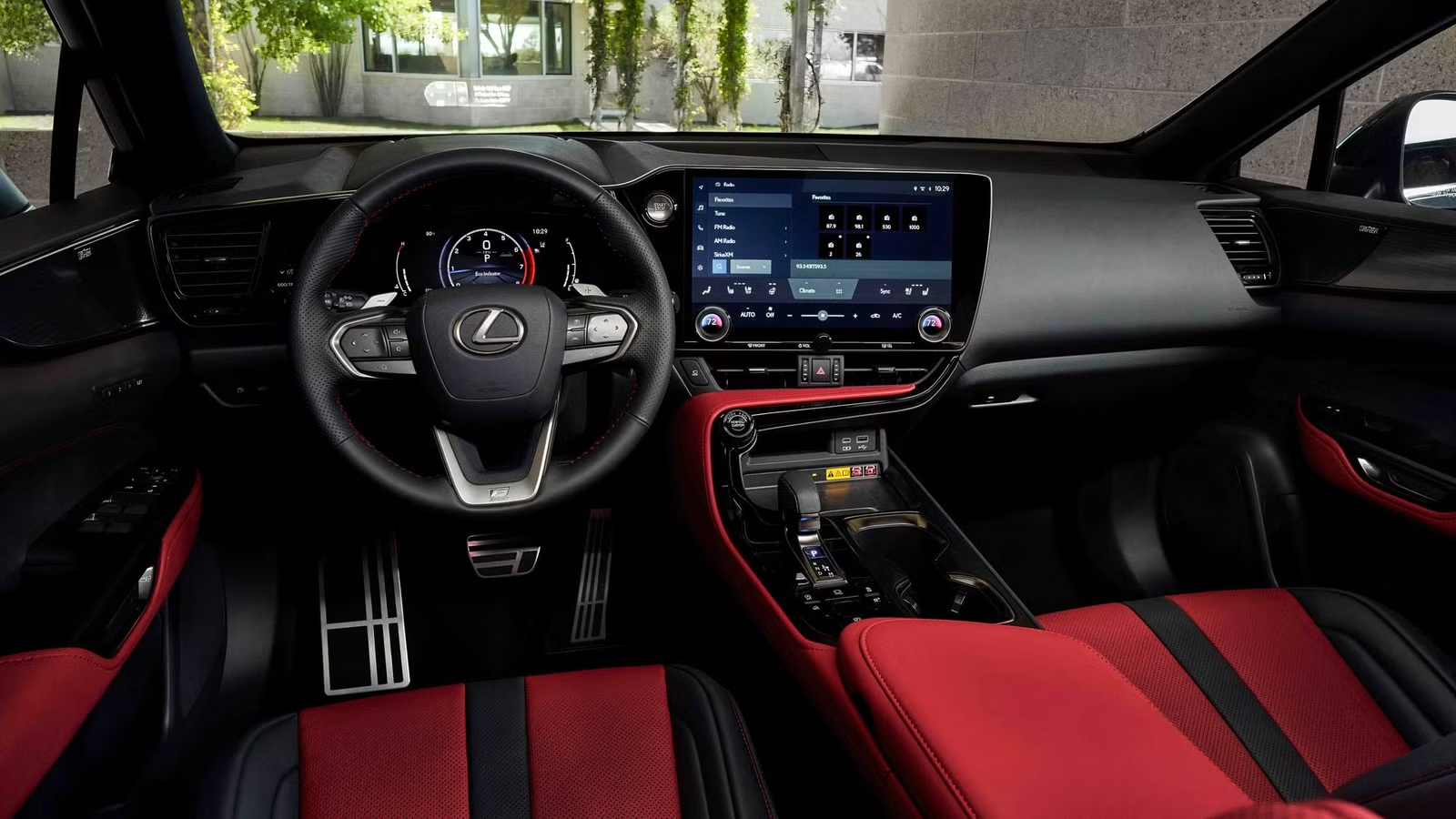
In keeping with its premium positioning, the NX had an extensive list of safety features, combined with a luxurious and technology-laden cabin. It wasn’t perfect, though, with the infotainment system relying on a Remote Touch Interface (RTI) touchpad system that set out to replace the joystick-like controls found in other Lexus models.
The touchpad attracted considerable criticism for its awkward operation, lack of accuracy and inconsistent sensitivity. Fortunately, it was replaced by a touchscreen system for the second-generation model launched for the 2022 model year.
Although sportier than the larger RX, the NX couldn’t quite match the BMW X3 and Audi Q5 in outright performance or handling, but its safety credentials were top tier. The NHTSA awarded the 2015 NX 200t a five-star overall safety rating, and it was selected as a Top Safety Pick+ by the IIHS.
Keeping Up With The Competition

In 2018, the NX received several upgrades, and the NX 200t was renamed NX 300 but retained the same 235 hp 2.0-liter turbo engine.
The second-generation NX was launched for the 2022 model year. Along with a refreshed design and improved interior, the NX gained four distinct powertrain options, starting with the NX 250 with a 203 hp 2.5-liter naturally aspirated four-cylinder engine. A 2.4-liter turbo unit was developed for the NX 350, producing 275 hp and 317 lb-ft, with a claimed 0–60 mph time of 6.6 seconds.
For hybrid customers, Lexus offered the NX 350h AWD with a total system output of 240 hp, or the range-topping 304 hp NX 450h+ plug-in hybrid that could sprint to 60 mph in a claimed 6.0 seconds.
Legendary Lexus Reliability

Lexus has consistently been one of the industry benchmarks for quality and reliability. It has led the JD Power overall vehicle dependability ratings 22 times since 2000, including four consecutive years from 2023 to 2026. Over the past two years, Lexus scored between 104 and 151 problems per 100 vehicles, versus the industry average of over 200.
The NX has been highly rated too, with a consumer-verified JD Power 100-Point Score of 84 out of 100 for 2026, placing it third behind the Tesla Model Y (87) and Porsche Macan (85), and equaled by the Jaguar F-Pace.
It was listed by Consumer Reports as one of the 10 most reliable vehicles of 2024 and 2025. One of the standouts of the Consumer Report rankings is that the Lexus NX costs significantly less to maintain than the average luxury SUV for the first 10 years of service. It also has a much lower chance of requiring a major fix during that period.
Hybrid-Only 2027 Range, End of The Turbo Four

Lexus announced its new NX range for 2027 in September of this year. Along with a long list of design and feature upgrades, the big news is that only two hybrid variants will be available, both powered by an updated 2.5-liter naturally aspirated four-cylinder engine.
The NX 350h now has a total system output of 244 hp with more electric power assistance, while the NX 450h+ plug-in hybrid gets a bump to 324 hp and an estimated pure EV range of 45 miles, up from 37 miles. Prices are expected to range from around $48,000 for the base NX 350h up to $60,000 for the top-spec NX 450h+.
That brings the curtain down on the turbocharged four that helped define the NX more than a decade ago. However, for buyers seeking a sophisticated compact luxury SUV without the complexity of a hybrid powertrain, the NX 350, along with the earlier NX 300 and NX 200t, makes a compelling case. Better still, opting for a used example can deliver substantial savings over the 2027 models.
Great Value As Used Car Purchase
According to Kelley Blue Book, the 275 hp NX 350 (2022-2025) currently commands between $30,300 and $38,500, leaving buyers with savings of $10,000 to $17,000 compared to a new NX 350h. The earlier NX 300 (2018–2021) is less than half the price of a new example (ranging from $19,350 to $23,100), while the original NX 200t can be picked up for between $15,500 and $17,000. Naturally, mileage, condition and specification will influence individual asking prices, with the F SPORT models typically carrying a higher price tag.
While the latest NX range reflects Lexus’s increasingly electrified direction, that doesn’t necessarily make it the most appealing choice for every buyer. There’s still plenty to be said for the simplicity and familiar character of a conventional turbocharged gas engine, particularly when it comes packaged in a well-built, comfortable, and refined luxury SUV.
The NX 350 is the sweet spot for those wanting more contemporary performance and technology, while the NX 300 and original NX 200t offer even more affordable entry points. They offer something increasingly difficult to find in a new-car showroom: a traditional gas-powered luxury experience, without the premium price tag. Add in the exceptional reliability and low running costs Lexus is renowned for, and sometimes, that’s exactly what makes a used car worth buying.
Sources: Lexus, Consumer Reports, Money Digest, JD Power, Kelley Blue Book

Related posts




Latest Post


No Comments