
The American Sedan That Was Faster Than Most Muscle Cars
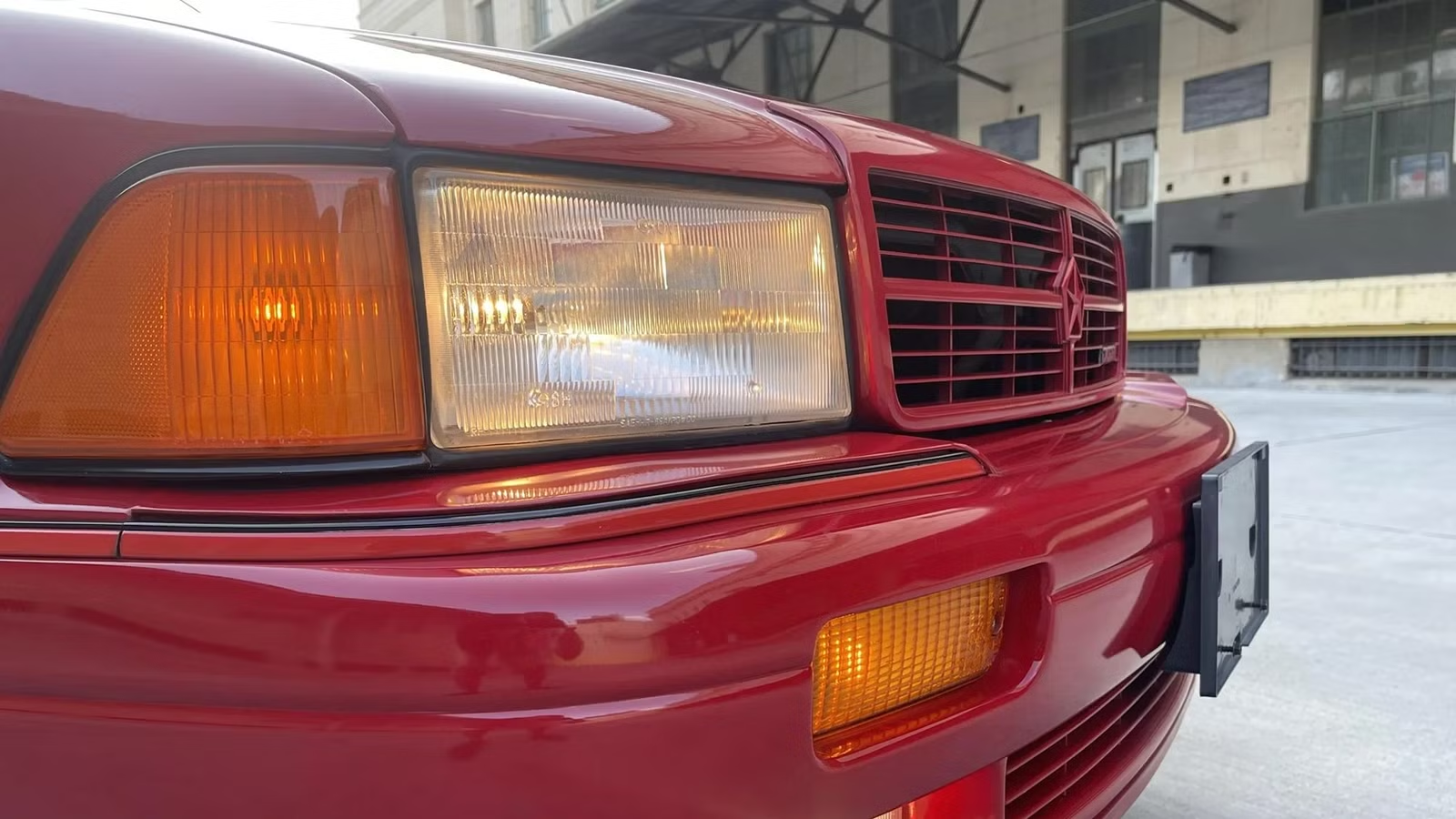
In the 1990’s, if you wanted to rule the asphalt, you bought a Fox-body Mustang GT or a Camaro Z28. These were the flag-bearers of muscle-car performance. Nobody would have imagined a threat to drop on these machines from something that looked extraordinarily vanilla, like a boxy, upright three-box sedan that looked like something a high school teacher would drive daily. But that is exactly what happened: a completely unassuming family car didn’t just keep up with Detroit’s finest V8s but beat them in a straight line. A humble front-wheel-drive car completely redefined the domestic performance scene.
The Downfall Of Traditional American Muscle Car Culture
By the early 90s, traditional American muscle cars had hit a technical ceiling, constrained by choking emissions regulations and aging architecture. Legendary powerplants like Ford’s 5.0-liter High Output V8 and Chevrolet’s 5.7-liter Small Block were pushed to their limits; they were heavy and becoming outdated. The muscle car had become visually aggressive yet mechanically stagnant, leaning on heritage rather than genuine innovation.
As a result, the early-90s pony cars’ performance was very modest, with the Mustang GT and Camaro Z28 producing between 225 and 245 horsepower. Still, this power had to push the heavy 3,300-pound steel mass through an ancient pushrod system and sluggish four-speed automatics or clunky 5-speed manuals. Acceleration was brisk off the line thanks to the V8’s low-end torque, but the engines choked at the top end.
This technical stagnation was at its peak in Detroit. And nothing could have challenged the mythical status of a rear-wheel-drive V8 on the drag strips and on the road. But true innovation, power-to-weight efficiency, and optimized dynamics were routinely ignored. This led to a massive blind spot in the muscle car space.

Rewriting The Rules Of Engagement Without A V8 Engine

During the early 1990s, Detroit found itself in a tight spot. The domestic automotive space was being reshaped by high-revving, technologically advanced imports from Japan and sophisticated sedans from Europe. And Detroit’s traditional answer of slapping a bigger engine was starting to look outdated.
Chrysler had a radical idea for its performance car. Instead of building a bespoke, expensive sports car to battle the high-tech imports and the American V8s, they chose to work with an architecture they already had: a humble, front-wheel-drive sedan. They planned to inject it with world-class performance. So they could rewrite what power meant on the streets with a proper sporty car.
They did not set out with the goal of building a car that looked fast; instead, the goal was to build a machine fast enough to take on the pony cars while remaining affordable and accessible to the average enthusiast. And what Chrysler came up with exactly achieved that objective.
The 1991 Dodge Spirit R/T: The Ultimate 90s Sleeper Car

The 1991 Dodge Spirit R/T. At first glance, it would look exactly like a domestic commuter car. As you start to look closely, you could see the subtle differences, like the rear decklid spoiler, a body-colored grill, and 15-inch cast-aluminum wheels, but it was when you looked past the visuals that you saw the real brilliance of the Spirit R/T. The mechanical masterpiece hidden underneath its hood shook the domestic performance car space.
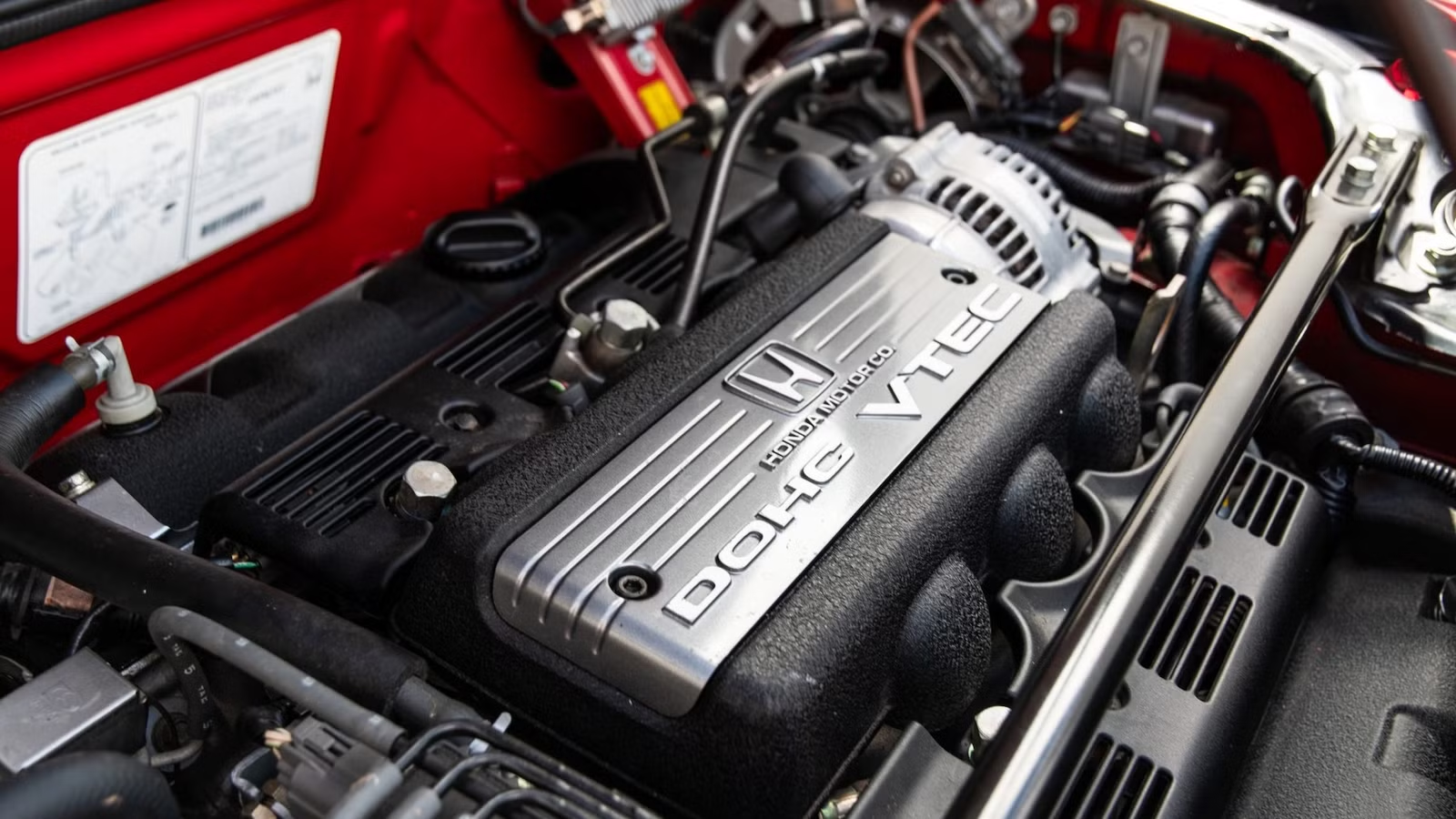
Chrysler went across the Atlantic to collaborate with the F1 engineers at Lotus Cars. They tasked Lotus with redesigning the cylinder head of Chrysler’s 2.2-liter inline four engine block. The British engineering firm developed an all-new aluminum alloy 16-valve dual overhead camshaft (DOHC) cylinder head featuring a high-airflow cross-flow combustion chamber. This configuration eliminated any airflow restrictions and allowed the engine to breathe efficiently throughout the rev range. The engine was paired with a liquid-cooled Garrett TB03 intercooled turbocharger with 11 psi of boost. This combination, dubbed the Turbo Three, produced an astonishing 224 horsepower at 6,000 RPM and 217 lb-ft of torque at 2,800 RPM.
When Car and Driver tested the Dodge Spirit R/T, the numbers sent a shockwave straight through Dearborn and Bowling Green. Going from 0 to 60 MPH in just 5.8 seconds, it completely outpaced the 1991 Ford Mustang, which required 6.1 seconds to do the same. The Spirit R/T ran the quarter mile in 14.5 seconds at 97 MPH, easily gapping the Mustang 5.0 and the Chevrolet Camaro Z28 down the drag strip. It crossed the line three-tenths of a second faster than the V8 muscle car benchmarks of its era, making it the fastest sedan made in America.
The Visceral, Unfiltered Reality of Driving an R/T on the Limit

Beyond the spec sheet, the Spirit R/T had raw, unadulterated mechanical dynamics. Power was sent to the front wheels via a heavy-duty New Process Gear A568 5-speed manual transmission featuring high-strength gear sets supplied by Getrag. This was the only gearbox available, which made the Spirit R/T a dedicated enthusiast-focused car.
The Lotus-designed head allowed the turbo to spool up aggressively at 2,800 RPM; the sudden influx of torque required precise driver inputs. And total focus was required to prevent excessive wheel spin and torque steer while dumping the clutch and launching the car. It forced the driver to be an active participant at the edge of adhesion, turning every straight-line pull into a visceral experience.
To balance this explosive power on a front-wheel-drive car, Dodge outfitted the R/T with a dedicated performance-tuned suspension system with stiffer spring rates, re-valved struts, and heavy-duty front and rear anti-roll bars. Braking duties were handled by vented four-wheel disc brakes that provided firm stopping power. As the turbocharger spooled up and the car came on boost, the quiet-looking car turned into a quick little rocket, which needed to be tamed and kept on a straight line.
The Lasting Legacy of America’s Greatest Factory Sleeper Sedan

The Dodge Spirit R/T remains a unique moment in American automotive history, as it proved that raw performance doesn’t need to be wrapped up in big muscle and a flashy visual package. It was an engineering win that focused every dollar on developing mechanical capabilities rather than on marketing fluff.
With only 1,208 units produced in its initial 1991 run, followed by an incredibly scarce 191 units in 1992, the Spirit R/T remains one of the rarest and most intensely sought-after cars on the collector’s market with those in the know. It stands as a testament to an era when domestic manufacturers took massive technical risks and blended British and American engineering and technology. The Spirit R/T didn’t care about the spotlight; it let its Lotus-engineered heart do the talking. It proved that a sleeper sedan can not only take on the best of American muscle but also beat it.
Source: Car and Driver, Hemmings, Hagerty, Bring a Trailer

Related posts






Latest Post


No Comments