
Jaguar Built Only 1,855 V12 Coupés Then Quietly Killed The Project
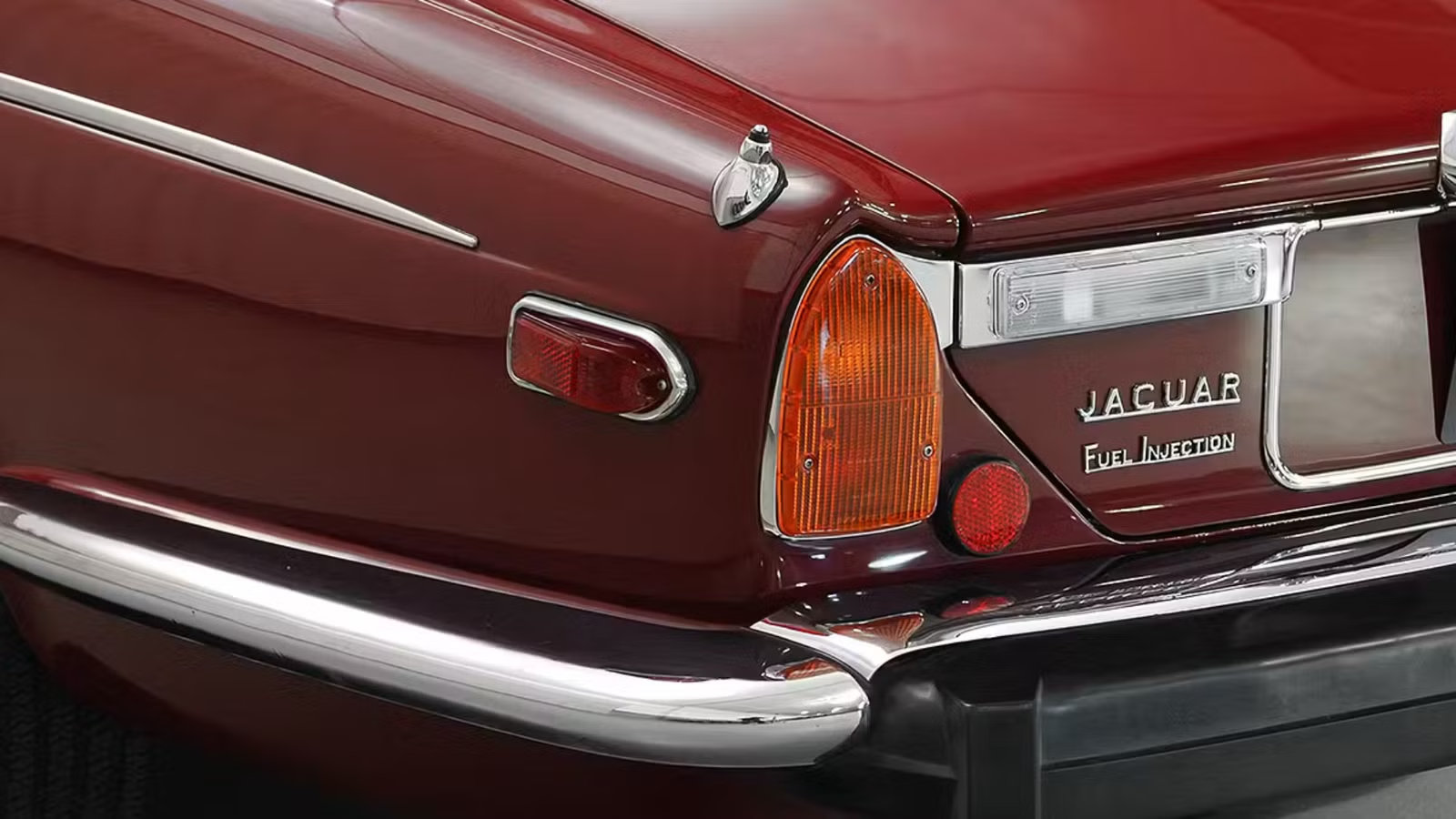
Someone at Jaguar looked at a roof that kept cracking its own paint and decided the solution was to cover it up with vinyl. That wasn’t a design choice — it was damage control dressed up as a luxury feature, approved at the factory and shipped to customers on every single car that left the line.

This was the mid-1970s, and British Leyland — Jaguar’s cash-strapped parent company — didn’t have the budget, the time, or apparently the appetite to fix the underlying problem. So it shipped the workaround instead.
The result was one of the most beautiful coupes Jaguar ever built: a car with a structural secret poorly hidden, produced in small numbers, then quietly discontinued before most buyers ever knew it existed.
Jaguar Spent Years Building A Car That Wasn’t Ready

The idea had been in motion since the late 1960s. Jaguar’s engineers had always intended a two-door version of the XJ sedan, and by the time the Series II arrived in 1973, the coupe was formally unveiled at the London Motor Show that October. Customers were told it was coming. What they weren’t told was that it wasn’t ready.
The car that appeared at Earls Court was essentially a show model with serious unresolved engineering problems underneath. The pillarless hardtop design — no B-pillar between the front and rear windows — looked spectacular, but it created a cascading set of problems that Jaguar’s engineers spent the next two years trying to solve. Sealing the frameless doors at speed was one. The complex rear quarter-windows, which had to drop electrically down into the door panels to maintain the uninterrupted glasshouse profile, took months of development on their own and further pushed back the launch.
The platform itself added another constraint. The coupe was built on the short-wheelbase Series II XJ body — the only model in the XJ lineup to keep the shorter shell after Jaguar moved all the saloons to the longer wheelbase. That decision locked the engineers into a tighter packaging envelope for every modification the coupe required. By the time the first customer cars arrived in 1975, the coupe was already running two years behind schedule. The problems, it turned out, were only just beginning.
The Most Underrated Mid-Engined Supercar Ever Produced
This supercar was virtually unrivaled when it arrived on the market…but no one wanted it.
The Vinyl Roof Was A Factory Cover-Up

The car was the Jaguar XJ-C, and every single one that left the factory came with a vinyl roof fitted as standard. Jaguar never officially advertised this as anything other than a premium feature — and in fairness, it looked the part. But period accounts and decades of enthusiast documentation tell a different story about why it was there.
Without a B-pillar to hold the roofline rigid, the body flexed. The paints available to Jaguar in the mid-1970s couldn’t handle that movement — they cracked. The vinyl covering, which ran the full length of the roof, concealed those cracks from the customer. Every XJ-C shipped that way. It’s worth noting that while this is widely accepted across enthusiast communities and plausible on engineering grounds, it has been questioned by at least one source — and reportedly, one car left the factory without a vinyl roof, built for a Jaguar PR executive.
But the fact that modern paints don’t suffer the same problem — and that restorers today routinely strip the vinyl when respraying — suggests the structural movement was real, even if the exact factory reasoning was never formally documented.

The door construction told a similar story about how much improvisation went into this car. The elongated coupe doors were fabricated by grafting two standard XJ front door shells together under a single outer skin. The weld seams are still visible under the interior panels on surviving cars today. The vinyl roof wasn’t an isolated fix, but part of a pattern.
The Fastest Car In The World In 1989 That Has Been Lost To History
It was the fastest production car in the world in 1989—then the world moved on. Today, it’s a forgotten masterpiece hiding in plain sight.
1,855 V12 Coupes Built, And The Pricing Killed It Anyway

The final V12 XJ-C rolled off the production line on November 8, 1977. Jaguar Heritage records put total production across all variants at 10,426 cars — 6,487 six-cylinder Jaguars, 1,677 six-cylinder Daimlers sold as the Sovereign Two-Door, 1,855 V12 Jaguars, and 407 Daimler Double-Six Two-Door models. The V12 Jaguar figure is consistent across every credible source: 1,855 cars, full stop.

The annual production breakdown tells its own story. Jaguar built 821 V12 coupes in 1975, the car’s first full year, then 663 in 1976, 329 in 1977, and just 31 in 1978. The market was losing interest faster than British Leyland was losing money, and British Leyland was losing a lot of money.

The pricing made the problem worse. When that last V12 XJ-C left the factory, it was listed at £11,755 — roughly $105,700 in today’s money. The XJ12 sedan, which was longer, had four doors, and carried the same engine, cost £10,668 at the time, equivalent to around $95,900 today.
Buyers who wanted a V12 Jaguar were being asked to pay a premium for less practicality and, as it turned out, less structural integrity. British Leyland was a loss-making conglomerate already looking for costs to cut, and the XJ-C — the only model in the entire lineup still riding the old short-wheelbase platform — was an obvious place to start. The program didn’t survive.
The World’s Longest-Produced V12 Is Also One Of The Most Unreliable
This 12-cylinder engine ruled for over two and a half decades, powering iconic sports cars and luxury sedans. It was smooth and famously unreliable.
Jaguar Tried Racing It, And That Didn’t Go Well Either

While British Leyland was struggling to sell the XJ-C to road car buyers, it was also trying to race one. Broadspeed Engineering developed a competition version of the V12 coupe for the European Touring Car Championship, with Derek Bell driving at the car’s debut at the RAC Tourist Trophy at Silverstone in September 1976. Bell was fast enough in qualifying — he lapped nearly two seconds quicker than the European Champion-elect in the leading BMW — but the car didn’t finish the race.
That became the recurring theme. The Broadspeed XJ-C was genuinely rapid when it ran cleanly, but reliability issues meant it rarely did. The program’s best result across two full seasons was a second place for Bell and Andy Rouse at the Nürburgring in 1977. By the end of that season, BMW had accumulated 160 championship points to Jaguar’s 37, and British Leyland pulled the plug before the season was even over.
The consequences lasted well beyond the XJ-C itself. When Tom Walkinshaw Racing prepared a competition version of the XJ-S a few years later, British Leyland declined to back it with factory support.
12 Most Reliable Jaguars To Buy Used
While it may sound like an oxymoron, reliable Jaguars do exist. These are the best Jags for a hassle-free ownership experience.
Fifty Years Later, Someone Finally Finished The Job

The XJ-C that Jaguar built in 1975 was never quite the car it should have been. The V12 came only with a three-speed automatic gearbox, the body flexed enough to crack its own paint, and the brakes were adequate rather than impressive. Nearly 50 years later, a small number of specialists have been quietly correcting all three.
UK restomod shop Retropower built its first XJ-C commission — known as Project XJC430 — roughly a decade ago, then took on a second build, Project Portofino, at the end of 2023.
Tom Lenthall Ltd’s documented build, named ‘Emma,’ replaced the original 4.2-liter six with a supercharged inline-six producing around 370 hp, fitted to a Getrag 290 five-speed manual gearbox and running X300-era subframes with Brembo brakes from the XJR. The build ran to more than 400 hours of specialist labor and was documented across ten YouTube episodes before the car sold at auction.
Harry Metcalfe, founder of EVO magazine, acquired his XJ-C as a project in 2014 and spent years rebuilding it with a five-speed manual conversion and a comprehensive mechanical overhaul. The resulting car drew nearly six million YouTube views and eventually sold at auction.
Carlex Design in Poland took the structural problem head-on, fitting a large cross brace in the rear seat area — the fix that actually addressed what Jaguar had covered with vinyl. The theme across every build is the same: a manual gearbox, a stiffened structure, modern stopping power. A checklist Jaguar drew up in 1975 and never finished.
Sources: Jaguar, Hagerty, XJC Register, Iconic Auctioneers, Bonhams

Related posts


Latest Post


No Comments