The Affordable Sedan That Feels Like An Entry-Level Lexus
8 minutes reading
Tuesday, 1 Sep 2026 13:01 0 57 autotech
Luxury cars are typically niche and low-volume sellers, with margins decreasing with each year that passes. Cars that operate in this segment often make for poor investments, with depreciation rates being among the worst across the entire car market.
As a result, there’s a lot of value in considering the more premium trims of functionally reliable mainstream sedans. Demand for more premium features across the new car market has exponentially increased recently, resulting in formerly budget offerings evolving into somewhat more luxurious cars.
The luxury car segment remains the cornerstone of the U.S. premium market. It serves as a critical benchmark for consumer confidence and high-end discretionary spending among affluent buyers. In Q1 2026, the segment’s performance was defined by a widening divergence between traditional internal combustion models and the electric vehicle sector. Lexus continues to assert itself as a prime contender for the U.S. luxury sales crown.
The marque generated 80,952 deliveries in the first quarter of 2026. Momentum strengthened through the first half of 2026, with Lexus accumulating 169,712 total sales. SUV demand remains the primary driver, recording 150,673 units through midyear, led by consistent gains for the RX crossover. Electrified models also represent a growing share of volume, accounting for nearly 42 percent of second-quarter deliveries. Passenger car volume experienced temporary friction due to the generational transition of the ES sedan, though strength across the crossover lineup absorbed most of the deficit.
This performance reflects a broader shift in consumer priorities across the U.S. luxury market. Demand is moving away from purely battery-electric vehicles toward hybrid powertrains and reliable crossover platforms. While European competitors encounter friction with aggressive EV transitions and model phase-outs, brands offering pragmatic, multi-pathway options sustain higher volume. Buyers prioritize proven hybrid reliability and versatile SUV utility over pure electrification. The strategy stabilizes sales amidst broader macroeconomic pressures.
How Toyota Refines Its Mainstream Offerings
Toyota
Toyota’s North American lineup has undergone a strategic transformation, pivoting toward a more aspirational identity by integrating premium materials and sophisticated technology into its top-tier grades. This evolution is most evident in the brand’s highest trims, which now feature high-grade leathers, advanced acoustic glass, and premium audio systems that rival dedicated luxury marques. By focusing on elevated interior aesthetics and refined driving dynamics, the brand has successfully captured a demographic of buyers seeking a sophisticated experience without the perceived pretension of a traditional luxury badge.
Crucially, this move upmarket has been executed without compromising the core mechanical integrity that underpins the brand’s reputation. By sharing global architectures and applying proven powertrain configurations across these premium trims, the manufacturer ensures that increased complexity does not undermine its industry-leading reliability or the exceptional value retention that remains a primary motivator for its customer base.
The Camry’s Upmarket Flagship Trims
An interior shot of the front of the cabin of the 2025 Toyota Camry XSE.Toyota
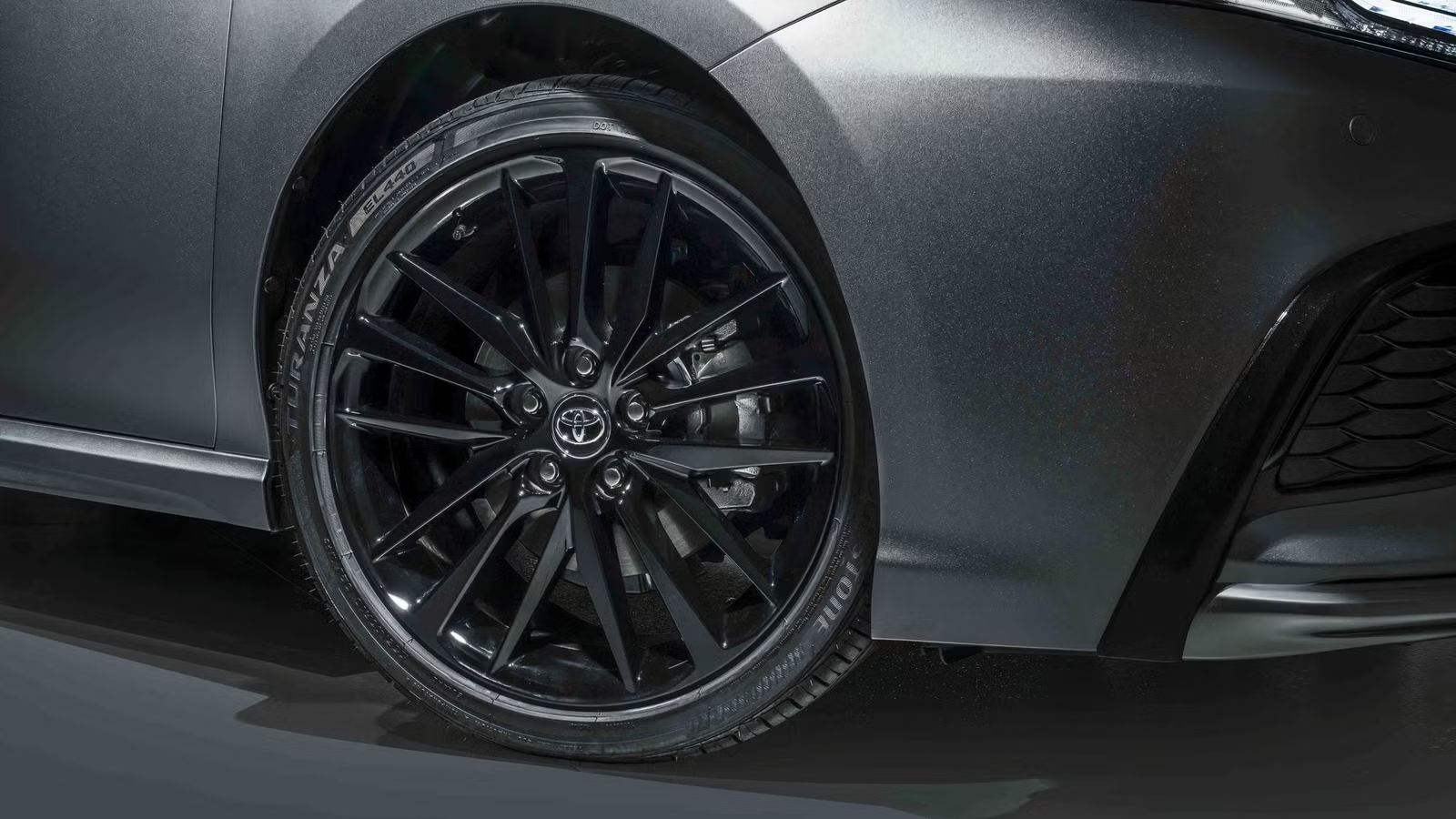
The most expensive Camry options are the XLE and XSE, priced at $34,800 and $36,000, respectively. On the exterior front, the XLE comes standard with heated and electrically adjustable door mirrors, LED exterior lighting, blacked-out exterior trimmings, and a dark metallic gray horizontal bar front grille. The standard wheel of choice is the 18-inch two-tone multi-spoke alloy set. The XSE falls in line with the same design, but with a more athletic approach. This includes dual chrome exhaust tips, racing-inspired gloss-black air curtains, color-keyed front-side canards, a sport mesh front grille and rear lower diffuser, and 19-inch smoked gray and black-finished alloy wheels.
2025 Toyota Camry XLE AWD Interior showing front cabinCraig Cole | TopSpeed
The interior is where these two trims start to feel a bit more special. Here you’ll find white ambient interior lighting, an auto-dimming rear view mirror with HomeLink, a wireless smartphone charger, and a collection of five USB ports located across the front and rear for charging and data transfers. Additional comfort features include dual-zone climate control, leather and microfiber-trimmed seats, front electrically adjustable seats with heating, and Toyota’s 12.3-inch digital instrument cluster. At the center of the dash, you get a 12.3-inch touchscreen infotainment system, including wireless Android Auto and Apple CarPlay. Visually, the XSE takes the same cabin and adds a layer of sportiness.
Premium Reliability At Its Best
Shot of 2026 Toyota Camry lineupToyota
In terms of depreciation, iSeeCars indicates that the model will lose $10,829 or 37.7 percent of its resale value after five years or 60,000 miles, which is a bit less than the average competitor in the midsize hybrid sedan segment.
J.D. Power gives the 2026 Toyota Camry model year an 82/100 consumer-verified overall score, including 80/100 for quality and reliability, 82/100 for the driving experience, 92/100 for resale, and 76/100 for the dealership experience.
This generation of the Toyota Camry currently holds a 4.2/5 owner review score on Edmunds, with key strengths being its reliability and manufacturing quality, driving experience, and fuel efficiency. It does lose some points for offering uncomfortable seating and a poor standard sound system.
Impressive Long-Term Ownership Appeal
Front 3/4 action shot of 2026 Toyota Camry in blue being drivenToyota
The Camry’s impressively low maintenance and long-term running costs are a major reason why so many American consumers continue to back it as their daily driver. According to Edmunds‘ True Cost To Own calculator, you can expect a new front-wheel-drive 2026 Toyota Camry XLE to cost you an additional $37,085 over the course of five years and 60,000 miles. This includes $14,591 worth of depreciation. You’ll also find yourself spending $3,290 on maintenance, and $601 on repairs. Fuel is also likely to cost you around $4,985.
According to CarEdge, you can expect to spend $36,433 on your Camry over the same period, which includes $14,274 on depreciation, $4,530 on fuel, and $1,512 on maintenance. iSeeCars gives the Camry range an 8.2/10 overall score, including 8.1/10 for reliability, 8.6/10 for retained value, and 8.0/10 for safety. The publication indicates that the model will run for 13.1 years or 171,785 miles without encountering any noteworthy mechanical issues, together with a 31.7 percent probability of hitting 200,000 miles.
The Added Benefit Of Low Fuel Consumption
Rear 3/4 action shot of 2026 Toyota Camry in red being drivenToyota
The main reason why you’d even be considering a new Toyota Camry is for its impressively low fuel consumption figures. Based on the EPA’s testing of the model, the new-generation midsize sedan excels at optimizing both range and fuel consumption. The front-wheel-drive XLE and XSE are the most preferable, boasting a 46 MPG combined fuel consumption estimate and a 598-mile range claim. The all-wheel drive XSE sits at the opposite end of the spectrum, with its 43 MPG combined fuel consumption estimate and 559-mile range figure.
Performance Figures Reflect Its Mainstream Status
Close-up shot of 2026 Toyota Camry engine bayToyota
The current-generation Camry range carries over the previous-generation model’s trusted naturally aspirated 2.5-liter four-cylinder Atkinson-cycle engine, which produces 184 horsepower and 163 pound-feet of torque in isolation.
The front-wheel-drive model features a pair of electric motors that generate a combined 134 hp and 153 lb-ft. Toyota doesn’t give us a combined torque figure, but it confirms that it limits peak power to 225 hp.
The all-wheel drive model adds a third electric motor to the rear axle, producing 40 hp and 62 lb-ft, which increases the peak output to 232 hp.
Why The Camry Remains So Important In The U.S.
Front view of 2026 Toyota Camry in red parkedToyota
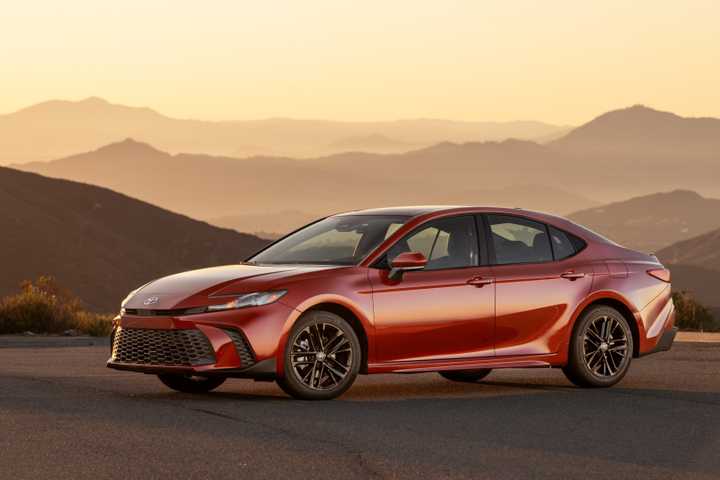
The 2026 Toyota Camry remains a cornerstone of the American automotive sedan segment, functioning as a primary volume-seller for the Japanese company. This is despite Toyota adopting an SUV and crossover-focused strategy. Toyota markets this model to a broad demographic of pragmatic buyers, including daily commuters and growing families who prioritize long-term value, reliability, and low maintenance costs over the rugged image of an SUV.
Toyota has pivoted the current-generation model’s strategy to focus more on electrification by adopting a hybrid-only powertrain offering. This evolves the Camry into a leader in efficiency and environmental consciousness without sacrificing its core reputation for durability. Toyota also manages to maintain a competitive entry price and offer optional all-wheel drive across every trim level.
How To Optimize The 2026 Toyota Camry’s Long-Term Reliability
Front 3/4 action shot of 2026 Toyota Camry driving on roadToyota
You must maintain the 2026 Toyota Camry at specific intervals to ensure optimal vehicle reliability. The manufacturer schedules service every 5,000 miles or six months. The first interval requires a tire rotation, fluid level adjustment, and multipoint inspection. You need an engine oil change and a new cabin air filter every 10,000 miles. Major service intervals occur at 15,000 and 30,000 miles. These milestones require new engine air filters alongside intensive brake and suspension checks. RepairPal reports an average annual maintenance cost of $388 for the Camry.
The standard ToyotaCare program covers all scheduled maintenance costs for the first two years or 25,000 miles. Toyota offers a very comprehensive online parts catalog for all of its models, but unfortunately, it does not list the 2026 Camry’s replacement battery pack, so there’s no way for us to tell you how much this part will cost you directly from the manufacturer. Based on online testimonials and information provided by some dealers, you can expect to pay somewhere around $3,000 to have the HEV battery pack replaced when the time comes.
Base Trim Engine
2.5-liter Four-Cylinder Hybrid
Base Trim Transmission
CVTi-S CVT
Base Trim Drivetrain
Front-Wheel Drive
Base Trim Horsepower
184 HP @6000 RPM
Base Trim Torque
163 lb.-ft. @ 5200 RPM
Make
Toyota
Model
Camry
Segment
Midsize Sedan
Sources: Toyota, Edmunds, iSeeCars, J.D. Power, and the EPA.















No Comments