The Affordable Performance Car That Feels Built By Enthusiasts
9 minutes reading
Monday, 7 Sep 2026 02:30 0 50 autotech
Trust the Japanese brands to create a vehicle that is both affordable and packed with fun and performance. Of course, affordable in performance car terms doesn’t mean it’s priced alongside America’s most affordable cars. All that performance costs money to make and develop, but relative to what it offers, the performance car in today’s article is more affordable than some of its competitors.
At the same time, this is a performance car that wasn’t simply developed for the sake of filling a niche. Instead, this performance car was built by a team of passionate engineers who are on a mission to redefine what its humble nameplate stood for. This is the story of a nameplate that was once attached to a performance car, but was more associated with practicality for most of its history.
How The World’s Best-Selling Econobox Became A Driver’s Car Again
Front 3/4 action shot of 2007 Toyota Corolla LEToyota
The current world’s bestselling car is the Tesla Model Y, but the bestselling car of all time since record-keeping began is the Toyota Corolla. The Corolla was born in 1966, and with more than 50 million units sold worldwide, it’ll take a while before any other car brand reaches this prestigious status. Reliability, affordability, and ease of use were the primary reasons for its popularity, but through the mid-1990s, the Corolla was also known for sportiness.
Corolla’s Sporting History
High-angle front 3/4 shot of 1985 Toyota AE86 Sprinter Trueno GT in black parked in parking lotBring A Trailer
Through the mid-1990s, a percentage of buyers wanted a Corolla specifically for the way it drove. The most famous Corolla of them all would probably be a model dressed in a two-tone black and white paint scheme that was prominently shown in an anime called Initial D. This prominent version of the Corolla was known as the AE86, and it’s part of the E80 lineage.
The range-topping GT-S became a sensational icon, with its 4A-GEC 1.6-liter four-cylinder easily becoming one of Japan’s most well-loved engines. The AE86’s lightness and rear-wheel drive (RWD) platform made it an affordable but ultra-fun sports coupe, and it would define the so-called “import car” culture in the United States in the coming decades.
1995 Toyota Corolla rear 3/4Bring A Trailer
This was followed by the E90 generation of the Corolla. The Corolla GT-S would live on with the AE92, wherein its 4A-GE engine would receive revisions that bumped its power output to 135 horsepower—for such a small engine without any use of forced induction.
How Three Decades Of Playing It Safe Nearly Killed The Corolla’s Soul
2013 Toyota Corolla front 3/4 shot parkedToyota
Unfortunately, beginning with the E100 or the seventh-generation Corolla, development focused less on the vehicle’s sportiness factor. The E100 grew bigger and wider, while its curvaceous lines and reduced exterior panel count gave it a cleaner, more modern look. All-around independent suspension as standard also helped improve its ride.
The E100 was still quite a leap over the previous generation, but the E110 that followed it was conservatively developed as a result of Japan’s “Lost Decades” recession. The overall platform and chassis were carried over, resulting in a better car—albeit only incrementally. The conservative engineering continued for the following generations, especially since by 1997, the Corolla became the best-selling car of all time, surpassing the Volkswagen Beetle. The goal for the next few generations was to simply make the Corolla appealing enough for those who simply wanted comfort, reliability, and ease of use.
Rear 3/4 shot of 2016 Toyota CorollaToyota
Steering feel, handling, and engine performance were no longer priorities. For better or worse, this has made the Corolla the default vehicle choice for families, businesses, and even taxis and ride-hailing services. It wouldn’t be until 2017 that Toyota’s then CEO, Akio Toyoda, declared “no more boring cars” as a company directive, which resulted in an interesting chain of events that would change Toyota’s image in the coming years.
Corolla Goes GRrrr
2026 Toyota GR Corolla ariel shotToyota
It was 2018, and the current E210, or the twelfth-generation Corolla, would make its debut. From the way it looks, it’s clearly still a sensible car, but unlike before, it now comes with a sporty hatch. Even the sedan wasn’t too bad, either. It even has a slick six-speed Intelligent Manual Transmission (iMT), but Toyota was just getting started.
Why The GR Corolla Rolls Off A Rally Car Production Line, Not A Corolla One
2026 Toyota GR Corolla front shotToyota
The GR Yaris became a smash hit when it debuted in 2020, but it was a no-go for it to be sold in the United States. In 2022, Toyota would ultimately shatter preconceived notions about the Corolla with the debut of the GR Corolla hot hatch, a vehicle that was engineered by a team on a mission to change Toyota’s trajectory. The GR Yaris uses the Corolla hatch’s rear half already, so to build the GR-Four AWD, the 1.6-liter G16E-GTS three-cylinder turbo engine on top of the Corolla’s TNGA-C platform was a natural fit. The GR Yaris barely shared anything with the humble Yaris. It was a WRC rally car for the road, and because of that, it was an instant hit.
Put this formula into a template that contains rear doors, while also attaching it to a platform already homologated to United States regulations, and you’ve got a solid business case to create a hot hatch with loads of personality. The 1.6-liter three-cylinder was a deliberate choice, not only because it’s already in the GR Yaris, but its lightness helps keep its 3,200-pound weight in check. It’s not Miata-light, but it is quite light for an AWD hot hatch.
2026 Toyota GR Corolla rear badge close-upTopSpeed | Michael Frank
The GR Corolla was supposed to be revealed in 2021, but Akio Toyoda, also a racing driver, was not satisfied with the prototypes. It’s not even produced on the same production line as a standard Corolla. Instead, it’s produced in the “GR Factory” inside Toyota’s Motomachi plant, which has more manual assembly processes, though since May 5, 2026, GR Corollas for North America are produced in Burnaston, UK.
Sublime With Personality
2026 Toyota GR Corolla interior shot showing front cabinToyota
Take one for a spin, as many of the TopSpeed team have, and you’ll be enamored by how much Toyota has changed the Corolla’s personality. The GR Yaris has the luxury of being a true homologation special, but the GR Corolla isn’t based on a rally car. However, our team’s experience behind both cars tells us that you aren’t missing out on much. In fact, the GR Corolla ends up being more civilized and livable as a result of its bigger and thus more refined platform.
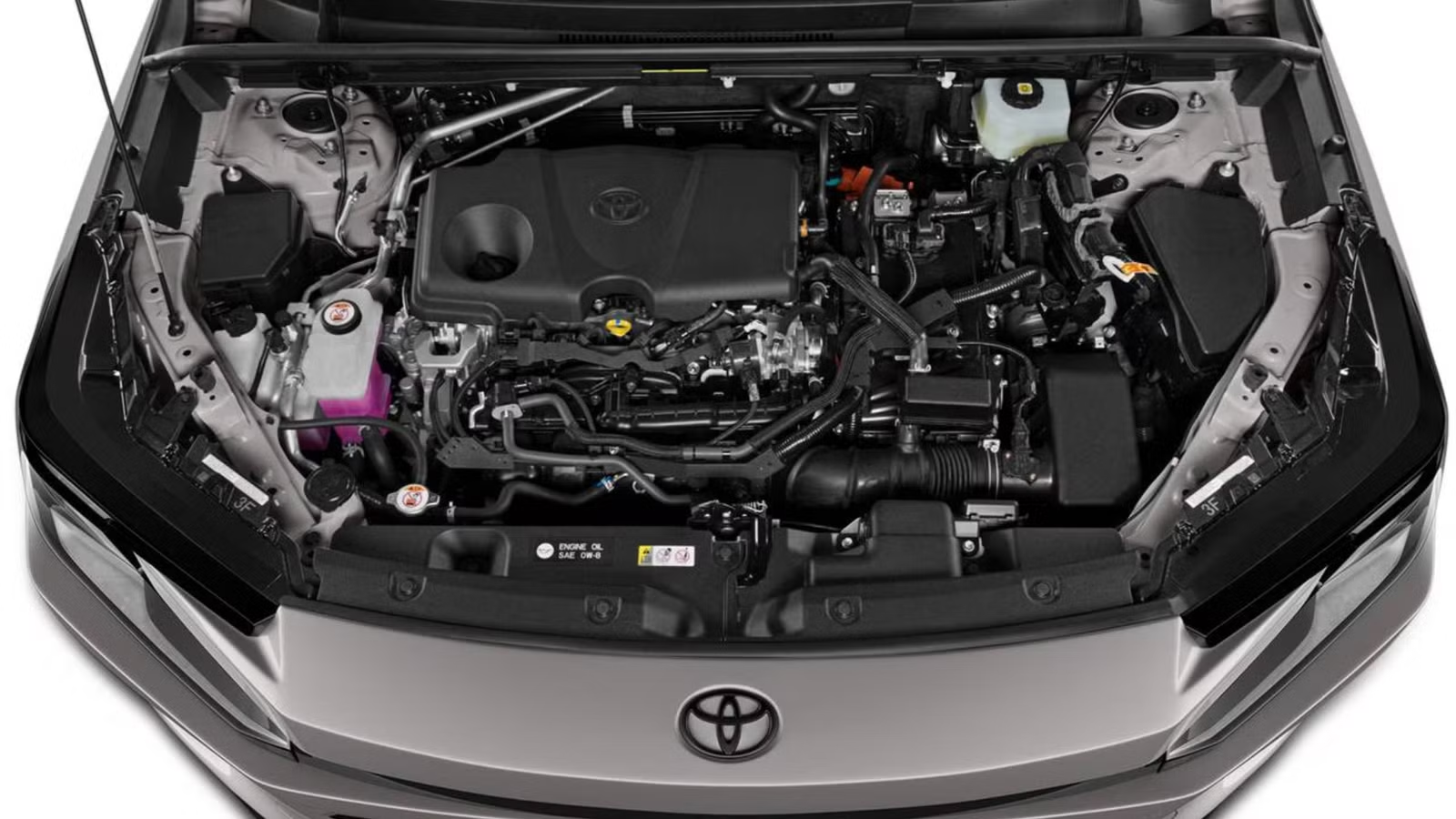
That uprated 1.6-liter turbo is brilliant. There are plenty of turbo whistles to remind you that it’s producing a diesel-like 26.3 PSI of boost. The six-speed manual’s notchy feel gives tactile confidence, and every shift feels precise to the hands. The chassis tuning is brilliant—even if it doesn’t have the adaptive dampers of a Civic Type R.
It’s surefooted, thanks to the grippy AWD with front and rear limited-slip differentials (LSD). Since it doesn’t have adaptive dampers, the GR Corolla can sometimes feel a bit rough on the edges when it comes to comfort, and combined with the less premium interior, the Civic Type R is the more polished car. Yet, this is also what gives the GR Corolla its personality. It also has a lower starting price than the Civic Type R, which should help you in your hot hatch considerations.
Making Ever Better Cars
With the debut of the GR Corolla, one might think Toyota is done shedding its boring image, only to realize it is still pulling out the big guns. The GR Corolla continues to be improved upon, and you don’t necessarily have to get the highest trim to experience one of the best hot hatches of our time.
Continuous Improvement Starts At $40,520
2025 Toyota GR Corolla action shot in sandToyota
Skip the $46,565 Premium Plus and its forged carbon roof, red interior stitching and trims, heated steering wheel and seats, and JBL audio, and you still get the fundamental GR Corolla experience and all the brilliance associated with it. For an AWD hot hatch, that sounds like a good deal, particularly next to the Volkswagen Golf R and the FWD Civic Type R. Sure, you’ll feel the price difference in the GR Corolla’s less premium interior, but if a raw and visceral driving experience is the priority, the GR Corolla is the value pick in the hot hatch segment.
The GR Corolla received a mid-cycle facelift during the 2025 model year. This came with a slightly sportier exterior design, the addition of the new eight-speed automatic, as well as chassis enhancements. Rebound springs were added to the suspension to suppress inner wheel lift during dynamic driving. Even the rear coils and stabilizers were improved to boost ground contact response when turning. The trailing arm mounting point was raised to reduce rear squatting for a more controlled body, while for 2026, 45.6 feet of additional adhesives were added for improved chassis rigidity and rear grip. A new secondary air intake duct further improved cooling.
Or $64,360 For Peak Performance
2026 Toyota GRMN CorollaToyota
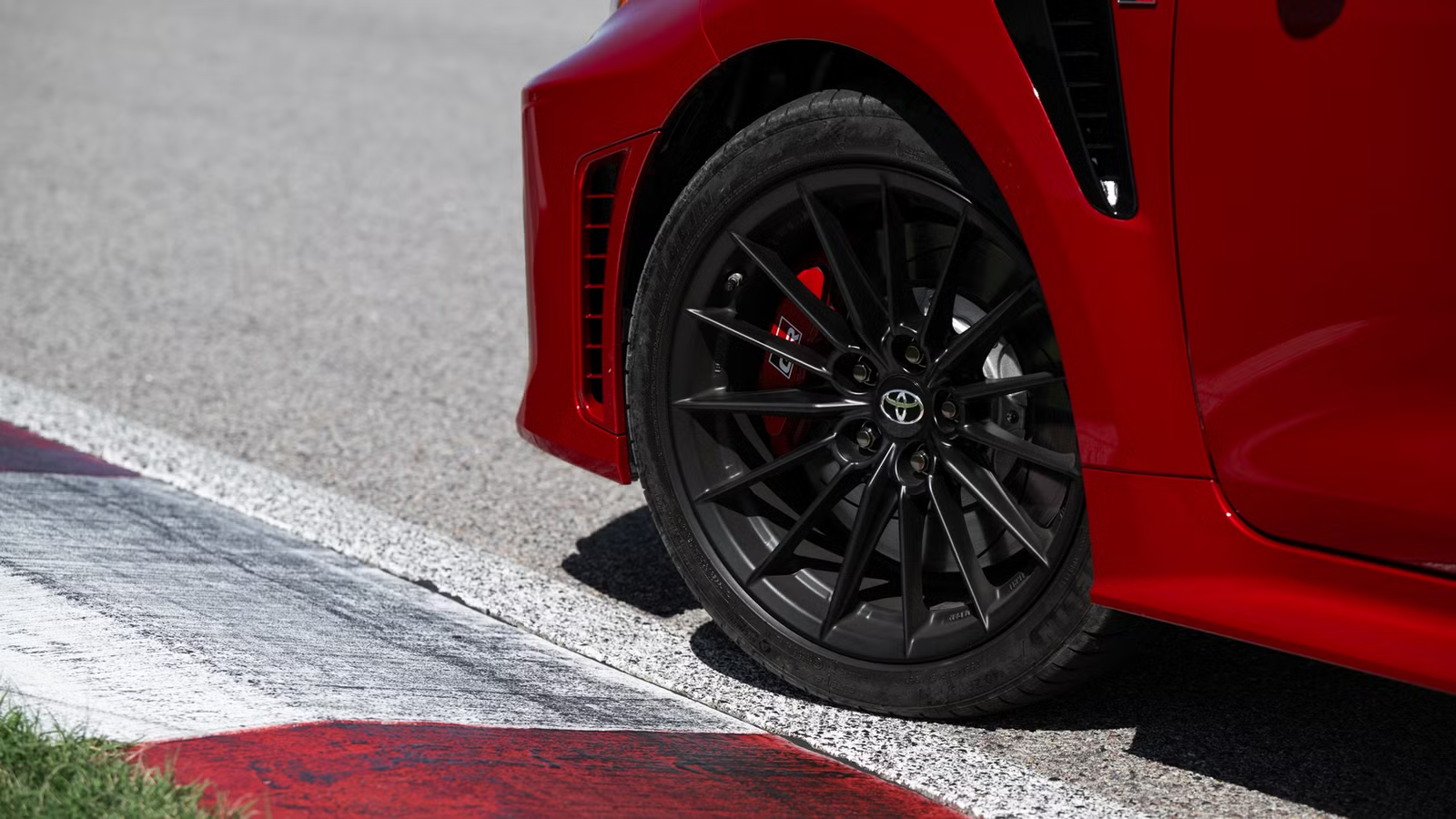
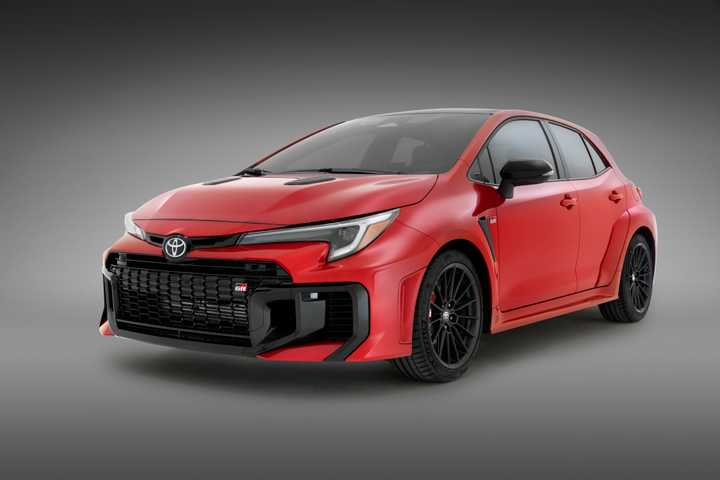
Now, we wouldn’t suggest spending more than sixty grand for what is still a Corolla, but if you want the pinnacle of Toyota’s engineering prowess, the GRMN Corolla might satisfy your needs. With a price tag of $64,360, it’s near the asking price of a GR Supra. Is it worth it? The limited nature of this model will probably attract some buyers. It all begins with its purposeful exterior. Air ducts have been added through the hood and fenders, while the front side spoilers and rear wing help keep the wheels planted on the ground. The rear wing can be adjusted to five degrees, and prospective buyers should note that rear seats have been removed entirely.
Built to endure the limits of the Super Taikyu race series in Japan, the GRMN Corolla now features an intercooler spray adapted from the GR Yaris. The GRMN Corolla also has front and rear monotube dampers with rebound springs and revised bump stops that have all taken into account the extreme dips and banks of the Nürburgring Nordschleife. Even the steering and GR-Four AWD system were revised. The GR-Four, in particular, was tweaked for improved rear torque distribution for enhanced stability. The GRMN Corolla is expensive, but it also represents Toyota’s relentless approach to making ever-better cars from lessons learned in racing.













No Comments