
The Forgotten Maserati That Beat Porsche And Ferrari To The Twin-Turbo Era
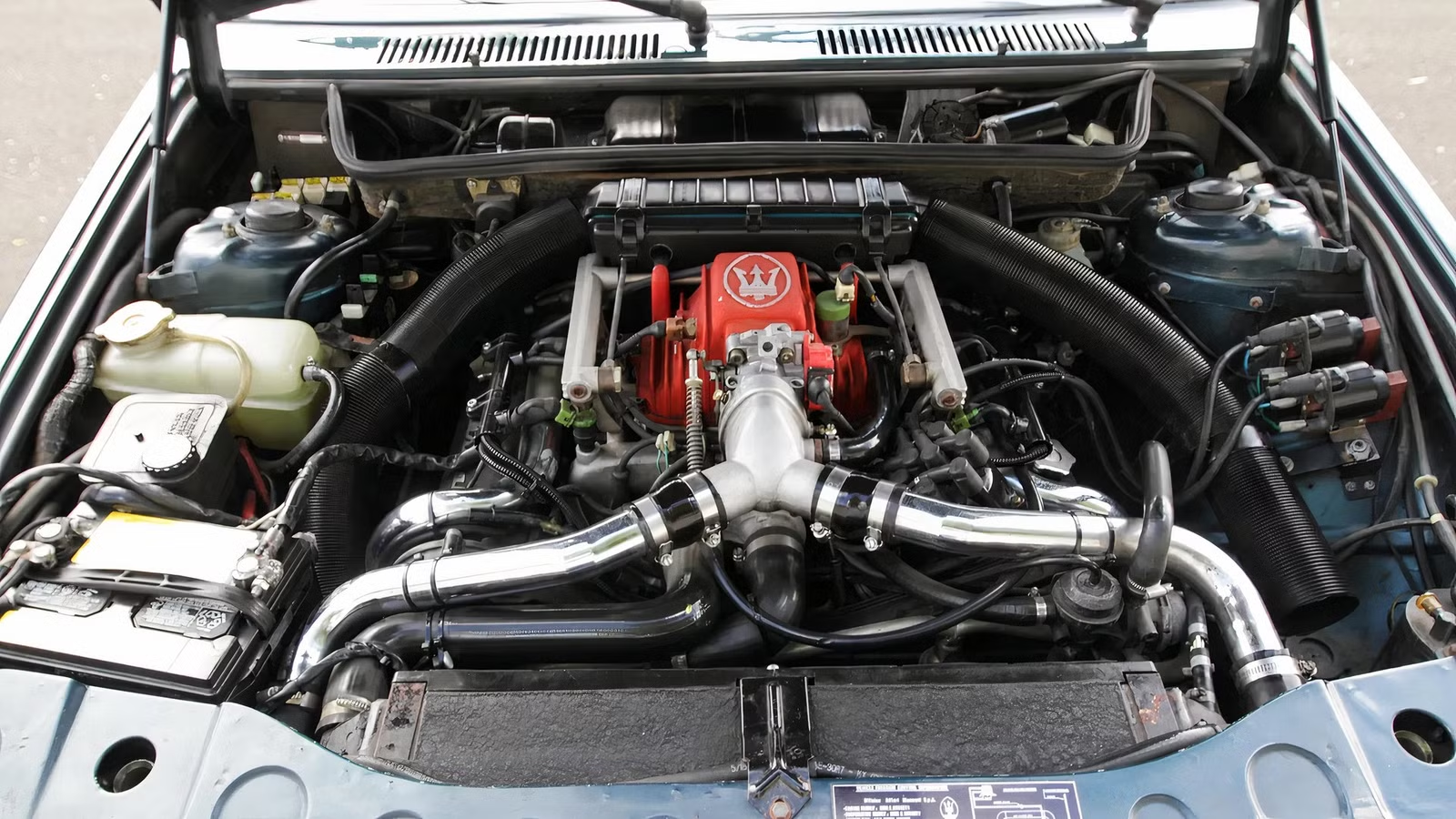
Twin-turbocharged engines have become the go-to recipe for Performance Cars in 2026, powering everything from German sports sedans like the BMW M3 to Italian exotics. Twin-turbo setups deliver sharper throttle response, stronger mid-range torque, and the efficiency needed to satisfy increasingly strict emissions regulations without sacrificing the character enthusiasts expect from a high-performance engine.

Four decades ago, however, even a single turbocharger was still considered cutting-edge. Twin-turbocharging was largely confined to race cars and engineering experiments, and the idea of fitting two turbochargers to a road car seemed almost excessive. While most enthusiasts would expect Ferrari or Porsche to have pioneered the technology on the street, it was actually Maserati that beat both marques to the punch with a car that history has largely forgotten.
Alejandro De Tomaso Had A Radical Plan To Rescue Maserati
When Alejandro de Tomaso took control of Maserati in 1975, the storied Italian marque was on the brink. Under Citroën ownership, it had earned comparisons with Ferrari, Lamborghini, and Porsche by building stunning low-volume exotics like the Bora, Merak, and Khamsin. The problem was that admiration didn’t translate into sales, since buyers with supercar budgets usually gravitated toward more established names.

De Tomaso knew Maserati couldn’t survive by chasing the same niche, so he completely rewrote the playbook. Instead of another hand-built halo car, he envisioned an attainable luxury coupe that could challenge BMW’s hugely successful 3 Series while offering genuine Italian exotic appeal. To hit that ambitious price point, however, Maserati first had to outsmart Italy’s tax laws that punished engines larger than 2.0 liters.
How An Italian Tax Law Forced Maserati To Reinvent The Performance Car

Alejandro de Tomaso’s affordable Maserati almost died on the drawing board because of Italian tax law. During the era, cars with engines exceeding 2.0 liters were slapped with a steep 38% VAT in Italy, while anything at or below the limit faced a far friendlier 19% rate. Maserati needed to stay under that magic number to keep prices competitive, but there was one obvious problem: a naturally aspirated 2.0-liter V6 engine wasn’t going to excite performance buyers, even in an era when the oil crises had forced horsepower into retreat. Ironically, those same crises had pushed automakers to adopt turbocharging, giving Maserati the perfect opportunity to bend the rules without breaking them.
Turbocharging solved Maserati’s displacement problem, but it introduced another one. Early turbo engines suffered from severe turbo lag because exhaust gases needed time to spool the turbine before boost arrived. The result was a frustrating delay followed by a sudden rush of power that could catch even the most experienced drivers off guard. That wasn’t the kind of driving experience De Tomaso envisioned, so Maserati’s engineers went searching for a better answer.
Two Is Better Than One

To tame turbo lag, Maserati’s engineers borrowed an idea from the racetrack. Rather than relying on one large turbocharger, they mounted two smaller turbos—one on each cylinder bank of its V6—reducing the time needed to build boost and making power delivery far smoother than the single-turbo systems of the day. The concept had already appeared on racing machines like the Toyota 7 (91E), Porsche’s fearsome 1972 917/10, 1973 917/30, and later the 935, as well as prototypes like the 1978 Vector W2.
Maserati’s breakthrough was bringing the technology to the street first and packaging it in an attainable production car rather than an ultra-exclusive exotic that only a handful of buyers would ever experience. Unfortunately, this revolutionary Maserati doesn’t get the respect it deserves. Many gearheads have never even heard of it.
Maserati Biturbo: World’s First Twin-Turbocharged Car

The star of the show is the Maserati Biturbo, a compact luxury coupe that quietly made history when it debuted in 1981 as the world’s first production car with a twin-turbocharged engine. The two-door coupe paired crisp styling with a plush cabin trimmed in leather, wood, and Alcantara, giving buyers a taste of Italian luxury without spending Ferrari money. Its sights were set squarely on the BMW 3 Series, offering similar practicality with far more Italian flair.
At launch, Italian buyers received a 2.0-liter twin-turbo V6 fitted with two small IHI turbochargers and rated at around 180 hp. Export markets were a different story since Maserati was no longer limited by the Italian displacement tax. When the Biturbo reached America in 1983, Maserati increased displacement to 2.5 liters to offset the power losses caused by catalytic converters and stricter U.S. emissions equipment, resulting in an output of 185 hp.

The Biturbo’s breakthrough didn’t go unnoticed. Ferrari introduced its first twin-turbo road car, the 288 GTO, in 1984 before perfecting the formula with the iconic F40 in 1987. Meanwhile, Porsche translated lessons from its dominant twin-turbo race cars of the ’70s into the 959 in 1986, which briefly became the world’s fastest production car with a 197-mph top speed. The trend quickly spread beyond Europe, with Nissan joining the movement in 1989 by launching the R32 Skyline GT-R and its twin-turbo RB26DETT inline-six. All these cars ended up becoming permanent fixtures in enthusiast folklore, but the forgotten Biturbo reached the showroom first.
The World’s First Production Twin-Turbo Engine Was Surprisingly Advanced

History remembers the Biturbo for introducing twin turbochargers to production cars, but the engine they were bolted to deserves just as much credit. Its roots stretched back to the 1970 Maserati-designed engine created for the Citroën SM, but Alejandro de Tomaso’s engineers reworked it so extensively that Maserati treated it as an entirely new powerplant. Retaining the original 90-degree architecture saved millions in development costs, while its unusually wide cylinder-bank angle created the space needed to package a turbocharger on each side.
From there, almost everything changed. The new V6 gained pioneering three-valve cylinder heads (two intake, one exhaust), quieter timing belts instead of chains, Nikasil-coated aluminum cylinder liners to withstand turbocharged heat, and a shorter-stroke design that encouraged higher revs. By reinventing an existing foundation rather than starting from scratch, Maserati delivered one of the most advanced production engines of the early 1980s without breaking the bank.
Maserati Reached The Twin-Turbo Era Before Ferrari And Porsche, But Speed Was Never The Goal

Twin turbocharging or even forced induction in general is usually associated with outright performance, and for good reason. It’s a great solution for extracting supercar performance from smaller engines, and Ferrari and Porsche proved just how potent the formula could be in the ’80s with icons like the F40 and 959.
The Biturbo had a very different mission. It wasn’t designed to dominate the autobahn or embarrass Ferraris at stoplights. Its twin IHI turbochargers existed to give a modest 2.0-liter V6 the punch of a larger engine without pushing the car into a higher tax bracket. Early models reached 60 mph in roughly the mid-7-second range. Later fuel-injected versions were quicker and more refined, but they still weren’t threatening the fastest sports cars of the day.

Instead, the Biturbo proved something arguably more important. It showed that twin turbocharging wasn’t just for six-figure supercars or race cars. It could make a small-displacement engine feel like a much larger one while keeping costs and taxes under control. It accomplished exactly what Maserati had set out to do.
The Pressure To Launch Quickly Cost Maserati Its Reputation

Today, those familiar with the Biturbo remember it less for pioneering twin turbocharging than for its infamously poor reliability. In truth, the earliest cars earned that reputation. They were plagued by hot-start problems from their blow-through Weber carburetor, turbochargers that suffered from oil coking if not cooled properly, persistent rust, electrical connector corrosion, and a Salisbury differential known for abrupt locking characteristics that could unsettle the car mid-corner.
Some teething problems were inevitable for the world’s first production twin-turbo car, but Maserati made matters worse by rushing the Biturbo to market. Alejandro de Tomaso was racing to keep the company afloat, forcing engineers to turn an ambitious concept into a mass-produced car on a shoestring budget and an aggressive schedule. Limited hot- and cold-weather testing, production tooling that wasn’t fully ready, and relentless cost-cutting all left their mark on the finished product, earning the Biturbo a reputation it would never fully shake.
By The Time Maserati Solved The Problems, The Damage Was Done

To Maserati’s credit, it didn’t ignore the Biturbo’s shortcomings. The first major updates arrived in 1985 with the Biturbo II, which introduced Nikasil-coated cylinder liners and replaced the troublesome Salisbury differential with a far smoother Sensitork limited-slip unit. A year later, Weber-Marelli fuel injection largely eliminated the hot-start problems that had plagued the carbureted cars, while ongoing revisions kept making it easier to live with.
Unfortunately, reputations are much easier to lose than to rebuild. Early horror stories spread quickly, particularly in the U.S., where poor dealer support and expensive repairs only reinforced the Biturbo’s reputation. By the time the Biturbo matured into a genuinely capable luxury car, many enthusiasts had already written it off. By 1991, declining sales and the lingering stigma surrounding the Biturbo forced Maserati to abandon the U.S. market altogether, where it remained absent for more than a decade.
The Biturbo Ended Up Saving Maserati Anyway

Despite its reputation for unreliability, the Biturbo ultimately accomplished exactly what Alejandro de Tomaso had hoped. With a starting price of around $25,000, the Biturbo undercut Italian exotics by a massive margin. Comparable Ferraris like the Mondial and 308 typically cost more than $60,000, making Maserati’s newest model an irresistible proposition. Buyers flocked to Maserati’s new entry-level model, with the Biturbo family selling roughly 40,000 examples and becoming one of the brand’s best-selling models to date. Sales slowed as reliability concerns grew, but the car still generated the revenue Maserati desperately needed to survive one of the most difficult periods in its history.

Its influence also extended far beyond the original coupe. The Biturbo platform spawned sedans like the 420 and 425, the Zagato-built Spyder, the 228 grand tourer, and later performance flagships including the Karif, Shamal, and Ghibli II. Just as importantly, the painful experience of the Biturbo’s troubled launch taught Maserati valuable lessons about durability and quality control, paving the way for the far more dependable cars that followed.
The World’s First Twin-Turbo Production Car Is Still Surprisingly Affordable

The Biturbo remains one of the cheapest ways to park a classic Italian exotic in your garage, with early coupes often changing hands for less than $10,000, while later fuel-injected models and Zagato Spyders command a healthy premium.
However, the cheapest Biturbo is rarely the best buy. If you’re shopping for one, skip the tempting project cars and pay more for a well-maintained, running example with comprehensive service records. Rust, neglected timing belts, failing fuse boxes, and deferred maintenance can quickly turn a bargain into a money pit. Enthusiasts also recommend sticking with 1987-and-later fuel-injected models, which solved many of the Biturbo’s infamous early reliability issues.
Find a straight one, and you’ll own a surprisingly affordable piece of automotive history that pioneered a technology that has since become the performance-car industry’s favorite formula.
Sources: Maserati, Radical Mag, Old Cars Weekly, The Boost Lab, Classic.com

Related posts



Latest Post


No Comments