
Honda’s Underrated NS400R Made Two-Stroke GP Dreams Rideable
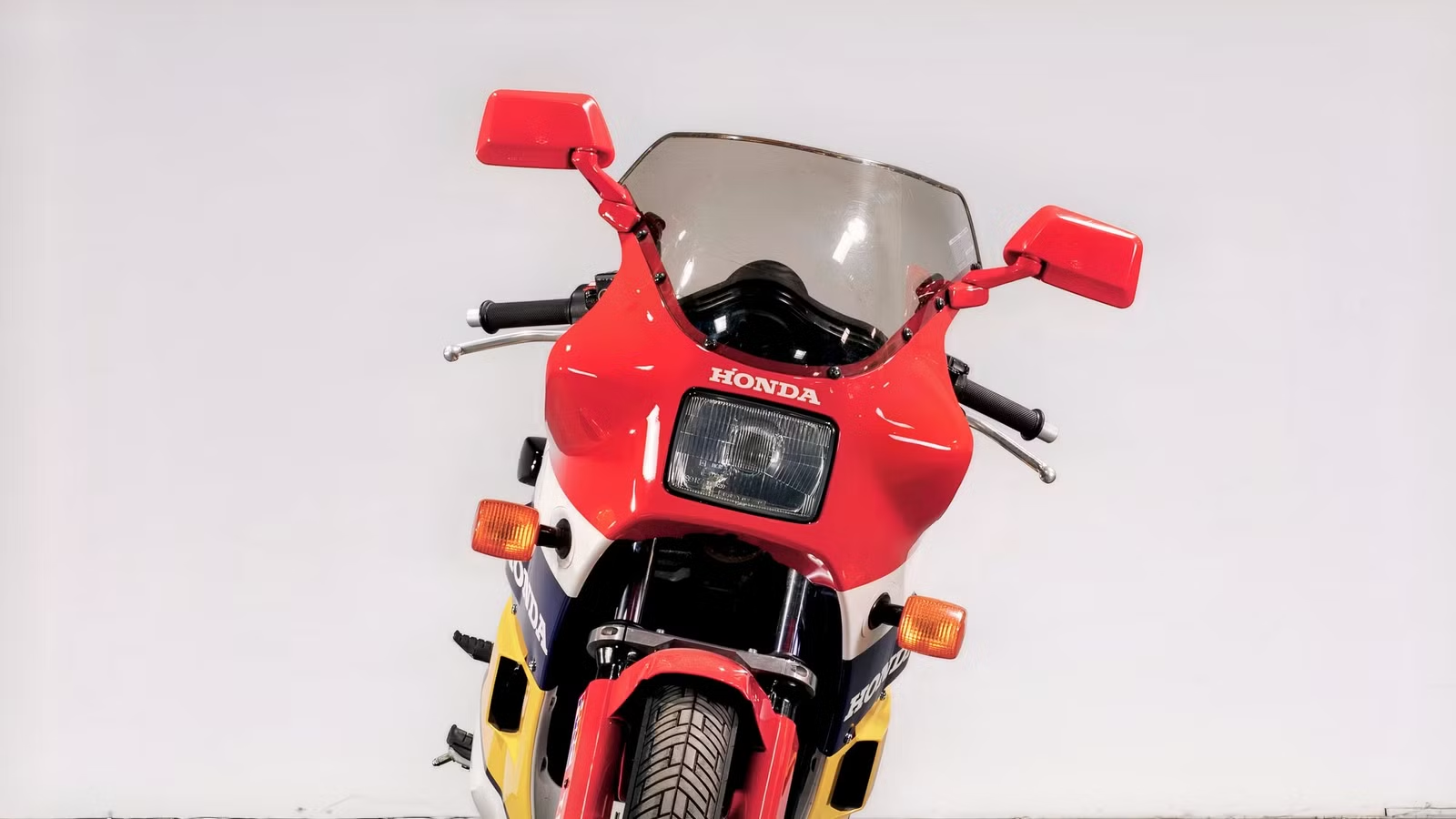
The mid-’80s motorcycle showroom had a simple way of flattering your ego. It put race paint on something smoky, sharp, and faintly mad, then dared you to believe you were one right wrist away from Grand Prix glory. Clearly, subtlety was not a priority.

However, one machine took a smarter route. It borrowed the emotion of a championship bike, softened the hard edges, and turned the whole thing into something a road rider could enjoy without needing a factory mechanic, fresh leathers, and a disregard for personal safety.
The Race Replica War Rewarded The Bravest Wrists
The 1980s two-stroke race-replica boom was basically a horsepower argument conducted in cigarette smoke and neon graphics. Yamaha had the RD500LC, Suzuki had the RG500 Gamma, and both machines leaned hard into the fantasy that a street rider could buy something with a very direct line to the 500cc Grand Prix grid.

Those bikes were brilliant because they felt like the real thing had slipped out of the paddock and somehow passed road registration. The bigger the displacement, the closer the connection seemed. If it had four cylinders, 500cc bragging rights, and a powerband that woke up like it had been poked with a cattle prod, it had showroom theater baked in.
Honda had a problem, though. Freddie Spencer had given the company a proper emotional hook by winning the 1983 500cc Grand Prix world title on a Honda V3, but simply chasing Yamaha and Suzuki into the 500cc street-bike brawl wasn’t the only answer. Honda being Honda, it looked at the obvious move and disregarded it completely.
Honda Once Created A V8 Engine With Only Four Cylinders
It was a weird engineering solution to a problem that plagued Honda for years.
Honda Built Its Tribute Backward On Purpose

The temptation would have been to build a bigger, louder road-going copy of Spencer’s NS500 and call it a day. That would have made sense on a poster, but it made less sense for the home market Honda cared deeply about, where Japan’s licensing structure made the 400cc class hugely important. So Honda aimed below the big 500s and created a smaller, more usable machine that carried the idea rather than copying the race bike bolt for bolt.
That decision shaped everything. The engine displaced 387cc, not 500cc, and the V3 layout was reversed compared with Spencer’s racer. The road bike used two forward-facing cylinders and one upright cylinder, a layout that helped package the bits race bikes don’t have to worry about, like an airbox, electrical hardware, and the general nonsense required to make a motorcycle behave itself on public roads.
This is where the bike becomes more interesting than the usual forbidden-fruit story. Honda wasn’t trying to win a bar fight against the RD500LC or RG500 Gamma on displacement. It was translating race thinking into something that didn’t require a rider to treat every traffic light like the start of a qualifying session.
The Honda NS400R Was The Friendly Freddie Spencer Tribute

|
Engine |
Power |
Torque |
1/4 Mile |
|
387cc V3 two-stroke |
72 hp |
37 lb-ft |
13.03 seconds |
The bike was the Honda NS400R, released in 1985 as a road-legal two-stroke tribute to the Freddie Spencer era. It used a liquid-cooled 387cc V3 two-stroke engine, a six-speed gearbox, and a claimed 72 hp at 9,500 rpm, with torque at around 37 lb-ft. On paper, that already put it behind the headline-grabbing 500cc machines, but the Honda’s dry weight of about 359 lbs gave it a different kind of performance story.
The factory power claim deserves context. Output from the rear tire was closer to 60 hp, which makes the NS400R look even less like a brute-force weapon and more like a precision tool. A light two-stroke with enough power, a close-ratio gearbox, and a chassis that actually wanted to cooperate could make a bigger bike feel as though it had brought too much engine to a fight.
Honda built the NS400R through the late 1980s, with production often placed at roughly 12,000 units. It was sold in markets like Japan, Europe, Canada, Australia, and South Africa, but it never officially came to the United States. That absence helped make it a cult object in North America, where the allure of an officially unavailable machine only added to its appeal.
The styling did its share of the work, too. The HRC colors and Rothmans-style look gave it proper paddock theater without turning the bike into cosplay. It looked the part of a Freddie Spencer machine, even if it was engineered for riders who had day jobs and insurance renewals.
The Honda Cruiser That Made Harley-Davidson Sweat In The 1980s
Harley-Davidson may rule the cruiser segment, but its not uncontested. In the ’80s, Honda made the giant bleed.
The Clever Hardware Made Less Power Feel Like More Control

The NS400R’s secret was that Honda didn’t leave the rider to negotiate with the powerband using hope and profanity. Its ATAC system, short for Auto Controlled Torque Amplification Chambers, altered exhaust resonance on the front cylinders to improve low-rpm response and help the engine transition into its stronger upper range. It didn’t make the V3 behave like a big four-stroke, but it made the two-stroke hit less like a prank.
The bike still needed revs, though. This wasn’t a lazy commuter with a race fairing and delusions of grandeur. Below the serious part of the tach, it could feel polite, even mild, but once it spun into the heart of the powerband, the little V3 came alive with the kind of urgency that makes riders forgive fuel consumption, smoke, and the persistent smell of two-stroke oil.
Fast In A Way Only Honda Could Make It

Honda also gave the chassis proper attention. The NS400R used a box-section aluminum frame, Pro-Link rear suspension, a 16-inch front wheel, a 17-inch rear wheel, and TRAC anti-dive forks to keep the front end more composed under braking. What you got was a bike that built its reputation around steering, balance, and confidence rather than outright speed.
That was important because the bigger Yamaha and Suzuki rivals could feel more dramatic, but the Honda was widely admired for being easier to place, trust, and ride quickly on real roads. It was sharp without being twitchy, fast without being unmanageable, and refined in a way that was distinctly Honda.
The Rare Sportbike From The ‘90s That Collectors Quietly Obsess Over
A rare ’90s homologation special hid in plain sight, but collectors know why this road-legal racer is becoming impossible to ignore.
The Underdog GP Replica Looks Smarter Every Year

The NS400R’s original problem was easy to understand. It didn’t have the 500cc badge, nor did it hit as hard as the RG500, and it didn’t win the showroom shouting match against the craziest two-stroke replicas of the day. For buyers who wanted the biggest displacement figure and the most direct connection to the Grand Prix class, Honda’s V3 looked like the sensible choice in a segment full of extremes.
Time has been kinder to the Honda’s logic. The very things that made it look conservative in 1985 now make it feel ahead of the curve. Modern sportbikes are built around the same idea: translate race technology into something usable, controllable, and repeatable for normal riders. The CBR600RR and Fireblade didn’t come from the NS400R directly in a parts-book sense, but philosophically, this little V3 is absolutely in the family tree.
Balance Over Brawn

With that context, it’s natural to see that collectors have started to notice. A clean 1986 example sold for $16,374, which shows that the NS400R’s reputation has moved beyond being simply a rare Honda that American riders never received. It’s now being appreciated as a clever, historically important race-replica alternative that chose balance over brawn and handling over bragging rights.
Sources: Honda, Motorcycle Specs, Motoriders Universe, Classic Bike Hub, Classic Motorbikes, Bike Social.

Related posts
Latest Post


No Comments