
Finding a cheap used 4×4 now takes more than sorting listings by price. Nostalgia has pushed clean older SUVs into collector territory, enthusiast demand has rescued once-forgotten trucks, and overlanding culture has added rooftop-tent tax to anything with a transfer case. Even tidy Jeep Cherokee XJs can sell for serious money, while older Toyota 4Runners and Nissan Xterras rarely count as secret bargains anymore. Yet one genuine low-range 4×4 still sits near the bottom of the market, ignored partly because buyers decided long ago that they did not like it.
Affordable 4x4s Are Becoming Harder Тo Find

The usual budget choices no longer feel very budget-friendly. Older Toyota 4Runners enjoy a strong reputation, a loyal following, and resale values that refuse to behave like those of ordinary aging SUVs. Jeep Cherokee XJs now attract collectors as well as trail drivers. Clean examples appear on enthusiast auction sites, where originality, low mileage, and the right shade of 1990s green can produce five-figure results. Nissan Xterras also carry growing demand because buyers recognize their simple truck-based hardware and useful off-road trims.
Low asking prices do not always solve the problem. The cheapest example may need tires, brakes, cooling-system work, suspension parts, rust repair, and a long conversation with a mechanic who keeps sighing. A worn-out $3,000 SUV can become a $7,000 SUV without ever becoming a good one.
Modern crossovers fill used-car sites with affordable all-wheel-drive choices, but most serve a different purpose. Their systems can move power between the axles when snow, rain, or a loose gravel road reduces traction. They often lack a two-speed transfer case, low-range gearing, useful recovery points, and suspension designed for repeated contact with rough ground. That does not make them bad vehicles, but it makes them less suitable for slow climbs, controlled descents, deep sand, or rocky trails.

The Biggest Weakness May Be The Vehicle It Replaced

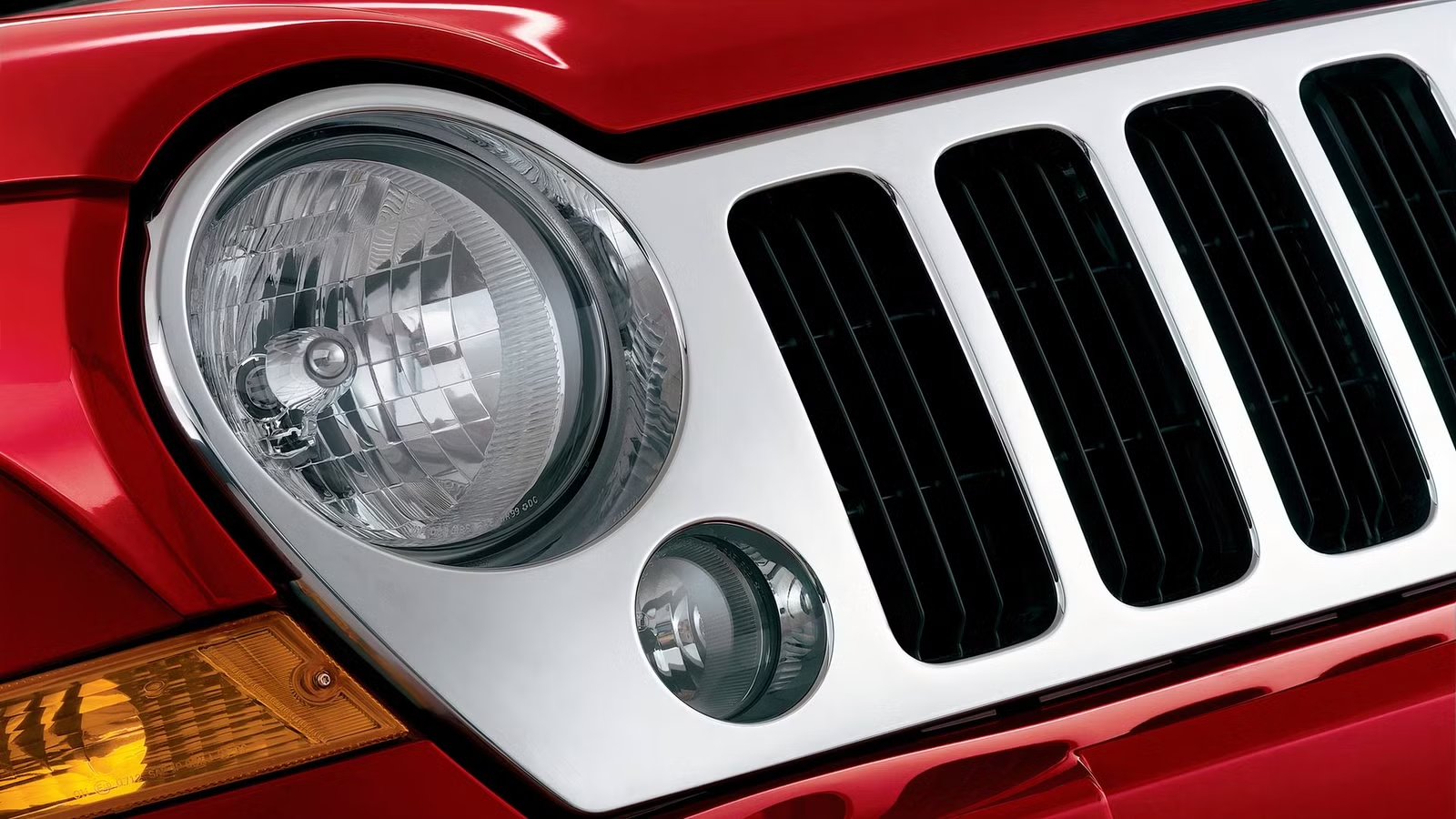
One bargain arrived in the early 2000s as the successor to one of the most loved compact off-roaders ever built. Its predecessor had straight lines, simple mechanical parts, solid axles, and the visual warmth of a filing cabinet. Owners liked that honesty, but the replacement went in another direction. It brought round headlights, curved body panels, a taller cabin, and a friendlier face.
The biggest argument centered on its front suspension. The old Cherokee XJ used a solid front axle, while its successor used an independent setup with rack-and-pinion steering. Traditionalists saw that change as proof that the company had traded trail ability for smoother road manners. Yet the rest of the design told a more complicated story—engineers gave it stout control arms, a coil-sprung solid rear axle, available skid protection, and a choice of two-speed four-wheel-drive systems with low range. Period testing also found substantial suspension travel and credible off-road geometry.
Still, reputations rarely follow engineering drawings. The new SUV looked softer, drove more comfortably, and aimed at families who might never leave pavement. Those facts mattered more to enthusiasts than the hardware underneath. Every rounded fender became evidence for the prosecution, every independent front-suspension component became a symbol of retreat.
The Overlooked Bargain Is The First-Generation Jeep Liberty

The vehicle in question is the 2002–2007 Jeep Liberty KJ, with the 2005–2007 3.7-liter V6 4×4 models standing out as the most useful targets. Current valuation guides and listings still place many examples in the low-four-figure end of the used-SUV market, though rust-free trucks with records command more. That low value does not come from a total lack of ability, though—the Liberty suffers from weak image value. It lacks the XJ’s square-jawed nostalgia, the 4Runner’s durability halo, and the Xterra’s adventure-brand appeal.
A four-wheel-drive KJ carries real Jeep hardware, though. Command-Trac uses a part-time transfer case with rear-wheel drive, four-wheel-drive high range, neutral, and four-wheel-drive low range. Selec-Trac adds a full-time four-wheel-drive mode that drivers can use on mixed surfaces, including roads that alternate between dry pavement, rain, snow, and loose material. Both systems use a 2.72:1 low-range ratio.
The chassis makes a stronger case than the styling suggests. The Liberty measures only about 174.5 inches long and rides on a roughly 104-inch wheelbase, so it fits between trees and around tight switchbacks more easily than many modern SUVs. The short front overhang also gives the nose room to approach steep obstacles. Factory figures for later models listed approach angles of up to roughly 37 degrees and departure angles above 31 degrees, depending on trim. Jeep quoted 9.4 inches of running clearance, though the measurement beneath the rear axle sat closer to eight inches.
Suspension And Engine

The rear suspension deserves more credit, too. Jeep used a coil-sprung solid axle located by trailing links and an upper A-arm. That setup allows useful articulation while keeping the axle durable and mechanically simple. The independent front end limits the Liberty’s easy lift height and extreme rock-crawling potential compared with an XJ, but it also improves steering feel and ride quality on broken pavement. Period testers found the rear axle capable of impressive movement over rough ground, while an off-road comparison praised the chassis strength, low-range gearing, and ability to tackle demanding terrain.
The 3.7-liter PowerTech V6 also suits the vehicle better than its reputation suggests. In 2005–2007 form, it produces 210 hp and 235 lb-ft of torque. Those numbers will not threaten a modern turbo SUV, but they provide adequate power for daily use, moderate towing, and trail work. The engine uses a cast-iron block, aluminum cylinder heads, chain-driven cams, and regular 87-octane fuel. Buyers gain broader parts and vehicle availability than they would with the interesting but less common diesel. The V6 can tow up to 5,000 pounds when properly equipped with the automatic transmission and factory towing package, though age and condition should make caution more important than brochure bragging rights.
`;
}
itemsHtml += `

`;
itemsHtml += `
${price}
${isGreat ? ‘Great price‘ : ”}
${below ? `
${below}
` : ”}
View full listing
${src.title || ”}${src.type !== ‘car_bid’ ? ‘ ‘ + (props.trim || ”) : ”}
`;
if (src.dealername || address) {
itemsHtml += `
${src.dealername ? `${src.dealername}${props.address ? ‘,’ : ”} ` : ”}
${address}
` : ”}
${distance ? `
${distance}
` : ”}
`;
}
itemsHtml += `
`;
}
if (!itemsHtml) return;
section.innerHTML = “;
initCarousel(section);
})
.catch(function () {});
function initCarousel(section) {
var track = section.querySelector(‘.listing-marketplace-carousel__track’);
var container = section.querySelector(‘.listing-marketplace-carousel__items’);
var cards = section.querySelectorAll(‘.listing-marketplace-carousel__item’);
var leftBtn = section.querySelector(‘#carousel-left’);
var rightBtn = section.querySelector(‘#carousel-right’);
var index = 0;
function cardStep() {
var gap = parseFloat(getComputedStyle(container).gap || 0) || 0;
return cards[0].getBoundingClientRect().width + gap;
}
function maxIndex() {
var visible = Math.max(1, Math.floor(track.clientWidth / cards[0].getBoundingClientRect().width));
return Math.max(0, cards.length – visible);
}
function go() {
index = Math.max(0, Math.min(index, maxIndex()));
track.scrollTo({ left: index * cardStep(), top: 0, behavior: ‘smooth’ });
}
var sendCarouselNav = function () {
if (!window._carouselNavFired && window.websiteSentinel && typeof window.websiteSentinel.sendEvent === ‘function’) {
window._carouselNavFired = true;
window.websiteSentinel.sendEvent(‘Car Marketplace’, ‘listingscarousel_nav’, window.location.href);
}
};
rightBtn.addEventListener(‘click’, function () { index++; go(); sendCarouselNav(); });
leftBtn.addEventListener(‘click’, function () { index–; go(); sendCarouselNav(); });
var scrollNavFired = false;
var scrollNavTimeout;
track.addEventListener(‘scroll’, function () {
if (!scrollNavFired) { scrollNavFired = true; sendCarouselNav(); }
clearTimeout(scrollNavTimeout);
scrollNavTimeout = setTimeout(function () { scrollNavFired = false; }, 1000);
});
window.addEventListener(‘resize’, go);
}
}
if (document.readyState === ‘complete’) {
setTimeout(init, 200);
} else {
window.addEventListener(‘load’, function () { setTimeout(init, 200); });
}
}());
What You Need To Know Before Calling It A Bargain

Underrated does not mean flawless, immortal, or immune to previous owners. The front suspension needs close inspection, especially the ball joints, control-arm bushings, tie-rod ends, wheel bearings, and CV axles. Jeep recalled some 2002–2006 Libertys because water could enter the front lower ball joints, leading to corrosion and possible separation. Naturally, you should check the VIN for completed recall work rather than trust a seller’s claim that “the last guy probably did it.” Clunks over bumps, wandering steering, torn boots, and uneven front-tire wear all justify a closer look from a mechanic.
The cooling system and engine condition matter just as much. The Liberty should start cleanly when cold, reach normal temperature without overheating, and hold that temperature during a long test drive. The buyer should inspect the radiator, hoses, coolant reservoir, water-pump area, and electric fan operation. Dried coolant marks deserve attention, and so do oil leaks around the upper engine, oil-pan area, and front or rear of the powertrain. A dirty engine does not always signal disaster, but thick sludge under the oil cap, low fluid levels, or a seller who cannot remember the last service date should end the inspection quickly.

The four-wheel-drive system needs a real test. The transfer-case lever should move through its positions without unusual force, and the correct indicator lights should appear. Four-wheel-drive high and low should engage as the owner’s manual directs, preferably on a loose surface where the driveline can release tension. A part-time system may bind on dry pavement, so a stiff turning test on asphalt proves very little beyond the driver’s ability to mistreat it. The buyer should also inspect the transfer case, driveshafts, axle seals, and underside for leaks or impact damage.
Rust Problems And Low Quality Interiors

Rust deserves its own search, especially in areas that use road salt. Inspect the rocker panels, floor, suspension mounts, rear control arms, brake and fuel lines, and the metal around the rear axle. FCA later recalled certain 2004–2007 KJs because excessive corrosion could weaken and fracture the rear lower control arms, but you should verify that repair by VIN and still inspect the surrounding structure.
Fuel economy remains the Liberty’s most predictable flaw. Factory information for the 2006 automatic V6 listed an estimated 17 mpg city and 22 mpg highway under the test standards of the period. Real use, larger tires, winter fuel, short trips, and two decades of wear can lower those numbers. The V6 combines a compact body with the thirst of something larger, which feels like getting a restaurant bill for a meal someone else ate. Anyone planning a long commute should include fuel in the purchase calculation rather than focusing only on the low asking price.
The cabin and road manners also reflect the Liberty’s original price and age. Hard plastics, simple switches, wind noise, modest rear-seat space, and an old four-speed automatic do not create a luxury experience. The tall body can lean, the ride can feel busy, and the V6 sounds more industrial than musical. None of that ruins the vehicle’s purpose, but you should not confuse rugged charm with refinement. More importantly, you should never buy the cheapest example simply because all Libertys seem inexpensive.
The Jeep Liberty Is Better Than The Story Told About It

The affordable 4×4 problem leaves people with awkward choices. Respected older trucks often carry prices shaped by nostalgia and enthusiast demand. Cheap crossovers offer comfort and all-weather traction but usually skip low-range gearing and trail-ready hardware. The first-generation Liberty occupies the useful space between them—it remains inexpensive, compact, easy to find parts for, and capable enough for camping roads, snow, sand, mild rock trails, and realistic weekend exploration. Its limits remain clear, but so do its strengths.
The Liberty never became a better Cherokee XJ. It grew heavier, rounder, more complex, and less friendly to extreme suspension modification. It also offered stronger power, better road manners, a solid rear axle, useful body clearance, and genuine two-speed four-wheel drive.
Condition now matters far more than the jokes, styling, or old forum arguments. A rust-free 2005–2007 V6 4×4 with working low range, stock suspension, matched tires, and service records can make more sense than a celebrated model held together by brand loyalty and undercoating. The first-generation Jeep Liberty carries flaws, but its reputation carries even more baggage.
Source: Jeep, Bring a Trailer, Car and Driver





No Comments