
The Unkillable Motorcycle Bargain Hunters Are Snatching Up
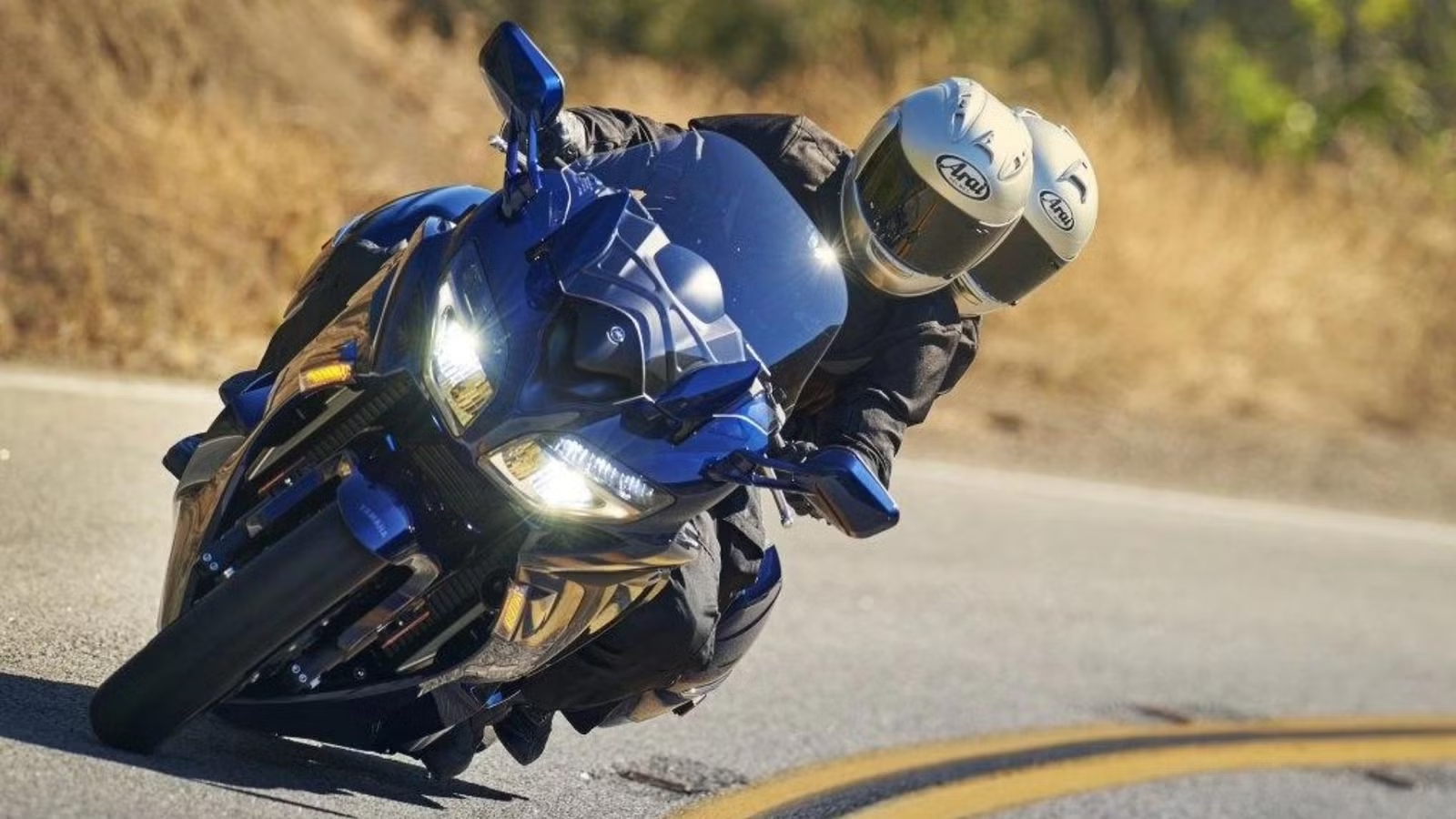
At some point in our motorcycle journey, we’ve looked at the used market and rejected several examples just because of high odometer readings. It’s honestly a valid reaction, too, since every engine technically has a life expectancy and the higher the odo, the closer it is to a massive expense. There is another side of the coin, though. In some cases, a large odo usually suggests there is something very right with the engine that it has kept running for such a long time. The focus word is ‘some cases’, referring to certain ultra-reliable motorcycles that prove high mileage isn’t as scary as most of us think. A now-discontinued Yamaha tourer proves that rather well.
Buying A High-Mileage Sport-Tourer Feels Riskier Than It Actually Is

A used-bike shopper’s instinct treats a high odometer reading as a signal to stay away. We’ve been ingrained with this idea as a universal fact, barring a few used examples that have a widespread reputation for durability, but even then, one approaches with caution. A sport-tourer is built with the specific intent of racking up long distances; thus, naturally, well-used examples would have high five-digit odo readings. Big fuel tanks, all-day ergonomic comfort, weather protection, and factory luggage systems exist for that very reason, and it makes the rider put in very little effort into simply picking up the bike and setting off on a whim.

So a shift in mindset is required when choosing a used high-mileage sport-tourer. Unlike a sport bike that experiences accelerated wear and tear when it’s taken to the racetrack frequently, even if the mileage on the odo is less, a sport-tourer is simply built with high-mileage consideration. So, if at all, a high-mileage sport-tourer is actually a testament to its engineering and robustness that made achieving those miles possible. A more fragile alternative would instead be sold at lower mileages attributed to frequent breakdowns and issues. And Yamaha’s example is just one of those machines that you shouldn’t be wary of while shopping used.
The Yamaha FJR1300ES Turns High Mileage Into A Reason To Buy


A brand-new FJR1300ES, listed as a 2024 model year, will set you back by $18,299. It’s the only fully-faired sport-tourer left in Yamaha’s US lineup, running close to the original recipe that was launched in 2001. So close that it’s hard to tell the differences at first glance from an older model. The 142 hp, 102 lb-ft, 1,298cc DOHC liquid-cooled inline-four paired with a six-speed gearbox and shaft final drive is the current package, weighing in at 642 pounds wet. It received updates to the suspension and gearbox along the way, but through all of it, the basic architecture and underpinnings, as well as the engine, remained unchanged, and with reason.
This Brings Over Two Decades Of Refinement

Yamaha’s engineers gave the FJR1300’s inline-four generous headroom from the get-go. A 10.8:1 compression ratio and a mild state of tune left margin below the engine’s actual threshold, as this isn’t a high-strung performance unit. The 2006 mid-cycle update revised the cooling and final drive ratio. Electronically adjustable suspension was added to the suspension in 2014, which gave the bike its “ES” designation, and a six-speed gearbox replaced the original five-speed in 2016. The core engine’s inline-four architecture remained unchanged and is still what powers the FJR1300ES today, albeit ending its production in 2025.
FJR1300ES’ Service Intervals Are Long, And The Bills Stay Small

Routine upkeep on the FJR1300ES follows a rhythm most riders can plan around while being busy putting down miles on it. Yamaha calls for an oil and filter change every 4,000 miles, and a full valve clearance check is only due every 26,600 miles, with spark plugs typically swapped at the same visit.

Owners who’ve had the work quoted at dealers report paying roughly $300 to $550 for the valve check, an expense that typically happens once every two to three years of average riding. Stretched across 100,000 miles, along with other maintenance expenses for keeping the engine in spec, barely dents the wallet. This is exactly the kind of ownership costs that keep an FJR owner riding it instead of replacing it, and precisely why it’s missed now that its production has ended.
A Cockpit And Luggage System Built For All-Day Distance

Yamaha built the FJR1300ES’ touring package keeping in mind its sport-touring intent and long days in the saddle. The 6.6-gallon tank and Yamaha’s 36 mpg estimate work out to roughly 235 miles between fuel stops. An electronically adjustable windscreen and a seat height that moves between 31.7 and 32.5 inches let a rider tune wind protection and reach without tools, while variable heated grips handle the cold weather miles that the fairing and windscreen can’t fully cover. This is a bike built to cross continents, and it has the equipment to do so.

Some of the standout features include an advanced LED lean-angle lighting system that acts as adaptive cornering lights, automatically illuminating extra LED lamps to light up the inside of turns as the motorcycle banks. Front and rear suspension both carry electronic damping adjustment, with 5.3 inches of travel up front and 4.9 inches out back. Finally, lockable, color-matched saddlebags are each sized to swallow a full-face helmet. These are just some of the reasons to put your money down on a used FJR today.
Used FJR1300ES Values Hold Steady

A used FJR1300ES doesn’t punish a buyer for wanting one even with a high mileage figure on it. KBB lists typical retail pricing for a 2018 model in good condition at $10,950, with a trade-in value of $7,770, while a 2010 model settles closer to $5,560. Current Cycle Trader listings track similar values, where a 2008 example with 43,887 miles was recently listed for $4,895, a luxury bargain like the Yamaha Star Venture, compared to new.

Owners have praise and a lot more mileage to report, with their own stories. One rider posted 340,000 miles on a single FJR1300 with nothing beyond a factory valve shim and routine maintenance, still riding it by his own account. Another reported a valve check at 77,000 miles that came back within factory tolerances on the first inspection, decades after the bike was built.

The one real weak point sits in the cam chain tensioner on early models. Owners have documented noisy, sticky tensioners, and in a handful of cases on 2004-model engines. Yamaha revised the tensioner design in later production years, and the fix is cheap and well-documented. The electronic suspension is mostly reliable, but rare reports of stepper-motor position faults can be an expensive dealer-only fix on what is otherwise a great used purchase, irrespective of what the odometer has to say.
Source: Yamaha, KBB, Cycle Trader

Related posts


Latest Post


No Comments