
The ADV Bike That Quietly Nails The Sweet Spot
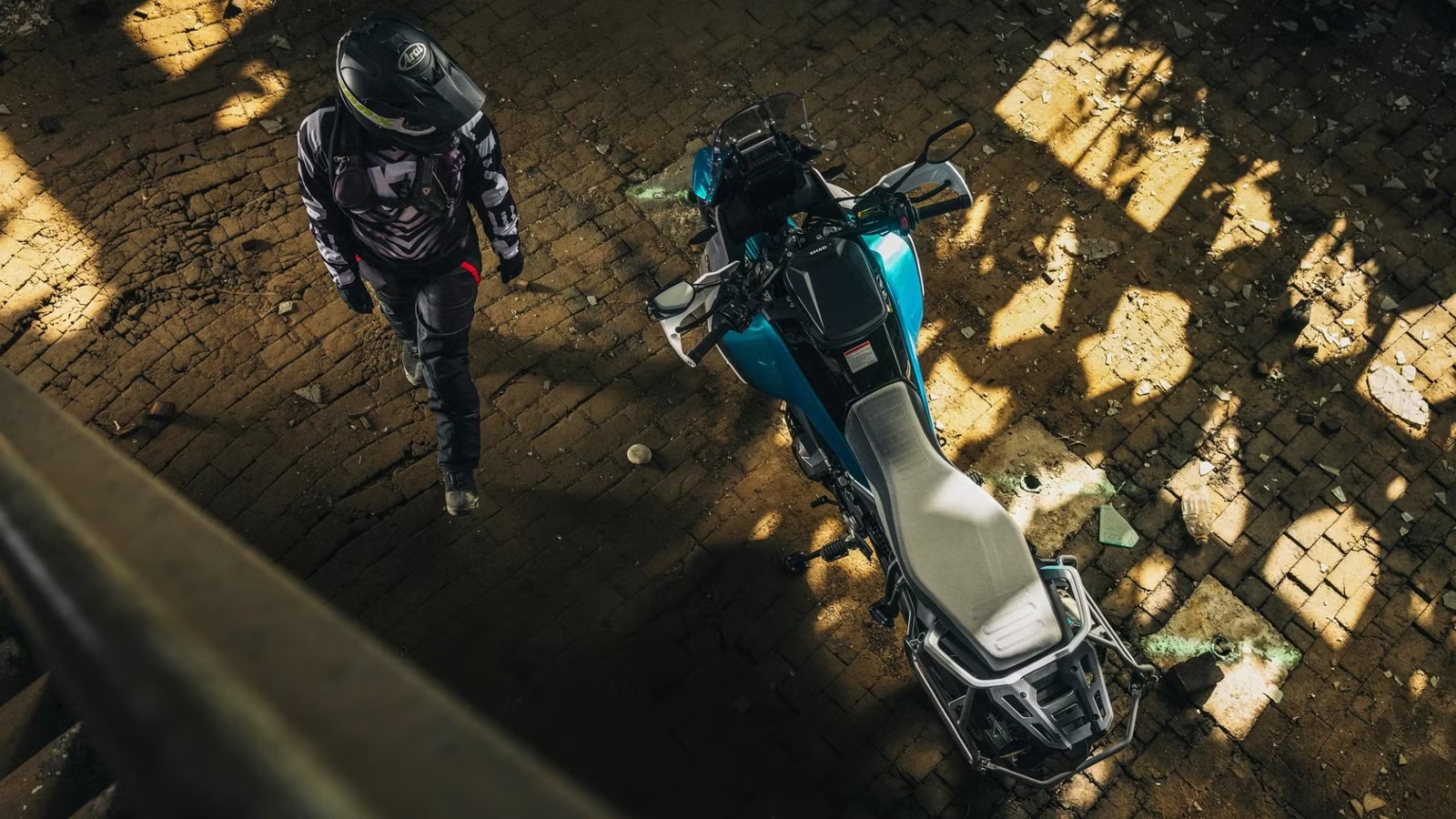
BMW laid the foundations of the modern adventure bike category almost by accident. In 1980, it built a 797cc flat-twin and bolted it to a stripped-down chassis, and it looked like an enduro bike but rode well on tarmac too. In essence, that’s the beauty of an ADV. But somewhere down the line, manufacturers tilted the scales towards bigger machines, meaning better in terms of weight, size, and engine size. That takes away the core element of an ADV, leading us back to smaller machines. We’re talking about one such ADV out there that’s proving that big performance can come from smaller packages.
The Entry-Level Dilemma Of The ADV Segment

“Sweet spot for riding the sweetest spots.” That’s an actual tagline that CFMoto is currently running in its marketing for its smallest ADV offering. On the cheesy-slogan scale, it probably ranks somewhere up top, but strip the wordplay off it, and there’s a real question buried underneath — what would a genuine sweet spot in this segment actually require?

Wire-spoked wheels are part of the quintessential rugged ADV look, but making them tubeless costs more to manufacture than cast alloy alternatives. Suspension travel gets cut the same way, as shorter-travel forks and shocks are cheaper to spec and tune. We’re talking small ADVs here, so weight has a direct impact on handling and agility, as well as the occasional or frequent drops depending on your skill level, and the need to lift it back up alone. Then there’s the modern need for electronics and aesthetics that makes the bike look like it was lifted straight out of a Dakar stage.

So cost seems to be the biggest restrictor in speccing a small-capacity ADV to the standards of bigger alternatives to achieve big performance. Thankfully, “Cheap Chinese” is a thing of the past now, and most importantly, all the kit and performance still has to be bundled at a price point that a first-time adventure rider won’t shy away from paying. The sweetest sweet spot would then mean a sweet price point with a sweet set of kit to not feel salty about being short-changed. Considering CFMoto already outshines its rivals in the middleweight space, it naturally does the same in the smaller capacity class, too.

The CFMoto Ibex 450 Offers A Lot To Be The Segment Sweet Spot

At $5,999, the CFMoto Ibex 450 is the bike straddling that tagline. To start with, it already meets the prerequisites of a great ADV. Wire-spoked, tubeless-compatible wheels, adjustable suspension setup at both ends, and a commendable electronics suite all come standard. At the same time, the Ibex shares its 449cc parallel-twin with three other bikes in CFMoto’s lineup sold worldwide, meaning good dependability.
A Parallel-Twin Built For Usable Power

This 449cc parallel-twin makes 44 hp at 8,500 rpm and 32.5 lb-ft of torque at 6,250 rpm. Sounds modest, yes, but it is ample for real-world use. You also get dual counterbalancers to smooth the delivery and a 270-degree crank that stacks the firing pulses unevenly for a thumpy exhaust note and more traction-friendly power delivery than a conventional firing order of a twin. The low-rpm fueling has been known to be a little jerky as dual cable throttles are used instead of a more precise ride-by-wire. But once the engine clears 5,000 rpm, the power delivery should be smooth and predictable, exactly the kind of delivery a rider wants standing on the pegs.
Low Curb Weight And Top-Shelf Rivaling Hardware

The Ibex 450 weighs 419 pounds curb, with no compromises on proper ADV hardware. A 21-inch front and 18-inch rear wire-spoked, tubeless-compatible wheel combination rolls over rocks and ruts that may limit a cast-wheel rival. 8.7 inches of ground clearance keeps the skid plate well clear of obstacles, and this traces back to an adjustable KYB suspension setup that offers 7.9 inches of travel at each end.

The front fork adds preload, compression, and rebound damping adjustment, while the rear shock gets preload and rebound adjustments. Considering the generous suspension travel, CFMoto has managed to keep the seat height approachable for a variety of riders, with adjustability ranging between 31.5 and 32.3 inches. This is already a great stack of kit for the price, making the Ibex 450 one of the best budget ADVs today, but CFMoto has more to offer.
Electronics And Equipment That Don’t Feel Budget Constrained

A lesser-known but competent supplier, J.Juan, equips the brakes on the Ibex 450, which consist of a 320mm front disc gripped by a radial-mount four-piston caliper, and a 240mm rear disc with a single-piston caliper. ABS runs dual-channel and switches off at the rear with a single button press on the handlebar, which also kills rear-wheel traction control and leaves the front wheel’s ABS active for your off-road adventures and antics. Keeping all of it on helps it blend into the urban space, meanwhile.

The beginner-friendly nature of the Ibex 450 is visible in the 5-inch TFT display that runs two ride modes: Standard and Off-road. There’s an 18-watt USB-A and USB-C combo slot built into the dash to keep your GPS unit or phone charged on the go. LED lighting covers the headlight, taillight, and turn signals, and there’s even an adjustable windscreen that you can set on the fly without tools. A skid plate and handguards come standard.
The Ibex 450 Against The KTM 390 Adventure R And Royal Enfield Himalayan 450

The KTM 390 Adventure R undercuts the Ibex 450 nowhere except on the sticker price. At $7,699, it’s $1,700 more, and that money buys 9 inches of adjustable WP Apex suspension travel at each end, 10.7 inches of ground clearance, and a curb weight of 388 pounds fully fueled. Cornering ABS and traction control add a better layer of electronic sophistication, and KTM backs the bike with a four-year warranty against CFMoto’s two. In essence, the 390 Adventure R does offer better value, although you get a single-cylinder architecture and lower 28.8 lb-ft of torque.

The Royal Enfield Himalayan 450 takes up the Ibex at a lower price of $5,799, and its Sherpa 450 single runs ride-by-wire with four selectable ride modes, plus a Google Maps-powered navigation display. What it doesn’t do is outmuscle the Ibex’s twin with its 40.02 hp and 29.5 lb-ft, and at 432 pounds curb, the Himalayan is a bit heftier too. So, all in all, the Ibex 450 clearly hits a sweet spot between its arch rivals by sitting bang in between a higher-spec KTM and the more basic Royal Enfield. Cheesy tagline or not, the marketing checks out with what the actual product delivers.
Source: CFMoto

Related posts


Latest Post



No Comments