
The Sleeper Harley-Davidson With Sports Car DNA
Harley-Davidson has spent over a century firmly entrenching itself in cruiser and then tourer lore. When you think of heavy metal, loud exhausts, and unshakeable tradition, the Bar And Shield comes to mind. It is what you defaulted to if you wanted a big, air-cooled engine and to spend time cruising the open highway. But the only constant is change, and Harley-Davidson needed to change at different points in its existence to keep abreast of the times – or afloat. There was a time or two when it made moves that would be considered too risky by the traditionalists.
The Secret Collaboration That Accidentally Came To Light

Harley-Davidson actually tried to change its direction decades before modern muscle cruisers came along. Back in the late 1970s, the company started a secret program called Project Nova, partnering with Porsche to build a brand-new family of liquid-cooled, overhead-cam engines in four-cylinder and six-cylinder layouts that remain Milwaukee’s rarest engine.
The goal was to build smooth, modern bikes that could keep up withi fast Japanese imports. However, money ran tight, and a change of ownership force Harley-Davidson to shelve the project and stick with the air-cooled Evolution engine. It only came to light because one of the Project Nova examples was put on display over 30 years later at the Harley-Davidson Museum in Milwaukee, Wisconsin!
Superbike Racing Experience Sparked A Second High-Revving German Partnership

Before the general public had stumbled upon Project Nova, Harley had already approached Porsche a second time. By this time, it had some experience, both with racing the XR1200 and with liquid cooling thanks to the VR1000 racing motorcycle — an oddity that is now cooler than ever. But the brief for the road-going motorcycle it wanted to develop with Porsche wasn’t as radical, though it was quite far out when it came to cruisers. It no doubt upset the traditionalists a lot, but at the same time it introduced the brand to a whole new target audience. And thus, it was a success.

The VRSCB Replaced Flashy Factory Styling With A Raw 115-Horsepower Sleeper Look

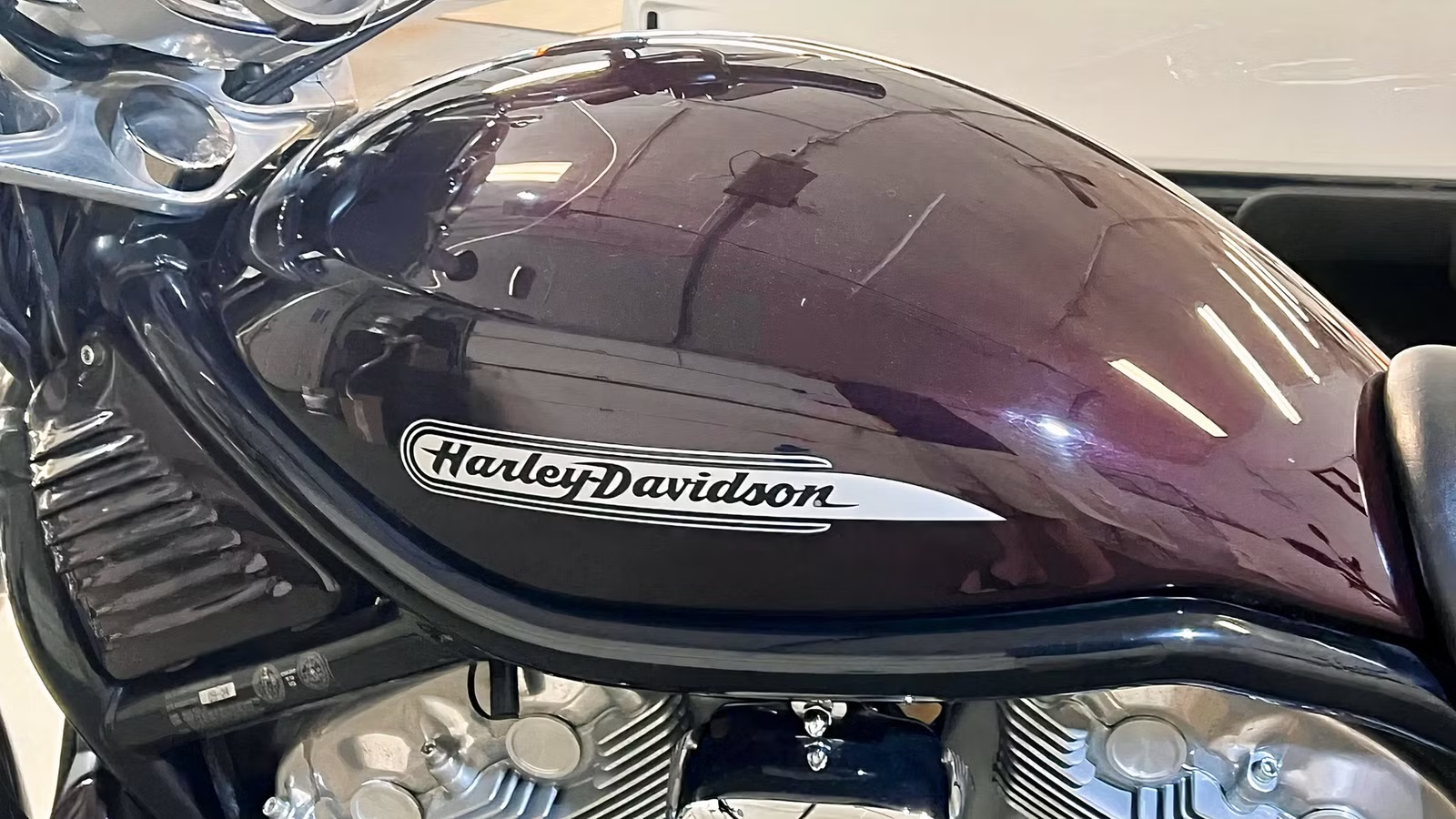
When the first VRSCA V-Rod arrived in 2002, it was covered in flashy chrome, polished metal, and lots of body covers. In 2004, the VRSCB showed up as the simpler, cheaper base version with a raw look. It ditched the strange one-piece handlebar shroud, cleared out extra body trim, and had a frame painted in plain black. What was left was a fast sleeper that hid genuine German sports car engineering behind a simple cruiser profile. It gave riders real Porsche-tuned speed without extra flash, making it one of the best sleeper performance cruisers from the brand.
The V-Rod Engine Was A Revolution

For the V-Rod, Harley stuck to the V-twin design, but here it had full liquid cooling. The 60-degree V displaced 1,130 cc, had double overhead camshafts, and four valves per cylinder. It made its power quite high up in the range for a Harley-Davidson, with 115 horsepower at 8,250 RPM and 74 pound-feet at 7,300 RPM. These figures were remarkable not just for a Harley, but for any cruiser at the time, and this engine has aged better than anyone expected.
It also used technology like fuel injection, and it had an appetite for revs more suited to a sports car than an American large-displacement cruiser. It loved pulling toward its 9,000 RPM redline. It stuck to some traditional Harley things like a belt drive and a five-speed gearbox.
Bolt-On Cradle Rails And A Cast-Aluminum Swingarm Modernized Harley’s Chassis Design

Like the engine, Harley-Davidson decided to go for a complete change with the chassis as well and ended up making one of the great Harleys for speed junkies. It was made out of hydroformed steel tubes. These were smooth, strong frame rails that wrapped around the engine. A unique feature was that the lower frame rails could be unbolted for easy access to bits of the engine, and this made servicing it easier.
Thick 49 mm Showa forks with 3.9 inches of travel handled the front, while at the rear, twin shocks offering 2.7 inches of travel were mounted to a cast-aluminum swingarm. The brakes were serious items as well, with twin 292 mm front brake discs mated to four-piston fixed calipers. At the rear, there was another brake disc of the same size mated to a caliper identical to those at the front.
Stretched Straight-Line Geometry Sacrifices Lean Angle For Straight-Line Stability

The V-Rod was built with a singular focus: stability in a straight line at speed, and great performance at the drag strip. The relevant dimensions are a length of 93.6 inches, a wheelbase of 67.5 inches, and a seat height of 26 inches. The ground clearance was 5.6 inches, although the cornering clearance was not very good.
The fuel tank sat under the seat, quite like the Nightster. Also like the Nightster, it doesn’t hold very much fuel, at 3.7 gallons. The V-Rod weighed 606 pounds dry, but the weight is carried very low, and the seat makes it easy for most to flat-foot, so it is quite manageable.
Stripping Shrouded Gauges Reclaimed Pure Roadster Ergonomics

Harley-Davidson gave the VRSCB a practical setup compared to the expensive original. Instead of the one-piece cast handlebar and gauge cover from the VRSCA, the VRSCB used standard tubular handlebars clamped into regular risers. This let riders adjust the bar position or swap it out easily. A round gauge sat plainly over the triple clamp, showing speed and revs without bulky plastic trim. The engine had black powder-coated cases with bare metal edges on the fins. The dummy gas tank up front was actually a cover for the airbox and intake stacks.
Sub-$7,000 Pre-Owned Pricing Makes The VRSCB A Bargain

Harley-Davidson only made the VRSCB for two short years, but you can pick one up today for surprisingly little cash, unlike other variants, like the V-Rod Muscle. A clean used VRSCB can be found on the secondary market for roughly $6,755. That is dirt cheap for a motorcycle that carries genuine Porsche engineering, a liquid-cooled engine, and over 100 horsepower.
Because many traditional collectors skipped the base model in favor of the chrome original or the later fat-tire variants, prices stayed very reasonable. It gives budget-minded buyers a rare chance to park an authentic muscle sleeper in the garage for a reasonable sum.
Source: Harley-Davidson USA

Related posts

Latest Post


No Comments