
The Affordable Motorcycle That Rewards Skill Over Horsepower
Motorcycles have spent the last decade getting absurdly powerful. Adventure bikes now make superbike numbers, electronics routinely intervene before riders even realize they’ve made a mistake, and adding another 20 horsepower has become an easy way of making a spec sheet look more exciting. Yet none of that necessarily makes a motorcycle more rewarding when the pavement ends, and the terrain starts demanding actual technique. If you’re onboard with that idea, this Chinese ADV is perfect for you.
More Horsepower Isn’t The Solution To Technical Riding
Horsepower is wonderful when there’s enough road to use it. On dirt, the equation changes quickly. Loose climbs, sand, rocks, ruts, and wet roots don’t care how impressive the dyno chart looks if the rear tire can’t put that output into the ground. More power can actually increase the rider’s workload because every throttle input requires greater restraint, and a small mistake can turn into a considerably bigger one before there’s time to correct it.
Weight Can Matter More Than What The Dyno Says

Weight also becomes harder to ignore once the ground stops being predictable. Every extra pound has to be slowed, turned, balanced, and occasionally caught when the bike starts heading somewhere you didn’t intend. If things go completely sideways, those pounds eventually have to be picked up off the ground, too. Repeat that process over a long day and a spec that seemed irrelevant in the showroom suddenly becomes one of the most important numbers on the bike.
A lighter, manageable motorcycle lets the rider spend more energy riding rather than wrestling. It also makes approaching the bike’s limits less intimidating. Instead of constantly managing a huge reserve of performance, you can work closer to what the machine can actually do. That creates room to experiment with braking points, body position, throttle control, and line choice.

Rally Bikes Have Always Played By Different Rules

Rally-raid motorcycles have understood this equation for decades. They still need high speed because competition stages can stretch across enormous expanses of desert, but power is only one piece of a much larger puzzle. Suspension has to absorb violent terrain for hours, fuel capacity has to cover huge distances, the chassis needs high-speed stability, and the entire motorcycle has to survive crashes and punishment without becoming unnecessarily heavy.
That helps explain why the 450cc single-cylinder formula became such a natural fit for serious rally competition. It’s enough engine to maintain substantial speed without saddling the motorcycle with the size and mass of a big multi-cylinder ADV. Everything surrounding it can then be designed around covering difficult ground efficiently. That’s very different from a luxury adventure bike expected to carry a passenger, luggage, heated amenities, extensive electronics, and enough highway performance to cross states in comfort.
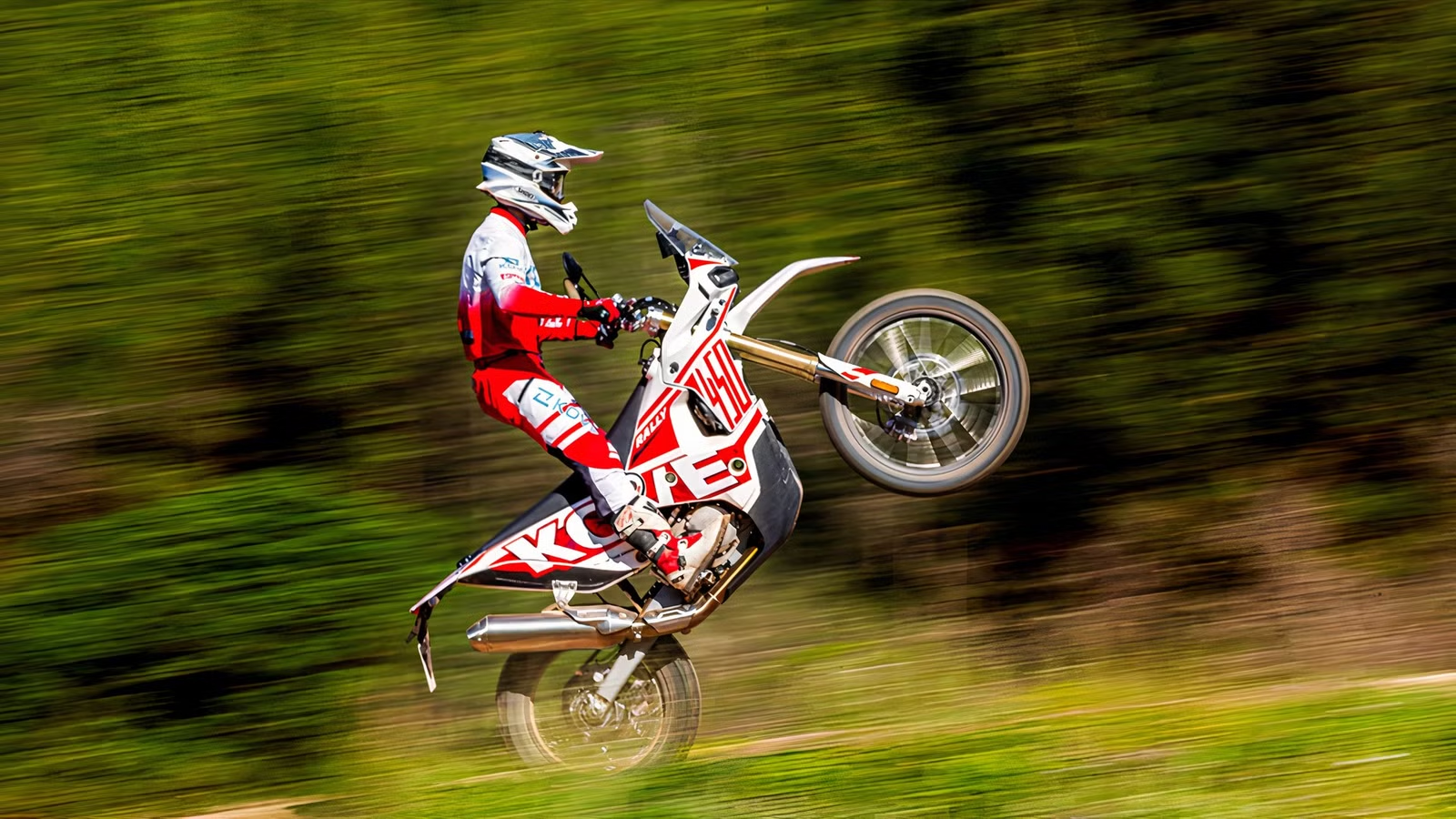
The Kove 450 Rally Is The Affordable Motorcycle That Rewards Skill Over Horsepower

That motorcycle is the Kove 450 Rally, and the current 50-state street-legal version is listed by Kove USA at $9,299 before freight, setup, tax, title, documentation fees, and dealer-installed options. EPA certification is complete, meaning this isn’t a competition bike that owners have to creatively coax onto the street. Kove says the road-going model is available in all 50 states, giving buyers something remarkably close in philosophy to rally machinery at close to entry-level midweight ADV price.
Powered By A Spirited Single-Pot Engine

At its center is a 449cc liquid-cooled DOHC single with fuel injection, paired with a six-speed transmission. Kove USA’s current technical information specifies Bosch EFI, dual cooling fans, an external oil cooler, electric starting, and a cable-operated wet multi-disc clutch. The engine sits inside a steel perimeter frame, while the air filter is mounted high beneath the removable seat to keep it better protected from the water and dust that inevitably come with off-road use.
Power varies by homologation. Kove’s current European specification lists 31 kW, or roughly 42 horsepower, while its current worldwide road-going specification lists 38 kW, or about 51 horsepower. Torque likewise ranges from roughly 25.8 to 28.8 pound-feet depending on the version. Kove USA doesn’t currently publish a horsepower figure for its $9,299 street model, so the important point isn’t chasing one definitive dyno number. No version is trying to win an ADV horsepower war.
Its Spec Sheet Starts Making Sense Away From Pavement

The chassis makes the intent much clearer. Kove USA specifies a fully adjustable 49mm YU-AN inverted fork with 12 inches of travel on the high-seat model, paired with a piggyback rear shock offering rebound plus high- and low-speed compression adjustment and another 12 inches of travel. Ground clearance is 12.2 inches, while the wheels are properly dirt-sized at 21 inches up front and 18 inches at the rear.
Braking comes from a 280mm front disc with a two-piston caliper and a 240mm rear disc with a single-piston unit. ABS can be switched off, and Kove says the system remembers the last selected setting when the engine is stopped with the kill switch. Riders also get LED lighting and a digital display mounted to a frame-fixed navigation tower, keeping the instrumentation centered even as the handlebars move beneath it.

Kove USA lists the comparable 2026 chassis at 319.7 pounds dry, while Kove’s current globally homologated road version is listed at roughly 342 pounds wet. Buyers can choose a 37.8-inch high seat or a 36-inch low seat in the US, giving riders some choice without abandoning the motorcycle’s long-travel proportions. Even the lower option is hardly cruiser territory, but accessibility clearly received some attention.
Decent Horsepower Is Plenty When You Can Actually Use All Of It
Those numbers create a different riding proposition from the giant ADV formula. With a single-cylinder engine and relatively little mass to manage, the rider can use more throttle without immediately turning every loose corner into a traction-control demonstration. Momentum becomes important. A good line through a climb matters. Carrying speed into a soft section matters. Getting your body into the right place matters. The bike can’t erase every poor decision with another mountain of torque.
That’s precisely why a machine like this can remain interesting as the rider improves. A newer off-road rider gets performance that isn’t hopelessly distant from their own ability, while an experienced rider can exploit the chassis much harder. Brake later, carry more corner speed, stand the bike up sooner, read the terrain better, and suddenly the same motorcycle is covering ground noticeably faster without a single modification to the engine.
The Real Hack Here Is Having Less Motorcycle To Fight

None of this makes the 450 Rally universally better than a large adventure bike. A big twin-cylinder ADV will generally be smoother and more relaxed on the interstate, happier carrying a passenger, and better suited to loading up with luggage for long highway trips. More cylinders, more displacement, better wind protection, and extra amenities are genuinely useful when the journey involves hundreds of pavement miles before the dirt even begins.
But trying to make one motorcycle excel everywhere comes with a physical cost. Once a machine becomes bigger, heavier, faster, and more luxurious, the rider still has to manage all of that mass when the trail narrows. The Kove takes another approach. It gives up some refinement and effortless highway muscle in exchange for long suspension travel, real ground clearance, huge range, useful off-road wheels, and a package designed around difficult terrain from the beginning.

At $9,299, that’s what makes the Kove 450 Rally especially interesting. Its performance ceiling increasingly depends on the person riding it. Rather than rewarding you simply for twisting the throttle harder, it rewards learning to brake later, carry momentum, choose cleaner lines, and waste less energy. More horsepower can always make a motorcycle quicker. Becoming quicker and more skilled yourself is considerably more satisfying.
Source: Kove

Related posts



Latest Post


No Comments