
The ‘90s Cruiser With Corvette Power And Room For The Whole Crew
In 1995, a full-size American sedan looked like an unlikely place to hunt for performance. The market was moving toward front-wheel drive, smaller footprints, and cars that treated fuel stops as something less than a social event. Chevrolet went the other way—its biggest performance sedan stretched nearly 18 feet long, weighed about two tons, drove the rear wheels, and packed a 5.7-liter V8 related to the one powering the Corvette. Better yet, it carried five people and their luggage while doing it.
Big Rear-Drive Sedans Were Becoming Dinosaurs

By the middle of the 1990s, the everyday family sedan had settled into a very different formula. Front-wheel drive made packaging easier, helped free up passenger space, and had become normal among high-volume four-doors. Chevrolet’s own redesigned 1995 Lumina sent its power to the front wheels, and so did the Ford Taurus, America’s best-selling passenger car that year. The old layout of a big engine up front and driven wheels at the back increasingly belonged to another era.
Enthusiasts looking for speed usually had more obvious places to shop. Coupes such as the Camaro and Mustang offered V8 power without hauling around the dimensions of a living room. Buyers with bigger budgets could look toward sporty European sedans, where rear-wheel drive still had a strong foothold. Powerful rear-drive sedans in the early 1990s were largely the territory of brands such as BMW.
That left the traditional American full-size sedan in an awkward spot. It was long, heavy, soft-edged, and designed to eat interstate miles without bothering anyone inside. Corner carving ranked somewhere behind trunk space and a comfortable armrest on the priority list. A car like that should have been heading quietly toward retirement, and turning one into a genuine factory performance car sounded a little like entering a recliner in the decathlon.

GM Had A Corvette-Bred V8 Looking For An Unlikely Home

Perhaps the best effort in that direction arrived from General Motors’ Gen II small-block program. The 5.7-liter LT1 had debuted in the C4 Corvette for 1992 and brought useful modern engineering to the familiar pushrod V8 layout, including reverse-flow cooling that sent coolant toward the cylinder heads first. GM soon spread versions of the LT1 beyond the Corvette and into other performance cars and larger rear-drive models.
The full-size sedan version belonged to that same LT1 family, but Chevrolet did not take a complete Corvette engine and simply lower it between a pair of sedan fenders. The big-car LT1 used cast-iron cylinder heads rather than the Corvette’s aluminum pieces and received a camshaft better suited to a heavier vehicle. Its tune produced 260 horsepower and 330 lb-ft of torque, trading some high-rpm glory for the kind of low-end shove a large sedan could use every day.
That was still a serious amount of muscle for the package around it, though. The sedan measured 214.1 inches long, or about 17.8 feet, and tipped the scales at roughly 4,061 pounds. Yet its engine sat up front, a four-speed automatic sent power rearward, and the car carried the basic mechanical ingredients Americans had associated with V8 performance for decades. It was a dinosaur, perhaps, but somebody had just given the dinosaur running shoes.
The Chevrolet Impala SS Was A Full-Size Muscle Sedan With LT1 Power

That car was the 1995 Chevrolet Impala SS, the second model year of Chevrolet’s 1994–1996 revival of the famous badge. Rather than engineer a clean-sheet sports sedan, Chevrolet started with its rear-wheel-drive B-body architecture and transformed the existing full-size formula. Underneath, the SS shared its roots with the Caprice and borrowed heavily from the tougher hardware developed for police-package cars.
The idea had started as something closer to a hot rod than a boardroom product plan. The team around Chevrolet Special Vehicles manager Jon Moss built the original show-car project in just 14 days, and public and dealer response changed the equation. When Chevrolet later showed it at a National Automobile Dealers Association convention, the company reportedly received roughly 3,000 orders. Suddenly, the giant hot-rod sedan had a business case.
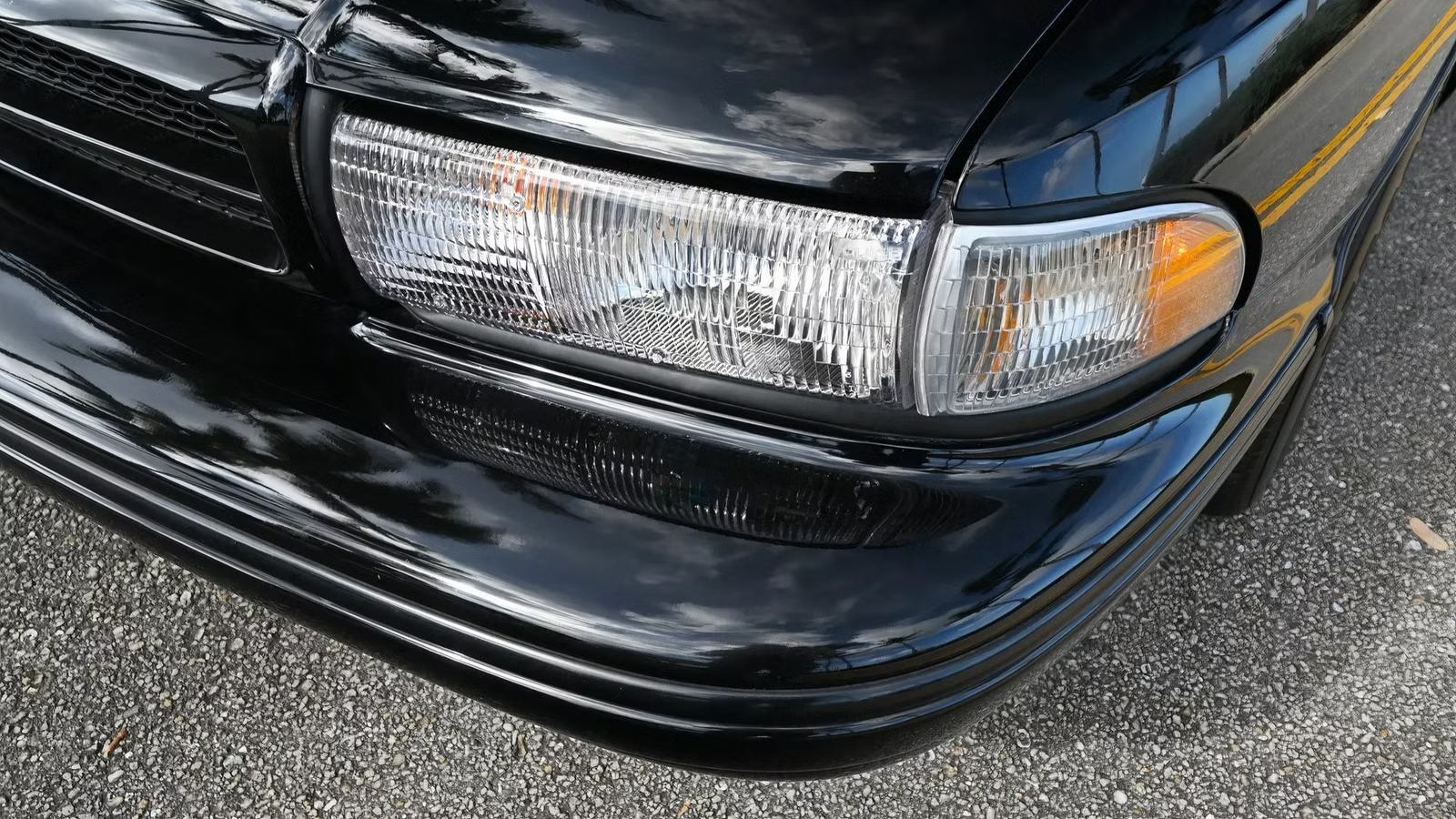
Production cars looked far more serious than ordinary Caprices. Chevrolet stripped away much of the bright trim, fitted a distinct single-bar grille, added a rear deck spoiler, and filled the wheel openings with wide five-spoke aluminum wheels. Monochromatic body treatment made the car look lower and cleaner, even though there was still enough sheet metal between the bumpers to make a compact car nervous. The design worked because Chevrolet resisted the urge to cover it in wings and stickers.
The 5.7-Liter LT1 Was The Heart Of The Car

The specification that sold the whole idea sat beneath that broad hood. The Impala SS’s 5.7-liter LT1 V8 made 260 horsepower and 330 lb-ft of torque, with a 4L60E four-speed automatic handling every shift. A limited-slip differential helped send the power to the rear tires. There was no manual transmission and no complicated drive-mode menu. The procedure involved a right foot, a V8, and enough rear tire to deal with the consequences.
The torque figure here mattered more than the horsepower number suggested. A 4,000-pound sedan needs force where drivers can actually use it, not just a heroic number at the top of the tachometer. The LT1 supplied 330 lb-ft and gave the Impala the lazy, immediate push expected from a traditional American V8. It could move away from a light without requiring drama, revs, or a downshift worthy of a courtroom objection. The car’s size never disappeared, but the engine stopped that size from feeling like an anchor. It could acclerate to 60 mph in 6.5 seconds and clear the quarter-mile in 15 seconds.
Chevrolet Didn’t Stop At The Engine

Dropping an LT1 into an otherwise ordinary big sedan would have made a great burnout machine and a questionable performance car. Chevrolet went further—the SS received a lower, firmer suspension with heavy-duty components, performance-oriented shocks, wide tires, and serious brakes. The package also included a limited-slip differential and hardware tied to Chevrolet’s police-car development work.
The wheels became one of the car’s defining features. Chevrolet fitted 17-inch five-spoke aluminum wheels wrapped in wide performance rubber, enormous shoes by mainstream sedan standards at the time. Underneath them sat four-wheel disc brakes, with 12.1-inch rotors, while the suspension rode about an inch lower than a regular Caprice. De Carbon shocks helped control the mass.
The result still behaved like a large American car, which was part of its appeal. The SS had a long wheelbase, wide body, big steering motions, and plenty of momentum. Its chassis upgrades simply made all that mass more cooperative.
1995 Model Year Might Be The Sweet Spot

The three years of this Impala SS often get grouped together, but 1995 has a character of its own. The 1994 car established the basic formula and came only in black. A year later, Dark Cherry Metallic and Dark Green Gray Metallic gave buyers choices without ruining the model’s sinister look. The redesigned mirrors moved into the corners of the windows, and Chevrolet cleaned up the rear-quarter-panel treatment. The car looked more finished while keeping the original concept’s attitude.
Inside, however, it still carried some of the delightfully old-school details of the first cars. The 1994 and 1995 Impala SS used a column-mounted automatic shifter and the earlier digital instrument arrangement. In 1996, Chevrolet moved the shifter onto the center console and replaced the digital speedometer setup with revised analog gauges that finally included a tachometer. The ’96 interior felt more like a conventional performance car, while the ’95 still let its driver select Drive with a lever hanging from the steering column like a proper land yacht.
That makes 1995 more than the year between the first and last versions. It combined the early car’s oddball full-size flavor with the broader color palette and cleaner exterior details that came after launch. The column shifter, digital instruments, LT1 V8, massive body, and newly available colors all coexist in one model year.
The Impala SS Made The Old-School American Sedan Exciting One Last Time

The rear-drive American full-size sedan was already living on borrowed time. Chevrolet ended production of the B-body Impala SS after 1996, along with the related Caprice, while the market continued moving toward different sedan layouts and, increasingly, SUVs. Chevrolet could have let its traditional big sedan fade away as fleet transportation and highway furniture. Instead, the company gave the platform one memorable final performance act.
Its appeal came from the entire package. The Impala SS combined a Corvette-related LT1 V8 with rear-wheel drive, upgraded suspension, big brakes, wide tires, four real doors, and seating for five. It also offered around 20 cubic feet of cargo space, so its passengers could bring more than a toothbrush and a strong sense of optimism. Few performance cars could move a full group of adults, swallow their bags, and still make a 6.5-second run to 60 mph.
Calling it a four-door Corvette misses what made the 1995 Impala SS special. A Corvette aimed for speed through a compact two-seat sports-car package. The Impala carried roughly two tons of steel and enough length to make parallel parking an advanced elective. Yet Chevrolet gave that traditional cruiser real V8 thrust and enough chassis to use it. Just as the old-school American sedan seemed ready to become a relic, the 1995 Impala SS gave enthusiasts one very good reason to miss it.
Source: Chevrolet

Related posts


Latest Post


No Comments