
The Mercury Sedan That Gave You Mustang Mach 1 Power With A Huge Back Seat
In the early 2000s, Ford enthusiasts faced a simple problem. Serious V8 performance usually meant buying a Mustang, while a traditional full-size sedan meant settling into something built more for highway miles than high-rpm fun. The brand had the parts to erase that divide, though: a modern four-valve V8, rear-wheel drive, a huge body-on-frame sedan, and a parts bin full of tougher hardware. For two brief model years, those pieces came together in one wonderfully strange four-door that put near-Mach 1 engine output behind a back seat adults could actually use.
Ford Had Plenty Of Fast Cars, But Almost None Worked Like A Traditional Full-Size Sedan

Ford buyers who wanted speed in 2003 did not have to search very hard. The Mustang lineup covered everything from the 260-horsepower GT to the supercharged 390-hp SVT Cobra, and the revived Mach 1 landed neatly between them. Its naturally aspirated 4.6-liter DOHC V8 made 305 hp at 5,800 rpm and 320 lb-ft of torque at 4,200 rpm. A five-speed manual came standard, the rear axle carried 3.55 gearing, and period tests showed 0 to 60 mph sprints around 5.3 seconds. The Mach 1 also looked the part, complete with a functional shaker scoop and retro trim.
The problem started when that buyer needed to carry more than a passenger and a gym bag. The Mach 1 stretched just 183.2 inches long on a 101.3-inch wheelbase, and had only 10.9 cubic feet of cargo room. It had rear seats because pony cars traditionally have rear seats, but transporting several adults comfortably never ranked high on the Mustang engineering checklist. That compact footprint helped make the Mach 1 quick and entertaining, but it also meant that a household needing four useful doors had to look elsewhere.
Elsewhere in Ford‘s empire sat almost the exact opposite kind of automobile. The company still built enormous front-engine, rear-wheel-drive sedans on separate frames, complete with broad passenger compartments and trunks seemingly designed around a family vacation. These cars earned reputations for durability, comfort, police duty, taxi work, and eating interstate miles. High-rpm performance rarely entered the conversation. The interesting question almost asked itself: What would happen if Ford stopped making buyers choose between Mustang-style V8 power and an old-school full-size sedan? The hardware to answer it already existed. Ford only needed to combine pieces that normally lived at opposite ends of the showroom.

The Perfect Starting Point Was Hiding Under One Of Detroit’s Most Conservative Shapes

The starting point looked about as threatening as a hotel conference room. Underneath that conservative shape, however, sat exactly the sort of layout enthusiasts tend to appreciate: an engine up front, driven wheels at the rear, and a separate full-perimeter frame beneath the body. The finished performance version measured roughly 212 inches long with a 114.7-inch wheelbase.
Timing helped. Ford substantially reworked its big rear-drive chassis for 2003, and period testers noticed the improvement. Drivers noted a much stiffer frame, thanks to hydroformed frame rails, stronger crossmembers, a cast-aluminum front crossmember, and new rack-and-pinion steering. For the hot version, engineers added performance-tuned Tokico monotube dampers, a 28-mm front stabilizer bar, rear air springs, a 21-mm rear bar, a 3.55:1 limited-slip axle, and staggered 18-inch BFGoodrich tires. Four-wheel discs and dual-piston front calipers handled stopping. It still carried a live rear axle, but now that old-school hardware had learned a few new tricks.
Then came the number that made the entire project interesting: 302 hp. That put this massive four-door only three horsepower behind the 305-hp 2003 Mustang Mach 1. The torque figures sat almost as close. Even the engine philosophy matched the Mustang more closely than anyone would expect from a giant luxury sedan, with dual overhead cams, four valves per cylinder, an aluminum block and heads, and an appetite for revs.
The 2003–2004 Mercury Marauder Was The Four-Door Muscle Car Nobody Expected

That car was the 2003–2004 Mercury Marauder, and its unlikely starting point was the Mercury Grand Marquis. Mercury revived a name with roots in its 1960s performance history and applied it to one of America’s most traditional sedans. Yet the company did much more than dress up a Grand Marquis for a photo shoot – the Marauder combined the freshly improved full-size chassis with a higher-output engine, dedicated suspension tuning, a limited-slip rear end, performance tires, revised exhaust, and a cabin that made a genuine effort to tell the driver that this Mercury had hobbies beyond arriving early for dinner. The idea had already generated enthusiasm as a 1998 SEMA concept before Ford approved the production program.
Under the hood sat a 4.6-liter DOHC 32-valve V8 making 302 hp at 5,750 rpm and 318 lb-ft at 4,250 rpm. Those figures deserve to sit directly beside the 2003 Mach 1’s 305 hp and 320 lb-ft. The two cars did not deliver identical performance, and nobody should pretend they did. The remarkable part is that Mercury put essentially the same level of naturally aspirated four-valve V8 output into a sedan almost 29 inches longer than the Mustang.

Weight quickly reminded everyone that horsepower never works alone. The car weighed around 4,282 pounds, while the manual Mach 1 weighed around 3,465 pounds. That left an 817-pound gulf between them. Based on those test weights and factory power ratings, the Marauder carried roughly 14.2 pounds for every horsepower, compared with about 11.4 for the Mach 1. In testing, the Marauder reached 60 mph in 7.5 seconds and ran the quarter-mile in 15.5 seconds at 91 mph, while a manual Mach 1 needed 5.3 seconds to hit 60.
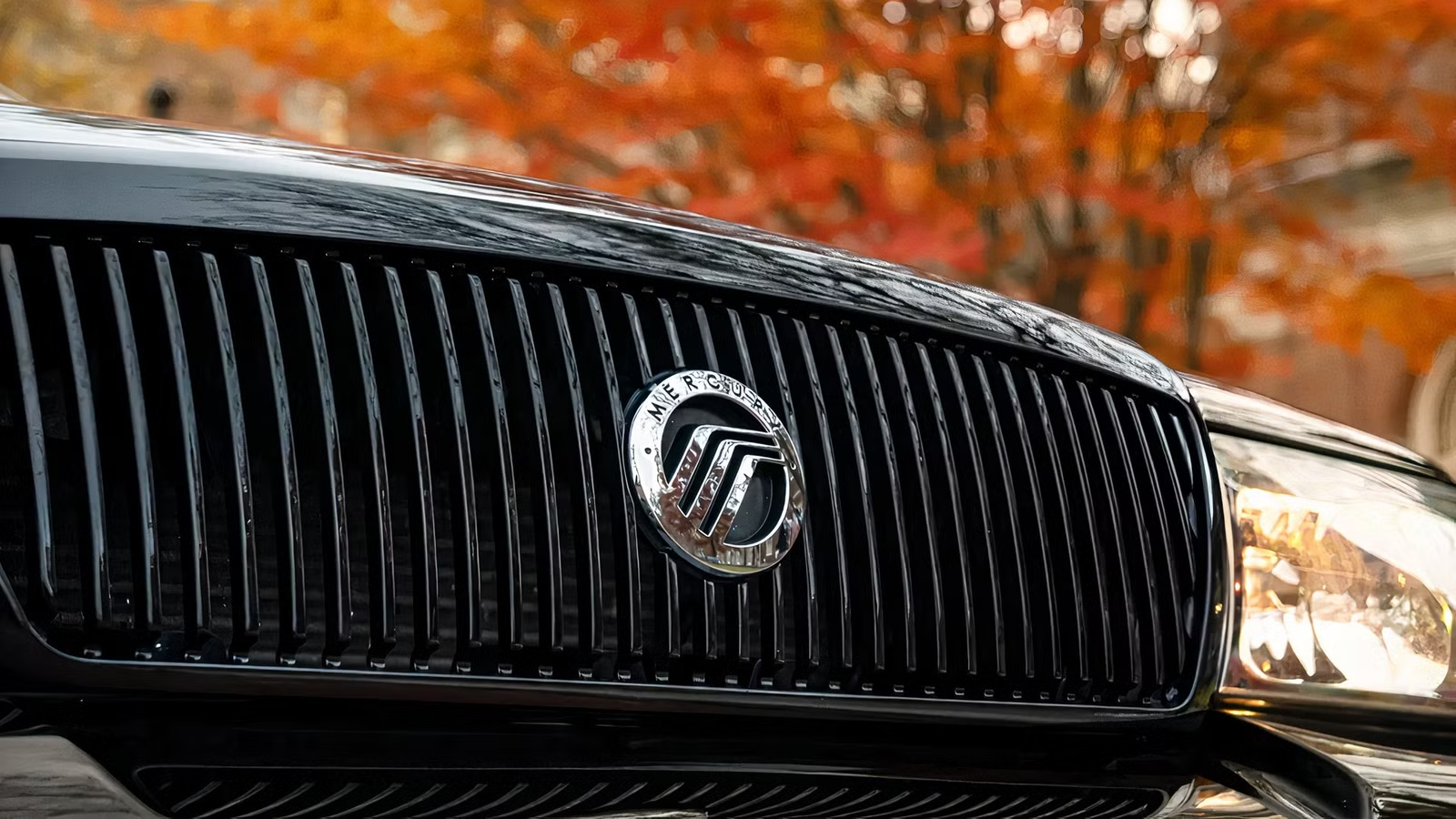
Mercury at least made sure nobody confused the Marauder with a rental-spec sedan once it rolled close enough. The car wore monochromatic bodywork, darkened lighting details, a blacked-out grille, huge polished 18-inch wheels, fat exhaust tips, and staggered tires measuring 235/50R18 in front and 245/55R18 in back. Inside, Mercury ditched the usual wood-look mood for metallic-style trim, front buckets, a center console, and a floor-mounted shifter. A 140-mph speedometer and tachometer faced the driver, while Auto Meter oil-pressure and voltmeter gauges sat ahead of the shifter. Black became the signature color, although small numbers later appeared in silver, dark blue, and red.
Its Biggest Advantage Over A Mustang Was Everything Behind The Front Seats

Horsepower made the Marauder interesting, but space made it unusual. At 211.9 inches long on a 114.7-inch wheelbase, the sedan stretched nearly 29 inches longer than the contemporary Mach 1. The sedan had 51 cubic feet of rear passenger volume and 21 cubic feet of trunk space against just 10.9 cubic feet of cargo space for the Mach 1. The Marauder therefore offered roughly twice the luggage capacity before anyone even started discussing the difference between climbing into a two-door Mustang’s rear seat and simply opening a full-size sedan’s back door.
That packaging changed what the car could do for an enthusiast. A driver could bring three or four adults, load the trunk with their bags, settle onto a long highway, and still have a naturally aspirated V8 driving the rear wheels through a limited-slip differential. The rear compartment offered 60.3 inches of shoulder room and 58.7 inches of hip room, figures that explain far more about the Marauder’s appeal than another tenth of a second at the drag strip.

Its size also gave the V8 a different personality. The four-valve 4.6 did not hit with the low-rpm shove of a large-displacement pushrod engine, and period testers repeatedly noted that it wanted revs before showing its best side. Once moving, however, the car became a fast, composed highway machine with a smooth engine and an appropriately deep exhaust note.It’s capable of 0.86 g on the skidpad, remarkable territory for something that still had a separate frame, rear air springs, and enough trunk space to lose a moderately sized lawn ornament.
Of course, there was criticism as well. 302 hp looked terrific on paper, but more than 4,200 pounds dulled the result. The four-speed automatic did not help, either. A 7.5-second sprint to 60 mph hardly frightened contemporary sports cars, and the lighter Mach 1 operated in another performance league despite its nearly identical output.
The Marauder Was A Strange Two-Year Experiment That Ford Never Really Repeated

The experiment disappeared almost as quickly as it arrived. Mercury sold the Marauder only for 2003 and 2004, and Ford built just 11,052 examples across those two model years – 7,838 for 2003 and 3,214 for 2004. That total looked especially small beside Ford’s early suggestion that it could produce around 18,000 Marauders per year if demand materialized. The enthusiasm surrounding the original 1998 SEMA idea never translated into that kind of showroom volume. There was even a wild 2002 Marauder convertible concept with a supercharged 335-hp V8, but the production story ended with the sedan before Mercury could turn the idea into a wider performance family.
Its short life makes more sense in hindsight because the hardware beneath it belonged to a disappearing branch of the family tree. Ford kept the Panther-based full-size sedans alive until 2011, when production of the Crown Victoria, Grand Marquis, and Town Car finally ended. The industry’s performance-sedan formula had already started changing – modern cars increasingly relied on smaller unibody platforms, more gears, turbochargers or superchargers, sophisticated electronic chassis systems, and all-wheel drive; electrification would later push the category even further from the Marauder’s recipe.

A 2003 Mach 1 remained the sharper weapon. It weighed hundreds of pounds less, accelerated much harder, offered a manual transmission, and existed mainly to entertain its driver. The Marauder solved another problem – it supplied near-Mach 1 engine output with four real doors, adult-sized rear accommodations, and the footprint of an old-school American luxury sedan. That combination explains why the numbers alone never tell the whole story. Mercury started with one of Ford’s least exotic shapes and produced one of its most memorable early-2000s performance sedans. The Marauder was too big to become a four-door Mustang and too rowdy to remain an ordinary Mercury. For two years, that odd space in between suited it perfectly.
Source: Ford, Mercury, Fastest Laps

Related posts

Latest Post


No Comments