
The 42 MPG Ford SUV That Pays For Itself In Two Years
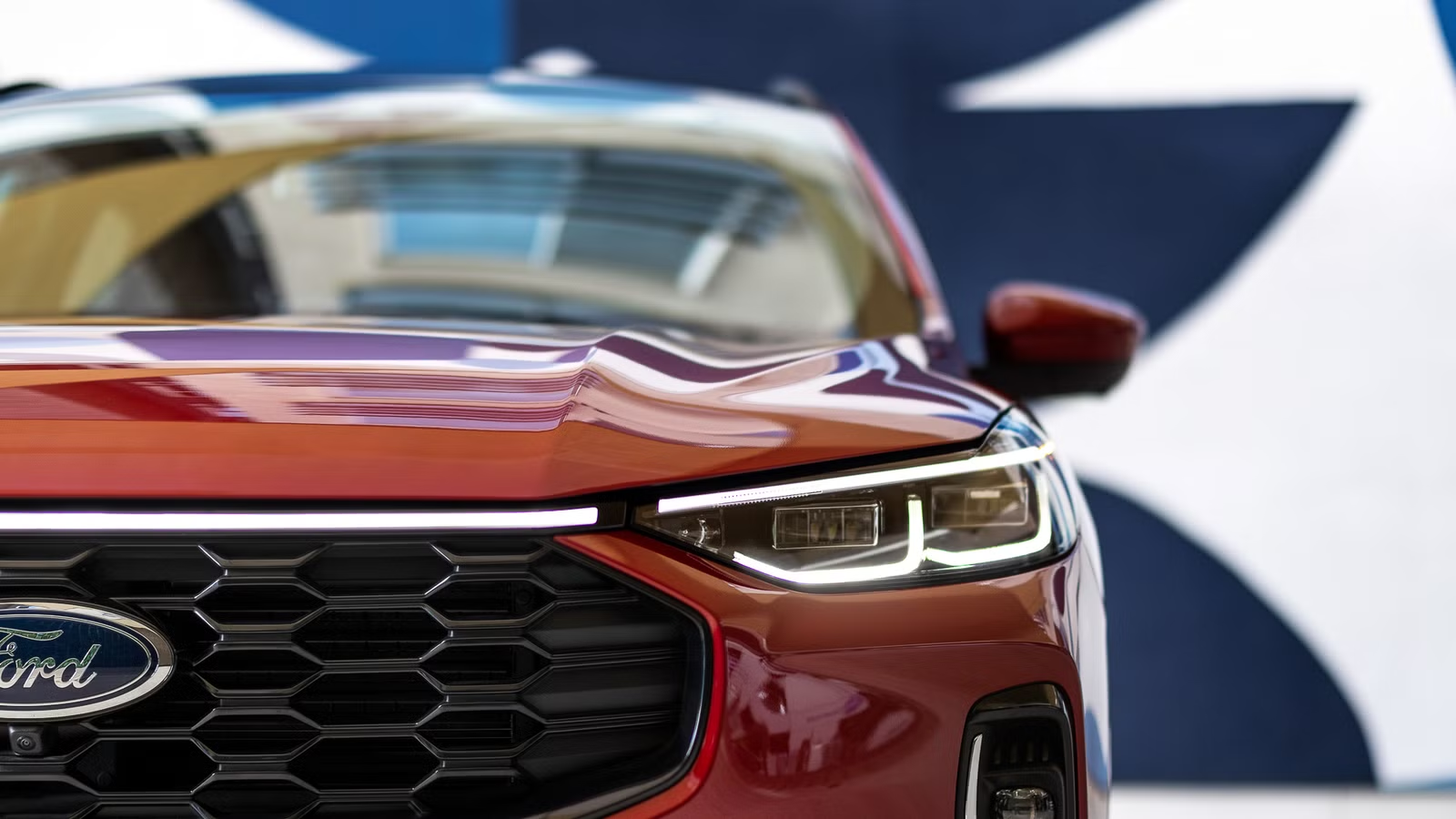
When a vehicle operates as a fleet vehicle, regular consumer metrics like cabin aesthetics and infotainment menus become completely secondary to the total cost of ownership (TCO). When your odometer is quite literally tied to your paycheck, buying a car becomes a far more cold, calculated capital investment. By prioritizing mechanical longevity over consumer trends, this specific vehicle functions as a high-return tool that wins on math that typically is not at the forefront of automotive marketing.

With 2026 officially marked as the final production year for this Ford SUV, the buying strategy is undergoing a critical transition. It is shifting away from new fleet adoption on showroom floors and turning directly toward identifying heavily depreciated, highly capable late-model assets on the secondary market. For anyone whose business model relies on maximizing the revenue generated by every single revolution of the crankshaft, understanding the underlying economics of this platform explains why it remains one of the smartest pure-math buys in the compact segment.
The 400,000-Mile Fleet Durability Record
If you want to know why a vehicle makes sense as a tool for earning a living, look at what happens when a municipal fleet truly runs it through its paces. Back in the late 2000s and early 2010s, big-city yellow cabs became an accidental, high-stress lab for a specific planetary-gear hybrid setup. Look at the numbers from a retired 2012 model taxi in New York City. That specific car cleared 400,000 miles on its odometer while still running its factory-installed nickel-metal hydride (NiMH) high-voltage battery pack and its original electronically controlled continuously variable transmission (eCVT).

Getting a powertrain to survive that kind of commercial beating without a major component swap is essentially like an athlete playing for a full decade without missing a single game. It proved that the massive engineering investments poured into the platform’s early development paid off in raw metal longevity. For a working driver, this history takes the guesswork out of long-term reliability.
Surviving The Urban Grind

San Francisco’s transit authority saw the exact same resilience when it finally retired its first wave of hybrid taxis. Those early units were pulled out of service only after they ticked past 300,000 to 350,000 miles. The fleet managers explicitly described them as “trouble-free” despite a daily diet of steep hills, a rotating cast of drivers, and zero cooldown time between shifts.
This record blows up the common myth that hybrids are too fragile or complicated for high-mileage work. By running these vehicles through hundreds of thousands of miles of city traffic, commercial fleets stripped away the marketing talk to prove a basic mechanical truth: a simple, well-cooled hybrid drivetrain can last as long as the old Crown Victorias that once dominated the taxi industry.
The Escape Hybrid Is The 42 MPG Ford SUV That Pays For Itself In Two Years

Critics will tell you that a modern fourth-generation showroom model shares virtually nothing with a yellow cab from 2012. They are right on the surface, but wrong about the engineering. Ford spent the last twenty years refining the platform to improve thermal efficiency and reduce internal friction. That old taxi legacy belongs directly to the modern Ford Escape Hybrid.
Instead of using a complex valve body and gear sets that wear out over time, the Escape Hybrid manages power through mechanical simplicity. The system blends gas and electric power using two electric motor-generators and a single planetary gear set. Because it does away with traditional failure points like drive belts, launch clutches, and hydraulic torque converters, this drivetrain is inherently stripped down for long-term survival in stop-and-go city traffic.
Decades Of Drivetrain Refinement

Ford has been offering hybrid versions of the Escape since 2005. That gives Ford a mountain of real-world telemetry data that almost no other manufacturer in this segment can match. This long development cycle let engineers iron out the clunky, jerky low-speed behavior that often plagues newer hybrid systems on the market. The transitions between the gas engine and electric power are seamless, which is a massive comfort factor when you are sitting behind the wheel for ten hours a day.
This quest for refinement also brought major updates to the battery setup. Ford replaced the old, heavy nickel-metal hydride batteries from the taxi era with modern, power-dense lithium-ion packs. These modern packs feature much better liquid cooling, which keeps battery temperatures stable and extends battery lifespan beyond what older designs could achieve, while saving cabin space and reducing vehicle weight.
Navigating The Gen 4 Buying Reality

If you are moving away from new-car showrooms and hunting for a deal in the pre-owned market, you need to look at the fourth-generation platform (2020 through the final 2026 production run) with a mechanic’s eye. The older generation established the platform’s durability, but modern emissions laws and tighter engineering tolerances mean buyers must be selective about which model years they choose. The financial upside is huge, but you have to know how to read the production timeline.
Thecurrent-generation Escape Hybrid is EPA-rated at 42 mpg in the city and 36 mpg on the highway. That makes it a serious weapon for city driving, but early fourth-generation models hit the market right during the peak of global supply chain disruptions. Because of that, certain early model years have specific production variances not found in older, more robustly built versions. Buyers looking for a working vehicle need to isolate these known trouble spots before handshakes happen.
Sifting Through Early Gen 4 Vulnerabilities

The biggest issue to watch for if you are shopping for a used 2020 to 2023 Escape Hybrid is NHTSA safety recall 23S27. This campaign covered an issue with the 2.5-liter Atkinson-cycle engine where a connecting rod bearing failure could breach the engine block. If that happens, oil or fuel vapor could leak onto hot exhaust parts and cause a fire under the hood. Ford fixed this by changing the under-hood shields and active grille shutters to vent vapors away, alongside software updates that cut engine power before a total mechanical breach can occur.
Buyers should also check for potential contamination inside the HF45 hybrid transaxle. On some early, high-mileage fourth-generation units, the transfer shaft or differential bearings can experience premature wear. If you let that go, the metallic debris floating around in the oil can eventually damage the electric motor windings inside the case. When taking a prospective vehicle out for a test drive, turn the radio off and listen closely—if you hear a faint, high-pitched whine or drone that changes pitch with vehicle speed, the transaxle oil is contaminated with metallic debris and the unit is failing.
Targeting The “Clean” Buying Windows

The simplest way to avoid these issues entirely is to focus your search on the post-refresh models, specifically the 2024 through 2026 model years. By the time these late-model examples rolled off the line, Ford had sorted out the engine block manufacturing issues and tightened up the tolerances on the HF45 assembly lines. Buying an end-of-run model delivers a mature, thoroughly validated powertrain without the early production issues.
If your budget forces you to look at a 2020–2022 model, don’t buy it without running the VIN through official safety databases to make sure a dealer has actually completed all the recall work. Once ownership transfers, disregard Ford’s optimistic “lifetime fluid” marketing intervals. Budget for a transaxle fluid drain and fill every 50,000 miles to remove any metallic contamination before it can damage the internal bearings.
The TCO Calculations: A Two-Year Payback

Retail car buyers usually figure out their budget based on driving 12,000 miles a year over five years. For a ride-share driver or a fleet operator, that math belongs in the trash. When a vehicle is operated as a tool that accumulates between 90,000 and 100,000 miles a year in heavy city traffic, the price premium paid upfront for a hybrid system is recovered very quickly.
$4,600 In Annual Fuel Savings That Recoups The Hybrid Premium In Under 18 Months

On the used market, the price gap between a gas crossover and a cleanly optioned late-model Escape Hybrid usually sits between $3,000 and $5,000. That means the hybrid recoups its own price premium within the first 12 to 18 months of heavy use.
You also get hidden savings from the brakes. In heavy city traffic, the electric motor handles nearly all the deceleration, capturing that kinetic energy to recharge the battery pack while the traditional brake pads and rotors remain relatively cool. This preserves the brake pads, extending their service life up to three times compared to a conventional gasoline vehicle, which translates to less downtime for brake service and more time generating revenue.
The 2026 Sunset Market Opportunity

With the 2026 model year confirmed as the final production run for the Ford Escape nameplate, the narrative around this vehicle shifts entirely. This is not about negotiating volume discounts on factory orders of new vehicles for large corporate fleets. The end of production opens up a massive value window in the pre-owned and late-model market.
Whenever a manufacturer kills off a long-running nameplate, it puts artificial downward pressure on used values because retail buyers immediately look toward newer, heavily marketed models. For a high-mileage operator who treats a vehicle as a depreciating asset, that market decline is an advantage. By acquiring a late-model Escape Hybrid that has already absorbed its initial retail depreciation, a buyer secures a highly advanced, liquid-cooled hybrid powertrain for a fraction of its actual utility value.
Source: Ford, Automotive-Fleet, GreenCarReports, CleanFleetReport

Related posts






Latest Post


No Comments