
The 300-HP Japanese V8 Flagship Nissan Quietly Downgraded To Chase Lexus
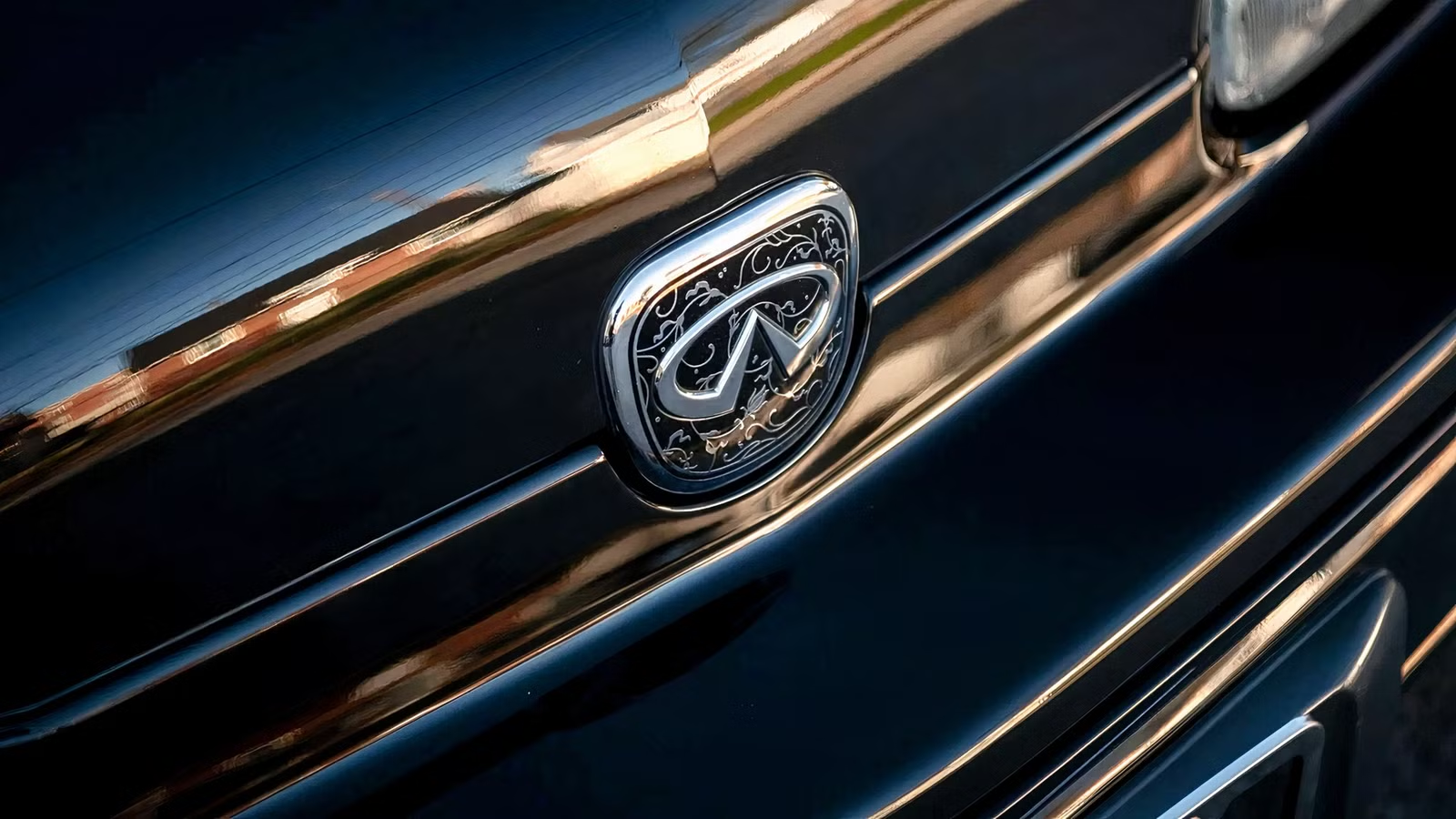
When you look at Infiniti today, all you see is a mid-tier luxury brand that serves as a cheaper alternative to the established Germans. But, it is very easy to forget that it did not start out this way. When Nissan launched Infiniti in North America in late 1989, they weren’t aiming for second place. Infiniti was supposed to be a brand that would easily rival some of the best luxury brands in the world. The first Infiniti was an uncompromising, high-performance luxury car meant to disrupt the industry. But after that first attempt, it all went downhill.
When Japan Decided It Could Build A Luxury Flagship

Let’s go back in time to the Japanese economic boom of the late 1980s. Between 1986 and 1991, Japan had the biggest economic expansion ever, which saw many companies make a great deal of money. Armed with a lot of cash, Japanese automakers decided they wanted to enter the global market. For decades, brands like Mercedes-Benz and BMW had held a stronghold in the executive luxury car market. Audi wasn’t even a big player here yet. Japan’s major manufacturers realized that to challenge these established brands, they needed truly dedicated luxury cars.
Honda launched Acura first, introducing the Acura Legend in 1986. Toyota poured billions into project “F1,” which eventually gave birth to the Lexus brand and the almighty LS400. Mazda had Amati, but that project was short-lived, and Nissan had Infiniti as its luxury division. All of these companies wanted to build the best engineered luxury cars possible that were still cheaper than their European counterparts.
Lexus Redefined What A Japanese Luxury Sedan Could Be

When the first Lexus LS400 hit the market in 1990, it shook the automotive world. Toyota had just built one of the best luxury cars in the world. To demonstrate, Lexus famously advertised the LS400 on a dyno with a pyramid of champagne glasses sitting on its hood while doing speeds of 145 mph without spilling a drop. Inside, the cabin was quieter than any Mercedes or BMW. This car was smooth, well-built, and half the price of the Mercedes S-Class.

The LS400 instantly redefined what a flagship Japanese luxury car could be, proving that Japan could beat Europe at its own game. But, while Lexus was perfecting the art of whisper-quiet luxury, Nissan was taking a slightly different approach.
The Infiniti Q45 Was Nissan’s Luxury Weapon

Nissan launched Infiniti alongside Lexus in late 1989 with a single flagship model: the Q45. Unlike the LS400 that had a bespoke platform, the Infiniti Q45 used the same platform as the Japanese-market Nissan President. The President was already an established Nissan luxury car, so it made sense for Infiniti to do this and help save some cost. The Q45 was an imposing, long-wheelbase, rear-wheel-drive sedan. But instead of going the route of quiet luxury, Infiniti made a luxury car with some performance.
The first-generation Q45 (G50) was not your traditional looking luxury car. It didn’t have a big chrome grill in front like every other luxury car, but it still looked smooth and sophisticated. Inside was a similar story: Infiniti didn’t bother with wood trim. It just had leather everywhere and a wraparound dashboard for the driver, almost similar to the dashboard design in a Toyota Supra. Nissan was quite clear about who its target audience was with this car, and the powertrain reflected that.
The V8 Was The Real Star Of Nissan’s Flagship

The Q45 was powered by Nissan’s 4.5-liter VH45DE V8. This wasn’t a standard Nissan engine; it was an all-aluminum, 32-valve DOHC, naturally aspirated V8 made for the Q45 and Nissan President at the time. Officially, it made 278 horsepower and 292 lb-ft of torque, but most people would tell you that was conservative. During this era, Japanese car manufacturers operated under a “gentlemen’s agreement” to limit power to a maximum of 276 horsepower. But in reality, the early cars made a bit over 300 hp and around 330 lb-ft of torque.
The way this engine delivered power was different from other luxury cars. While Toyota’s 1UZ V8 in the LS400 was tuned for silent, low-rpm torque, Nissan’s VH45DE wanted to rev all the way to its 6,900 RPM redline. It could hit 60 mph in under seven seconds, which was fast enough to beat V8 counterparts from Germany.
The Q45 Was More Of A Performance Luxury Sedan

Nissan did not stop at putting a big engine under the hood; it built a capable chassis to complement it. The Q45 came standard with a sophisticated multi-link suspension setup front and rear, heavy-duty brakes, and rear-wheel-drive with a Viscous Limited-Slip Differential (VLSD). The Infiniti Q45 even had trims depending on what buyers wanted. The Q45t (touring) had stiffer anti-roll bars and Nissan’s Super HICAS (High Capacity Actuated Steering) system or early rear wheel steering, which electronically steered the rear wheels to improve high-speed stability and cornering.
Next was the advanced Q45a with its Full-Active suspension. Unlike Lexus’s air suspension, Nissan’s system used complex hydraulic actuators at each wheel fed by an engine-driven hydraulic pump. It read road conditions in real time and instantly countered body roll, pitch, and dive. Where the Lexus LS400 was all about comfort, the Q45 was more like a luxury sports sedan.
The Q45 Started Losing Its Edge Before Nissan Replaced It

This car was great, but it struggled to sell as it didn’t appeal to luxury car buyers. It didn’t have a chrome front grille or wood trim interior, and it had a firmer ride. It could only seat four people since the back seats were really designed for just two people. Sensing the market’s reaction, Nissan gave the Q45 a facelift in 1994. Nissan added a traditional chrome grille and wood interior trim to make it look more like a luxury car. But the biggest change came in 1996.
To comply with the US OBD-II regulations, Nissan had to delete the Variable Timing Control (VTC) system from the VH45DE engine. The loss of VTC seemed to bring back the engine’s power to its official claimed power figures, but the engine’s sharp, low-end response was gone. Infiniti replaced the car the following year but it wasn’t better.
The Second Gen Q45 Became Softer

In late 1996, Nissan unveiled the second-generation Q45 (FY33) for the 1997 model year. It was a good-looking sedan but no longer projected luxury. It also no longer had a bespoke platform; the new Q45 sat on the smaller Nissan Cima platform shared with cars like the Nissan Cedric, Gloria, and Leopard. To make matters worse, Nissan retired the legendary 4.5-liter VH45DE engine in favor of the smaller 4.1-liter VH41DE V8. This car was trying to play it safe.
Nissan Didn’t Just Reduce The Q45’s Power, It Reduced Its Ambition

This new 4.1-liter V8 made 266 hp and 278 lb-ft of torque, which was significantly less than the 300 hp made by its predecessor. All the fancy hardware the previous Q45 had was also gone. The complex hydraulic active suspension and Super HICAS rear-wheel steering were gone. The suspension was softened dramatically to mimic the floaty ride of the Lexus LS400.
In chasing Lexus’ ride quality, Nissan stripped away the Q45’s unique identity. It still wasn’t as quiet or refined as an LS400, nor was it as solid as a Mercedes-Benz E-Class, and it was no longer fast or agile enough to out-handle a BMW 5-Series. Nissan gave up the identity of the Infiniti Q45 and produced an even less distinguished luxury car that could easily be forgotten.
The Original Q45 Proved Nissan Got It Right The First Time But Still Failed

Today, the Japanese have shown what they are capable of doing in the luxury car space. The original 1990-1996 Infiniti Q45 was Nissan’s best engineering feat so far. Nissan nailed the formula on its first attempt with a bespoke chassis, a high-revving engine, and a capable suspension setup. This is the exact formula that most luxury sports sedans use today, and it works. The Infiniti Q45 was just well ahead of them all. It was an unapologetic statement that Japanese luxury cars didn’t have to copy the European formula.
Its failure boils down to a few things. First, the Infiniti brand was quite new and unknown, so selling a new brand to luxury buyers was tough. Infiniti also didn’t have the dedicated dealer network Toyota had established for Lexus. Finally, there was that grill-less design that was a bit too radical for conservative luxury buyers.
No Other Infiniti Has Matched That Raw Ambition

After the Second Gen Q45, Infiniti did make some very compelling vehicles, like the G35 sports sedan and coupe, the V8-powered FX45 crossover, the full-size QX56 and later QX80 SUVs. But Infiniti never recaptured that sheer ambition after dropping the Q45. The original Q45 was the most ambitious project Infiniti had ever undertaken. This was done at a time when Nissan didn’t care what Lexus or Mercedes was doing, and simply wanted to build one of the best performance luxury sedans in the world.
Sources: Infiniti, Nissan, Lexus.

Related posts




Latest Post


No Comments