
The 2006 Suzuki Superbike That Still Out-Launches Ducati’s 2026 Flagship
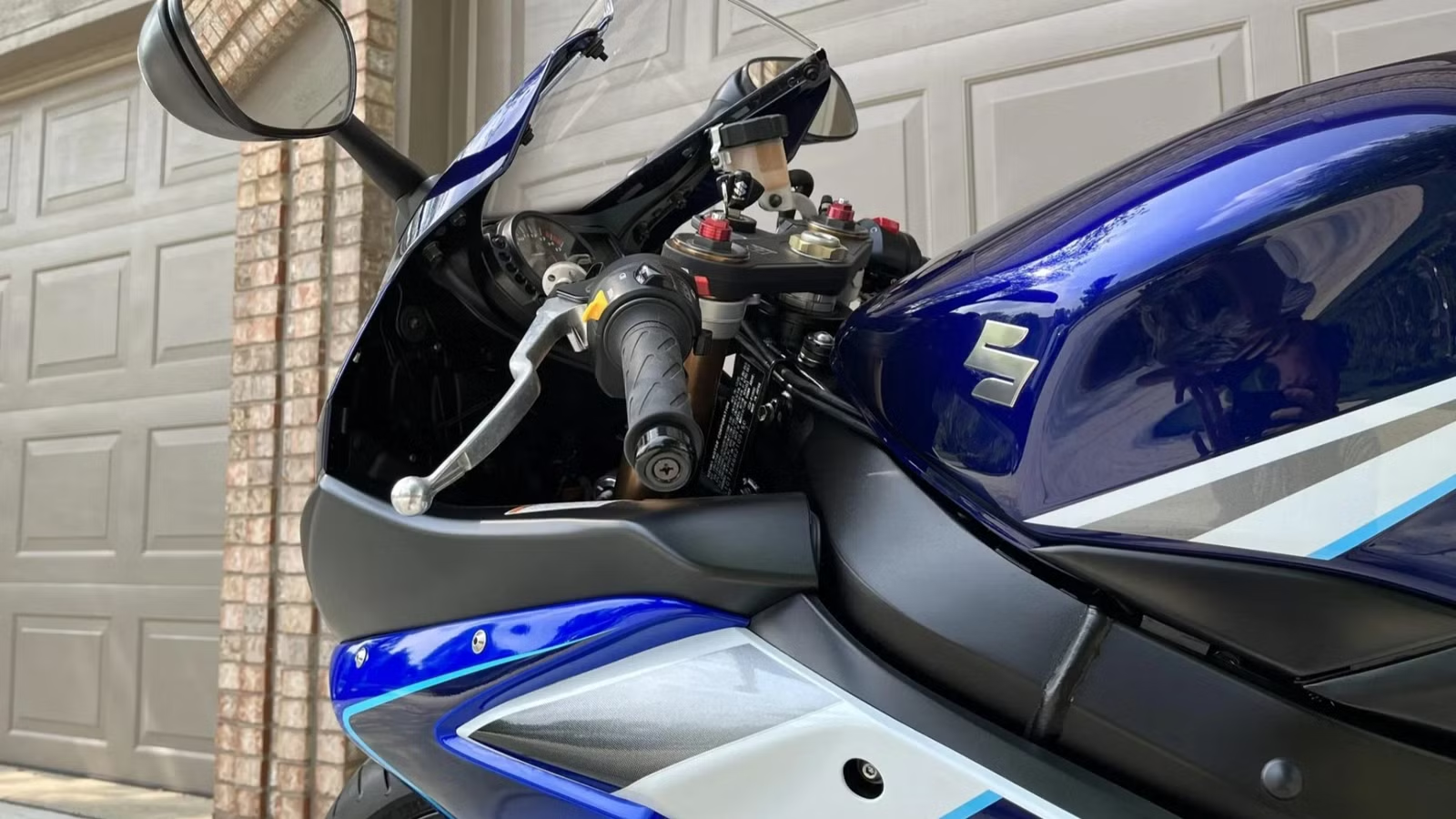
Some performance benchmarks age quietly, forgotten the moment a newer machine claims the spotlight. Others just refuse to go away, no matter how much technology gets thrown at the problem. Suzuki built a motorcycle two decades ago that still shows up in conversations about the quickest production bike ever to hit 60 mph, and it did so with nothing more sophisticated than a throttle, a clutch, and a genuinely skilled rider. A brand-new, six-figure-adjacent flagship from a rival manufacturer just tried to beat that number. It came close.
The Race To Zero That Never Really Ended

Motorcycle manufacturers have chased the fastest possible 0-60 mph time for decades, and for most of that history, the record belonged to whichever bike had the most horsepower and the least weight. That formula held up reasonably well through the 1990s and early 2000s, as Japanese manufacturers traded blows building ever-lighter, ever-more-powerful literbikes with almost nothing standing between the rider’s right wrist and the rear tire. Launching one of these machines hard from a standstill was a genuine skill, closer to a rodeo than a driving test, and the riders who could actually extract a bike’s full potential in the first few seconds were rare.
Then the electronics arrived. Traction control, wheelie control, launch control, and increasingly sophisticated ride-by-wire throttle mapping all promised to close the gap between an average rider and an expert one, turning a genuinely difficult skill into something closer to holding a button and letting the computer handle the rest. On paper, that should have made modern flagships dramatically quicker off the line than anything from the pre-electronics era, since raw horsepower has only gone up in the meantime. In practice, the results have been far less conclusive than the spec sheets suggest, and one number from the mid-2000s keeps refusing to move.
A Two-Decade-Old Number Modern Electronics Still Can’t Clearly Beat


One motorcycle built at the tail end of the purely mechanical superbike era has developed a kind of mythical status among riders who pay attention to acceleration numbers. It arrived with no traction control, no wheelie control, and no launch control of any kind, just a conventional clutch, a razor-sharp throttle response, and a chassis light enough to reward a rider who genuinely knew what they were doing. Getting the fastest possible launch out of it required real mechanical sympathy and a willingness to risk looping the front wheel skyward if the technique was even slightly off.
That bike has been cited for years as the quickest production motorcycle ever recorded to 60 mph, a claim that has followed it through two decades of far more powerful, far more electronically assisted machines without ever being definitively beaten. Modern flagships now routinely produce well over 150 rear-wheel horsepower and lean on launch control systems specifically engineered to extract a perfect start every single time. And yet, when the numbers actually get compared, that old mechanical benchmark keeps landing somewhere between dead even and still slightly ahead. That is a genuinely strange thing for two decades of engineering progress to produce.
The Suzuki GSX-R1000 Sets A Benchmark Nothing New Has Broken

That motorcycle is the 2006 Suzuki GSX-R1000, part of the K5 and K6 generation widely regarded as the high-water mark of the model’s development. Its liquid-cooled inline-four produced 162 horsepower at the rear wheel, a genuinely serious figure for the era, and Suzuki built the whole package around a dry weight of just 166 kg, making it one of the lightest literbikes ever sold. There was no traction control, no wheelie control, and no ride mode selector of any kind, only a conventional cable-actuated throttle and a clutch that demanded to be read correctly every single time. That combination of low weight, strong midrange torque, and zero electronic intervention is exactly what makes the bike’s acceleration numbers so remarkable, and exactly what makes them so difficult to repeat.
The Fastest Run Nobody Should Expect To Repeat

The number most often attached to this bike is a 0-60 mph time of 2.35 seconds, a figure that has circulated across enthusiast media for years and is frequently cited as the quickest production motorcycle launch ever recorded. It is worth being precise about what that number actually represents. That figure has never been definitively substantiated, and a more detailed breakdown of the bike’s real-world performance puts a more grounded estimate at 3.10 seconds, a number that still requires a genuinely skilled rider willing to accept some risk of looping the bike to get anywhere near.
That 2.35 seconds represents a documented best-case, expert-launch peak rather than a number any owner should expect to replicate under everyday conditions. Even the more conservative figure still places the GSX-R1000 solidly among the quickest-launching production motorcycles ever built, electronics or not.
How The GSX-R1000 Stacks Up Against Today’s Electronics-Laden Flagships

The most direct modern test of that old benchmark comes from Ducati’s newest flagship, a bike built specifically to be the quickest-accelerating production motorcycle the Italian manufacturer has ever sold. Comparing the two machines side by side says less about which brand builds better bikes and more about how far electronics have actually closed the gap on raw mechanical talent, and the answer turns out to be closer than most riders would assume.
Ducati’s Newest Flagship Still Can’t Quite Catch It

The 2026 Ducati Diavel V4 RS carries a MotoGP-derived Desmosedici Stradale V4 producing 182 horsepower, a genuinely massive power advantage over the GSX-R1000’s 162, backed by a full electronics suite that includes Ducati Power Launch, wheelie control, and traction control specifically tuned to extract the best possible start. According to Ducati’s own published figures, the Diavel V4 RS reaches 60 mph in 2.43 seconds, a number worth disambiguating carefully since some coverage has mistakenly reported the bike’s 0-100 km/h time of 2.52 seconds as if it were the 0-60 mph figure instead. Even using Ducati’s correct 2.43-second number, the GSX-R1000’s widely cited 2.35 seconds still edges it by 0.08 seconds, a genuinely tiny margin but one earned entirely without electronic assistance.
That gap looks even more remarkable set against the rest of the fastest production motorcycles ever built. The Suzuki Hayabusa, widely cited at 2.47 seconds to 60 mph, and the Yamaha VMAX, commonly cited around 2.50 seconds, both trail the GSX-R1000’s number, and even the flagship Yamaha YZF-R1M, independently tested at 2.6 seconds, lands solidly behind it too. Every one of those figures carries the same caveat as the GSX-R1000’s own number, since precise 0-60 mph testing on motorcycles is notoriously difficult to standardize. Taken together, though, the pattern holds regardless of which specific numbers prove exactly right: a 20-year-old, electronics-free superbike remains at or near the front of a list dominated by machines built decades later with every rider aid available.
The Quiet Case For Buying One Before Everyone Else Catches On

None of this has translated into serious money on the used market yet, and that is exactly what makes the K5 and K6 generation GSX-R1000 worth watching. Values for clean, unmolested examples remain firmly in used-literbike territory, nowhere close to what a bike with this kind of documented performance pedigree might otherwise command. Most buyers shopping this generation are after a cheap, capable track day weapon rather than a piece of acceleration history, which has kept prices grounded even as the bike’s reputation among enthusiasts who actually know the numbers continues to grow.
That gap between reputation and price will not last forever. As more riders learn that a two-decade-old Suzuki with zero electronic assistance still keeps pace with a brand-new six-figure-adjacent Ducati flagship, the K5 and K6 generation stands to gain the kind of recognition that eventually shows up in asking prices. This is not a bike to buy purely as a financial play, and treating it that way misses the point entirely. It is a genuine mechanical achievement worth owning and riding for what it actually is, a reminder that raw talent, both mechanical and human, was never fully replaced by a computer.
Sources: Ducati, Bring a Trailer.

Related posts
Latest Post


No Comments