
The 1987 Kei Car That Revved To 9,500 RPM And Triggered Japan’s 64-HP Gentleman’s Agreement
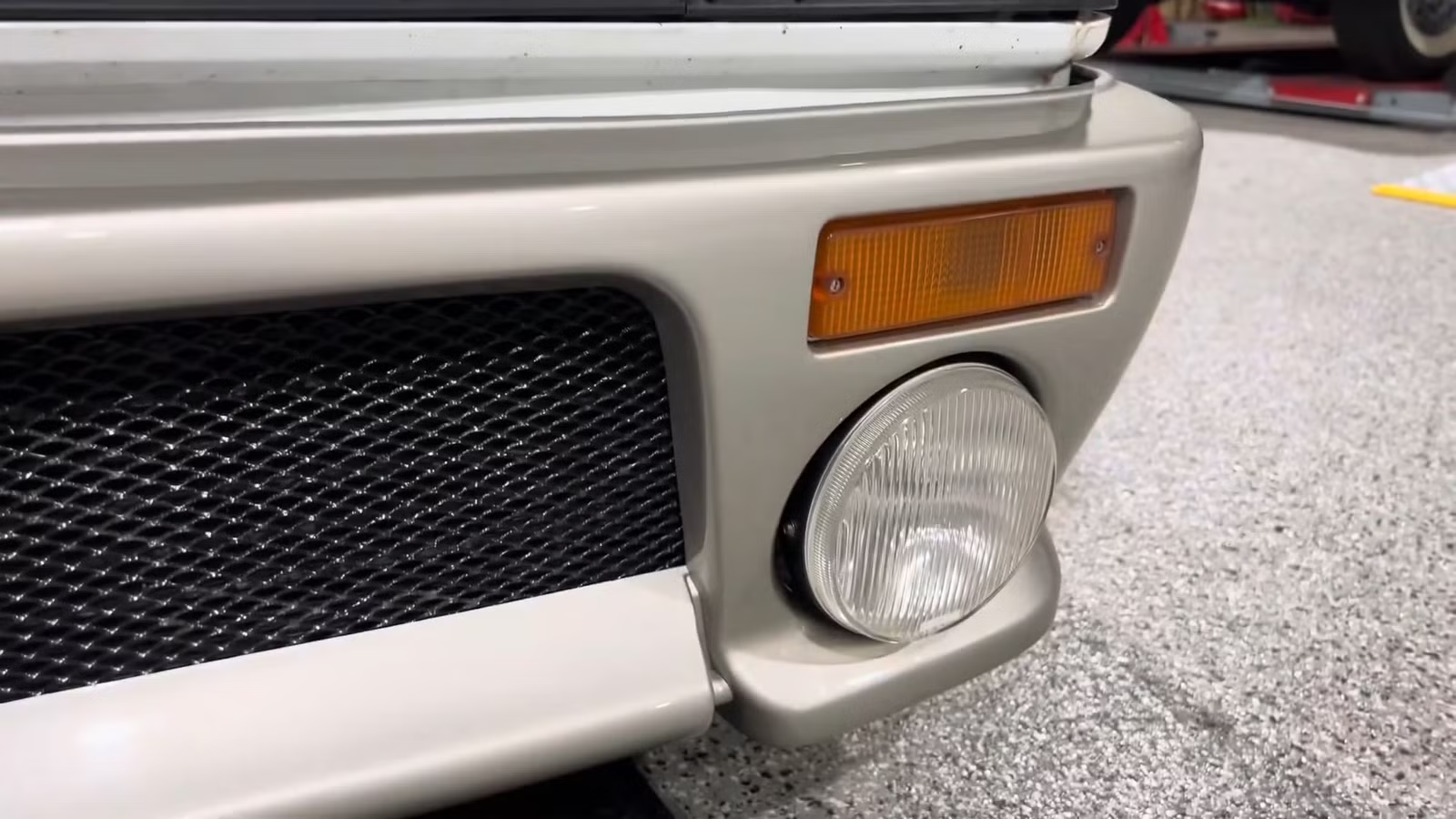
Kei cars were never trying to be intimidating. Japan’s microclass of passenger cars was about being useful, inexpensive, and about as non-threatening as a tricycle, with much of their design dictated by strict limits on vehicle size and engine displacement.

A few cars pushed that ethos far enough to earn spots in Japanese automotive folklore, with one in particular arriving in 1987 with a turbocharged three-cylinder ready to be rung out for all it had to give.
Japan’s Kei-Car Rules Left Almost No Room For Horsepower
Japan’s “kei car” terminology is sometimes thrown around as a loose approximation for “really small vehicle,” but it’s a very specific regulatory designation with firm rules and guidelines aimed at supplying the Japanese market flush with compact, practical cars that people can afford. ‘80s kei car rules limited engine size to 550 cc. By staying under that cap buyers could enjoy a lower tax bill, not to mention reduced ownership costs from maintenance to fuel to repairs.

But that didn’t mean they had to stay boring. Turbocharging was quickly raising the ceiling for what could be done with a minimal-displacement engine, and advances in multivalve cylinder head design, improved electronics, and major leaps in drivetrain technology were all giving engineers more ways to squeeze performance out of designs that retained that hard 550 cc limit.
By the middle of the decade, it was getting hard to deny that kei cars could be speedy. The bigger question was whether manufacturers were going to push each other into a small-displacement horsepower arms race that would eventually lose the plot with respect to what kei cars are even supposed to be.
The Suzuki Alto Works Arrived With 64 HP And A 9,500-RPM Redline

Suzuki was one manufacturer clearly willing to go out on that limb, and introduced the Alto Works in 1987. The company’s unrepentantly practical and inexpensive Alto had already been quietly plugging along as pretty much a model kei car since the late ‘70s, but the Alto Works was something else.
It had a 547-cc three-cylinder engine with dual overhead cams and 12 valves with electronic fuel injection, capped off with an intercooler and a turbocharger that came together for a power output Suzuki rated at 64 PS (about 63 hp). It redlined at 9,500 rpm.
The Alto Works was about more than a zippy motor, though. It was available with full-time four-wheel drive and a five-speed manual, and it even looked the part compared to its non-Works sibling, with more aggressive bodywork and an RS/X performance model.
547 CC And 610 KG Made 64 HP Feel Like Plenty

Sixty-three hp isn’t exactly an eye-popping figure, but keep in mind that the Alto Works RS-X weighed 610 kg, just about 1,345 pounds, and even the “heavy” four-wheel-drive RS-R weighed in below 1,500 pounds. It was less than half the weight of today’s so-called compact cars, and its spirited little three-cylinder was more than eager to show the difference between power and power-to-weight.
With peak power coming in at 7,500 rpm and that 9,500-rpm redline, the Works encouraged drivers to live high in the revs for a driving experience that was lively when you wanted it to be. On paper it was still a kei car. In reality, it would have felt like something different entirely.
Did The Alto Works Really Create Japan’s 64-HP Limit?

Separating fact from legend becomes challenging when evaluating the veracity of the Alto Works as the cause of Japan’s kei-car horsepower limit, especially if you don’t happen to speak enough Japanese to dig through the in-period reading material.
Allegedly, though, the Works was poised to launch with more like 78 hp when the Japanese Ministry of Transport stepped in. It wasn’t a rule or regulation exactly, but some accounts credit that moment with prompting Japan’s major manufacturers to settle on the so-called gentleman’s agreement that would informally draw a line in the sand at 64 PS.
The problem is that the historical record isn’t especially tidy. Some accounts tie the ceiling directly to the Alto Works in 1987, while others place its broader establishment closer to the 1990 changes to kei-car regulations, which increased the displacement limit to 660 cc.
It’s hard to say at this point, and in hindsight it probably doesn’t matter. What really can’t be argued is the fact that Suzuki had delivered something special and proved decisively that kei cars and performance cars were not mutually exclusive.
The 64-HP Ceiling Started A Kei-Car Arms Race

Regardless of to what extent you believe the Alto Works lore and legend, the zippy little car clearly played a role in kei-car history. With horsepower effectively capped, Japan’s automakers found other ways to distinguish themselves in the segment.
Daihatsu delivered the turbocharged Mira TR-XX. Mitsubishi showed up with the Minica Dangan ZZ and its five valves per cylinder. Subaru had the supercharged Vivio RX-R, with all-wheel drive available. Subaru even entered the Vivio in the famously punishing Safari Rally. Colin McRae’s car retired, but another Vivio finished, proof that kei cars had come a long way from being simply the most logical solution for dense urban passenger cars.
Suzuki Kept Building Engines With More To Give

Kei car evolution hadn’t stopped and neither did the progression of the Suzuki Alto Works. Multiple iterations of the motor came and went, eventually moving to the 658-cc K6A, but the power figure remained parked obediently at 64 PS, at least officially.
There’s no doubt, though, that the engines were getting better. Suzuki’s F6A used a cast-iron block and became a go-to for tuners who found that it could handle a lot more power than what Suzuki had been asking of it. Later K6A versions moved to an aluminum block with more modern engine management and more torque, all still rolling off the line with that claimed horsepower in the mid-60s.
As enthusiasts leaned into the platform, 64 hp started looking less like a ceiling and more like a floor, a foundation on which 100-plus-hp builds became common, with some claiming figures closer to 120 despite relatively modest modifications. The implication was that a stock bottom end could tolerate quite a lot and that great gains could be had with setup, boost, and tuning.
Which might be the best legacy for the Alto Works. The rules kept the number on the spec sheet small and the potential to go much further remained on the table. The horsepower battle didn’t end in an OEM boardroom; it just moved into the aftermarket.
Sources: Suzuki

Related posts



Latest Post


No Comments