
How Ford Beat Chrysler To The NASCAR Aero Loophole
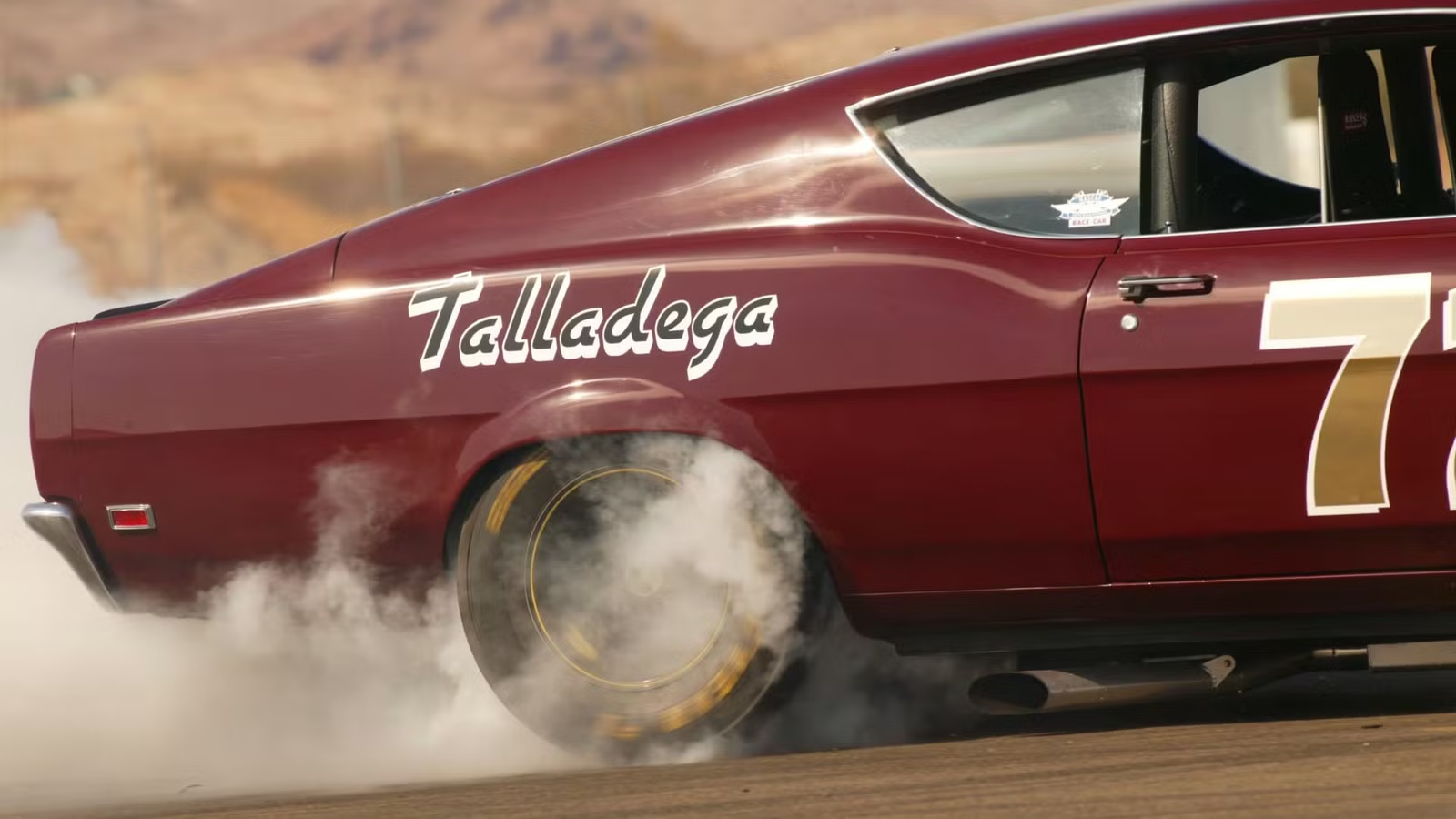
Sure, Chrysler does receive credit for building its massive aero wing cars like the Plymouth Road Runner Superbird and Dodge Charger Daytona. These cars certainly stand out with historical context for their wild aerodynamic designs and racing dominance. However, Ford built a wild aerodynamic car to get around a NASCAR loophole first.

A certain Ford terrorized the track months before the Charger Daytona arrived with its massive rear spoiler wing. In fact, the Charger Daytona might never have existed if this Ford had never been made. It proved that Dodge’s first attempt to beat it needed much more than pure brute force.
Ford Started The Aero Wars
Chrysler had a choke hold on NASCAR with its aggressive HEMI power. Cars like the recently redesigned Dodge Charger were formidable opponents that Ford wanted to leave in the dust. So it built the 1969 Ford Torino a bit differently, shifting its focus from churning out raw engine power to aerodynamics to improve speed while reducing engine strain.

Although it still packs heat with potent power. It uses a 428 cubic-inch (7.0-liter) Cobra Jet V8 engine with 335 hp and 440 lb-ft of torque. This race car accelerates from 0 to 60 mph in about 5.5 seconds with a quarter-mile time of roughly 14.1 seconds. While the street-legal model has a top speed of 130 mpg, the professional racing versions can reach track speeds of about 190 mph.
The engine features a cast iron block, forged connecting roads, and a 735 CMF Holley four-barrel carb. Engineers provided a standard engine oil cooler and power steering oil cooler to prevent overheating during sustained high RPMs. Plus, the chassis includes heavy-duty springs, a robust stabilizer bar, and a distinct staggered rear shock setup.
The 1969 Torino Talladega Was An Instant Success

While the Cobra Jet V8 engine provided tons of power, the Torino Talladega’s unique aerodynamic design helped it achieve new levels of success. The Ford Holman-Moody racing team modified its standard SportsRoof by stretching the hood and front fascia by six inches. The sloping roofline delivers a gradual disengagement of airflow to prevent rear-end lift.
The nose slopes downward to cut air at high speeds. Also, the rear bumper was borrowed from the 1968 Ford Fairlane and modified with a narrowed V-shape to act as an air dam to push air over the car instead of allowing it to drag underneath. Plus, the drop snoot style stops air from getting trapped under the hood and lifting it at high speeds.
Its recessed, flush-mounted grille allows air to flow smoothly and continuously over the front. Ford engineers hand-rolled the rocker panels to lower the car’s overall height and lower the center of gravity by one inch. It reduces turbulent air under the chassis. All of these design features combined to help the Torino Talladega rapidly become a dominant force.

The Ford Torino Talladega won 26 out of 54 Grand National races during the 1969 season and helped Ford win the 1969 Manufacturers Cup. David Pearson came in first and Richard Petty came in second, both driving Torino Talladega models. It won five out of six of its first races, then gained 11 consecutive wins.
Chrysler Tried To Fight Back With The Charger 500

Rivals such as Chrysler couldn’t have Ford embarrassing their cars. So, it built the 1969 Dodge Charger 500 to compete against the Torino Talladega. Its 426 cubic-inch (7.0-liter) HEMI V8 churns out 425 hp and 490 lb-ft of torque. The Charger 500 can accelerate from 0 to 60 mph in 5.7 seconds with a 13.5-second quarter-mile time and top speed of 192 mph.
The 1968 model’s deep-inset front grille acted as a parachute, causing significant drag and front-end lift at speeds around 170 miles per hour. This made the car difficult to handle. So, the 1969 variant received a few updates to fix these problems. It gained a flush-mounted grille, a sloped rear window plug, and a shorter deck lid to improve its aerodynamics.
But the recessed rear window led to tons of aerodynamic drag. Sometimes referred to as a backlight, it created a low-pressure turbulent pocket that pulled the car backward and impacted its top speed. Unfortunately for Mopar fans, these updates weren’t enough, and the Charger 500 couldn’t keep up with the Torino Talladega.
Then The Dodge Daytona Arrived Fashionably Late

|
Car |
Engine |
HP |
Torque |
0-60 MPH |
|
1969 Ford Torino Talladega |
428 ci (7.0-liter) Cobra Jet V8 |
335 |
440 LB-FT |
5.5 seconds |
|
1969 Dodge Charger 500 |
426 ci (7.0-liter) HEMI V8 |
425 |
490 LB-FT |
5.6 seconds |
|
1969 Dodge Charger Daytona |
426 ci (7.0-liter) HEMI V8 |
425 |
490 LB-FT |
5.2 seconds |
Chrysler had to get more aggressive with its approach after learning that it needed more than raw power to win more races. So, the 1969 Dodge Charger Daytona arrived a bit late to the party on September 14 at the Talladega 500. It uses the same HEMI V8 engine with the same power output.
But thanks to aerodynamic advancements, it could accelerate from 0 to 60 mph in about 5.2 seconds and cover a quarter mile in around 13.5 seconds, with a top racetrack speed of 200 mph. It has an 18-inch elongated nose to significantly reduce drag and a 23-inch rear wing for stability at high speeds.
The Torino Talladega won more races, but the Charger Daytona was the first car to break the 200 mph barrier. It also won six races in 1969 and four during the 1970 season before NASCAR implemented rules to crack down on the aero wars. New regulations limited winged warrior cars to a maximum of 305 cubic inches of engine displacement and banned radical aerodynamic features.
Here’s How Ford Got Around NASCAR’s Aero Loophole

In the late 1960s, NASCAR’s homologation rule demanded that manufacturers build a minimum of 500 street-legal models based on their race cars to qualify for the Grand National circuit. As a result, Ford built between an estimated 730 and 754 street-legal 1969 Ford Torino Talladega models.
Ford built a specialized race car disguised as a production model to exploit the rules. Ford rolled the rocker panels inward by an inch along the sides of the car to allow racing teams to mount the body an inch lower without violating NASCAR’s ground clearance rule. It also modified the rear bumper and placed it on the front to create an air dam effect without violating any rules.
The droop snoot and stretched front fenders reduced aerodynamic drag to cheat wind without breaking airflow limits. It certainly played a role in both starting the aero wars and getting winged warrior cars banned. Meanwhile, the Dodge Charger Daytona and Plymouth Superbird get all the credit and lore.
The 1969 Ford Torino Talladega Is An Aero Bargain

About 300 to 350 1969 Ford Torino Talladega models may survive today. Many were raced hard and wrecked. Based on quality, condition, and mileage, these race cars can be sell for serious money. One sold for $355,000 in January 2026. However, they can sell for a fraction of that record price.
Automotive historians estimate that about 300 to 400 1969 Dodge Charger Daytona models currently survive. But only 70 of them have the 426 HEMI V8 engine. Once again, most models were pushed to their racing limits or wrecked. Models with the 440 cubic-inch engine sell for between $300,000 and $400,000.
However, the HEMI models often fetch between $1 million and over $3 million. One model sold for $3.3 million. Both of these historic muscle cars typically go to auction a few times a year. So, despite coming out first and igniting the aero wars that inspired Chrysler to build the Charger Daytona, the Torino Talladega can be found at much lower prices.
Source: Hagerty

Related posts


Latest Post


No Comments