
The Four-Cylinder That Outclassed The 2JZ For A Quarter Of The Price
The Toyota 2JZ is the undisputed king of performance modding. Don’t let LS3 or 5.0 Coyote fans hear you say it, but in that crucial balance of efficiency, block strength, the ability to handle unbelievable levels of boost and power, there really hasn’t been a better engine built in the history of the automobile. With that said, you don’t necessarily need six cylinders or more to make big power achievable. The first obvious source of proof is the Honda K24 four-cylinder. Yet finding one of those is almost as easy as going to the store to buy milk. If you want a 2J-fighting four-cylinder that’s a little less ubiquitous but arguably even more special, there are certainly other options.
How to be a 2J Fighter in a Few Easy Steps

To build a four-cylinder capable of standing toe-to-toe with Toyota’s 2JZ-GTE, you can’t just rely on modern lightweight tricks. Given the nature of current open deck aluminum engine blocks, many of them simply aren’t up to the task of accepting more forced induction boost than it left the factory with. At least, not without a comprehensive teardown and build-up so extensive it invokes the ship of Theseus. Nowadays, every engine is built to an upper tolerance and anything above it is liable to make the block disassemble rapidly. This wasn’t the case in Japan, back before the economic bubble burst.
Back then, JDM engineers were happy to take blank checks from their bosses awash with money, free to overengineer engines to the heart’s content. While aluminum is lighter, and at least nowadays often cheaper to turn into engine blocks, it simply can’t stand the tolerances needed to handle huge boost, and the best and brightest JDM engineers of the ’80s, ’90s, and into the 2000s understood this on a deep level. They also understood that the bore and stroke numbers had to be absolutely perfect, a near-square ratio between 85 and 88 mm to strike a balance between low-end torque and screaming horsepower up in the rev range.

Add ridiculously beefy oiling and cooling systems, and suddenly you were in a position to make an engine as small as two liters make as much power as a V8 three to four times its size. It’s how Toyota was able to make the comparatively massive three-liter 2JZ straight-six capable of handling turbo power that’d make World War II fighter planes jealous. In the case of dedicated 2J performance specialists like Proline Racing and El General Racing, they’ve been able to reach an eye-watering 3,000 hp out of a 2JZ without breaking the block. The thing is, Toyota was far from the only manufacturer that followed this formula. Though, it was undoubtedly the most famous name in the game to do it. Of course, there’s the K24 we already mentioned, which also got that formula down pat to perfection. But don’t get it twisted, they weren’t the only games in town. Arguably, one Japanese OEM followed the formula even more diligently than Honda or Toyota. There was only one problem.

Mitsubishi: Forging World-Class Turbo Engines Through Racing Excellence

Toyota and Mitsubishi had two very different paths toward making their names in the overbuilt turbo engine scene. While the Toyota Supra was tasked at being a viable alternative to established European and American sports cars like the Mustang and the 911, Mitsubishi let the crucible of rally racing dictate the development of its flagship engines. First entering the WRC scene in the 1980s with the Galant VR-4, homologation rules demanded that Mitsubishi sell a road-optimized variant of its rally cars to the public in a mass production capacity. With this in mind, the Galant VR-4’s follow-up, the first-generation Lancer Evolution, was set to become the basis for Mitsubishi’s most iconic automobile in its storied history.
Using the same full-time all-wheel-drive system that made the VR-4 rally cars so effective, the road team took the whole system and shoved it into a roughly 1.5-ton compact sedan platform and called it the Lancer Evolution. Paired with that world-class AWD system, the Lancer Evo didn’t just survive the punishment of international rally racing; it decimated the competition in a manner not seen since the Audi Quattro was brand new. It carried iconic Finnish driver Tommi Mäkinen to four consecutive WRC Drivers’ Championships from 1996 to 1999.

Though the Evo wouldn’t reach American shores officially until 2003 with the introduction of the USDM-spec Evo VIII, the car reached international superstardom via video games like Gran Turismo, and later, the Colin McRae Rally series. Little did the youngsters playing those games realize, the engine in that little Evo was so overbuilt, so capable, and so well-regarded for its performance that it’d give their beloved 2JZ a run for its money.
The 4G63T: Factory Supercar-Slayer Performance

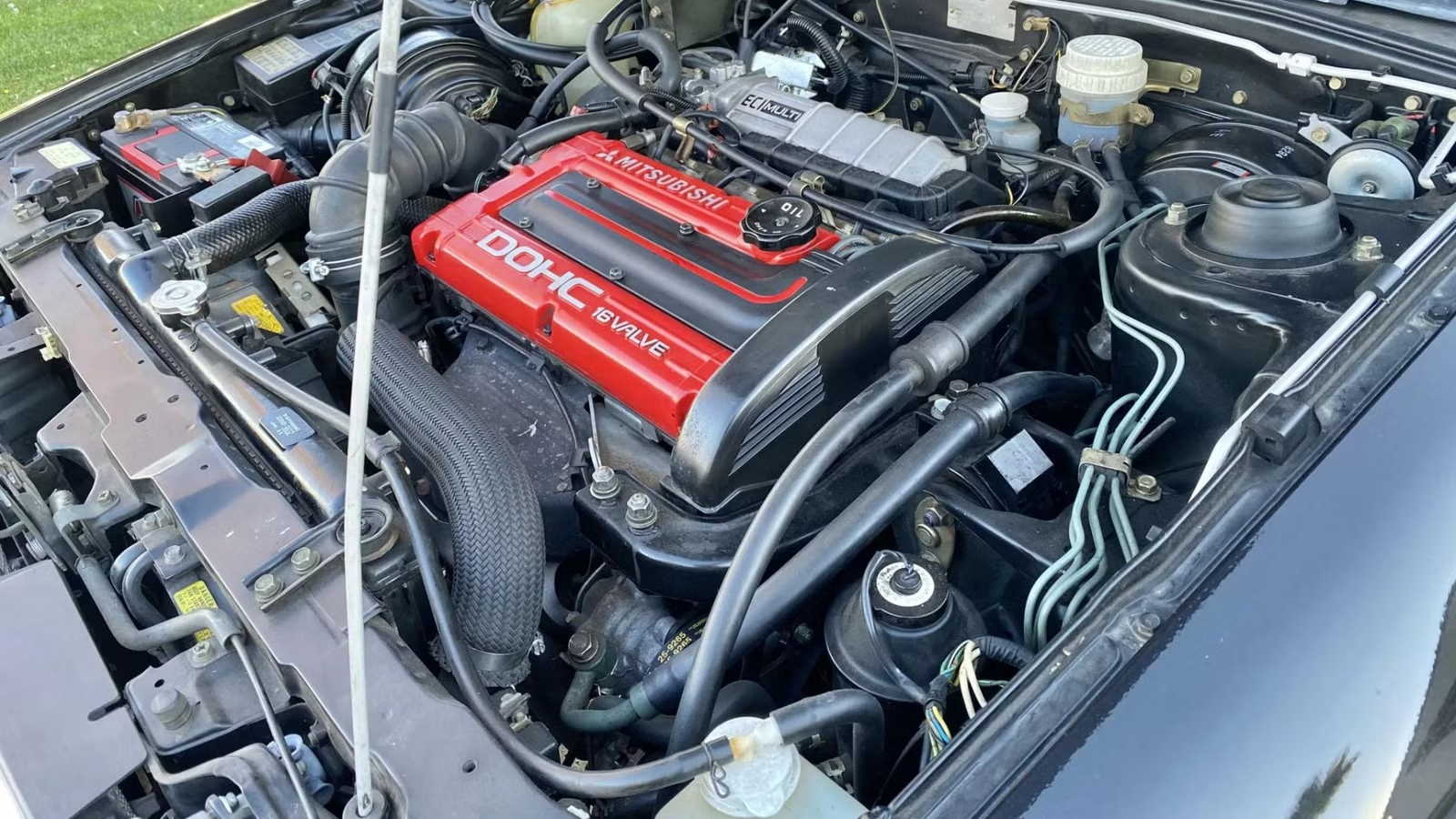
For nine glorious generations, Mitsubishi’s 4G63T two-liter four-cylinder engine was one legitimate bridge between six-cylinder turbo JDM motors like the 2JZ, and smaller four-pots with similar levels of boost potential. Sporting a deep-skirt cast iron block, along with that crucial 85 mm bore and 88 mm stroke, this little cinder block of an engine is stout enough to handle far more boost than it left the factory with. Produced with a seven-bolt crankshaft after May 1992, that little bit of extra strength deep in the core of the engine paid huge dividends in aftermarket performance.
With a stock bottom end, these motors can easily turn out 400 to 500 horsepower with just basic bolt-ons. In fact, the UK-spec Mitsubishi Evo VIII FQ-400 made 403 hp to the wheels with a factory tune, a bigger intercooler, and a reworked turbo. At the time, that was one of the highest hp-per-cubic-centimeter figures of any engine in the entire world. Not including modern hybrids and PHEVs that inflate the power figure by adding electric motors, it’s still a staggeringly high figure for a small ICE powerplant. If you decide to go all-out and swap everything for forged internals, larger-diameter turbochargers, and beefed-up oiling and cooling, these blocks can put down 1,000 hp or more, reliably, without blowing up after a handful of pulls.

As wonderful an engine as it was, the 4G63T couldn’t survive newly-minted emissions laws as the 2000s rolled into the 2010s. By the time the final generation, the Evo X, was ready for production, an altogether different two-liter turbo engine, the 4B11T, was Mitsubishi’s best attempt to capture that same magic in the modern age. With 291 horsepower on tap in the US market, or 276 in Japanese and European markets, the power was definitely there. Yet, with a die-cast aluminum block and an open deck and four-bolt main bearing caps, there simply wasn’t the same potential for insane modifications without a complete engine teardown. By 2016, the last Evo X had rolled off the assembly line, and along with it went almost all of the sporting credentials of the entire Mitsubishi lineup. From then on, the company transitioned to selling boring, humdrum crossovers in North America, alongside the astonishingly cheap Mirage hatchback.
Every Bit the Match for a 2JZ

Make no mistake about it, comparing a 4G63T to a 2JZ isn’t just a fun thought experiment. It’s actually a legitimate dilemma for tuners and wrenchers across the world. Both are deep-skirt iron block beasts with the spirit of a bygone era when engines were allowed to be overengineered. Both command “Evo and Supra taxes” that make them cost a pretty penny for folks who want to swap them into projects in their own garages, and both are so beloved by their respective fanbases that they still find their way into restomods years after they left production service.
Whichever engine you call your favorite will ultimately come down to which manufacturer you support more. However, there are plenty of JDM fans out there who love both. Then again, you can only have one under the hood of your car. So, which one’s it going to be? Let us know in the comments down below.
Source: Mitsubishi, Toyota

Related posts



Latest Post


No Comments