
The 1970 Chevy Chevelle LS6 Cost A Third Of A Family’s Income. Here’s What It’s Worth Today
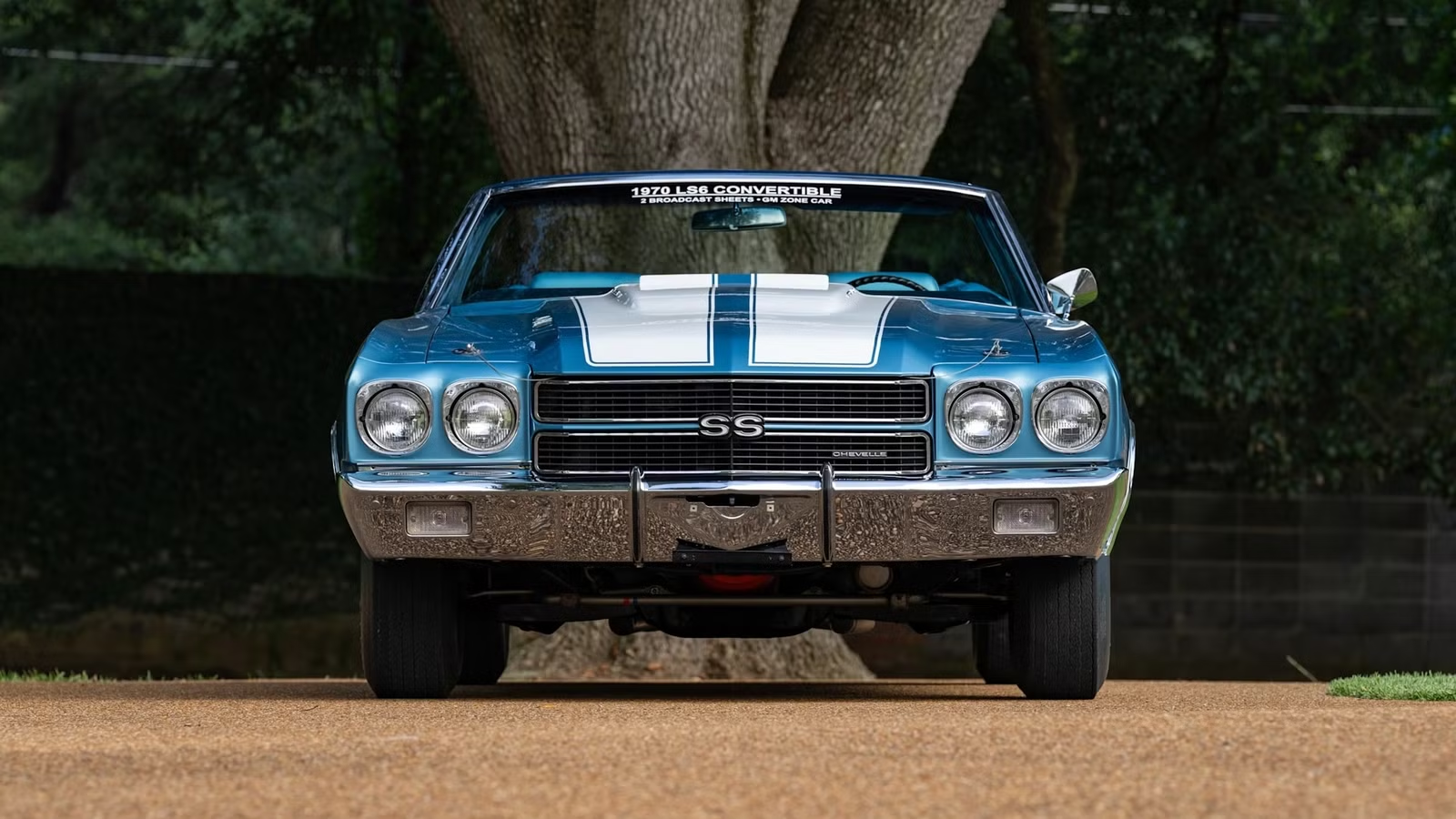
The 1970 Chevrolet Chevelle SS 454 LS6 packed a factory-rated 450 hp and 500 lb-ft of torque, and putting one in the driveway took more than a third of what the median American family earned that year. Today, a genuine example can sell for less than $100,000 or command several hundred thousand dollars, and exactly how far comes down to condition, originality, and paperwork.
More Than A Third Of A Year’s Income Bought The Meanest Chevelle Chevrolet Ever Rated

Getting into an LS6 meant working down a long order form. A buyer started with a V8 Malibu Sport Coupe at $2,809, added the $503.45 SS 454 package and the LS6, then picked a transmission, because the SS 454 couldn’t be ordered without one. Choose the M22 four-speed at $221.80, and the bill reached $3,797.55 before a single extra, tax, or delivery charge. Prefer the Turbo Hydra-Matic 400, and that transmission line alone climbed to $290.40. Against the $9,870 median family income for 1970, that’s about 38% of a household’s entire year. The funny part is how little of that went on the engine.
Since the SS 454 package already came with the 360-hp LS5, stepping up to the LS6 cost $263.30 for an extra 90 hp, or roughly $2.93 per horsepower. Hardly anyone stopped there, either. Cowl induction, power steering, gauges, and the rest of the options sheet pushed plenty of LS6 orders higher still. This Chevelle was a serious purchase decades before anyone called it a collectible. What all that money bought was the angriest version of Chevrolet’s 454-cubic-inch big-block, rated at 450 hp gross at 5,600 rpm.

Getting there took 11.25:1 compression, domed pistons used in no other engine, square-port heads with 2.19-inch intake valves, a Holley four-barrel on an aluminum intake, and a forged steel crankshaft built to live with all of it. The mechanical-lifter camshaft was the same one Chevrolet used in the 375-hp 396, which tells you exactly what kind of engine this was meant to be. That gross figure was measured to period standards and won’t line up neatly with a modern net rating, but it made the LS6 the hard-charging version of the Chevelle, not merely a Malibu with a large engine.

Torque is what made the car feel savage from low speed. With 500 lb-ft arriving at 3,600 rpm, a driver did not need to wind the 7.4-liter V8 to the moon for the Chevelle to move with real intent. That low-end shove suited a heavy, rear-drive midsize coupe, and the M22 “Rock Crusher” four-speed became part of the legend for manual-transmission cars.
Why A Real LS6 Is Worth More Than One That Looks The Part

Chevrolet sold the LS6 option in 4,475 Chevelles for 1970, spread across the Malibu Sport Coupe, the convertible, and the car-based El Camino pickup. There’s no official breakdown by body style, so nobody can say precisely how many of each left the factory. It was a one-year deal, too. For 1971, the LS6 moved to the Corvette alone, rated at 425 hp, and just 188 buyers ordered one.

Registry records suggest that 5,448 LS6 engines were built in total, which means 973 of them never went into a new Chevelle at all. Those were service engines, sold as replacements, and any one of them could end up in a Chevelle that left the factory with something milder. So a correct LS6 under the hood proves nothing on its own. Even the stamped engine code has to match the rest of the car, since CRV-coded LS6 engines were built for the M22 four-speed and CRR-coded ones for the Turbo Hydra-Matic 400 automatic.
Collectors pay for evidence as much as horsepower. Build sheets, the original Protect-O-Plate, matching engine and transmission stampings, partial VINs, and a consistent production history help establish whether a Chevelle left the factory as an LS6. The cowl tag can confirm details about the car’s body, paint, and trim, but it doesn’t prove the LS6 engine option. Two Chevelles with identical stripes, hoods, and badges can sell for vastly different prices, and the documentation can make all the difference.
Six Figures Is Now The Price Of Admission

The auction results show exactly how wide that gap runs. A manual-transmission LS6 sold for $231,000 at a Florida auction in January 2026, while another LS6 Chevelle changed hands in Houston that April for $97,900. Even the cheaper car landed a whisker short of $100,000. A spread that wide almost always comes down to condition, originality, and proof, which is this entire market summed up in two transactions.
Convertibles are in a class of their own. A four-speed LS6 convertible sold for $770,000 at that same January 2026 sale, reported as the most anyone has paid for a Chevelle at public auction. The convertible was always the rarest way to order an LS6, and buyers now price it like one. Coupes are the realistic entry point, and even they demand six-figure money once the paperwork checks out. Spend $3,797.55 in 1970, and you drove home in the highest-rated Chevelle Chevrolet ever sold. A properly documented one now goes for about 60 times that, and the folder in the glove box is doing as much of the work as the 454 under the hood.
Sources: Bring A Trailer, Mecum, Classic.com, Hagerty Valuation Tool

Related posts


Latest Post


No Comments