
The 18-Month GMC Side Project That Became The Performance Truck Blueprint
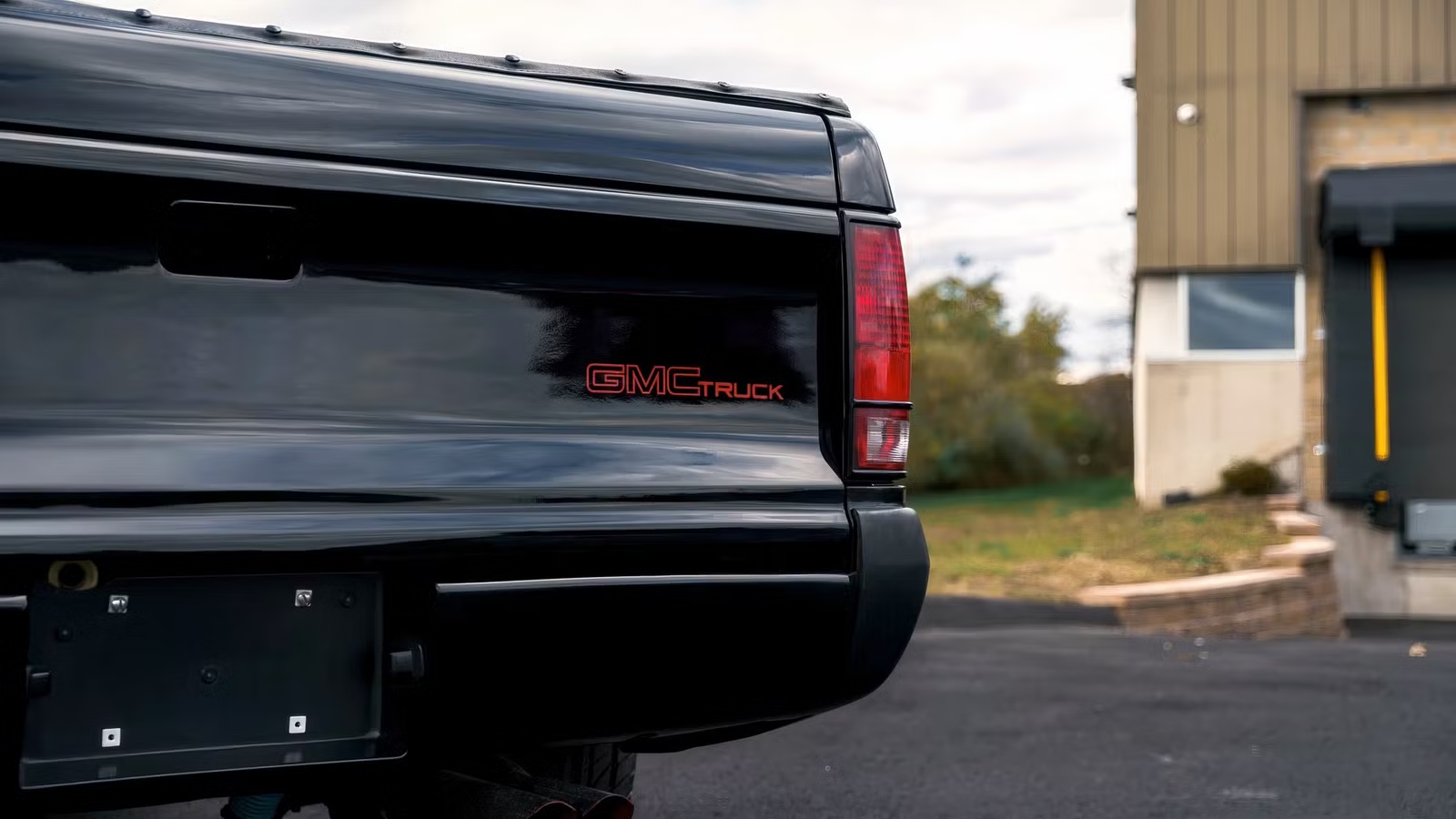
In the early 1990s, a small American pickup embarrassed expensive sports cars and challenged the established performance hierarchy. Its development reportedly took just 18 months and cost a fraction of what General Motors normally spent creating a new performance vehicle. The project emerged from an unusual mix of drag racing enthusiasm, existing GM components, and unconventional engineering.
GM Had A Performance Problem That Ordinary Pickup Trucks Couldn’t Solve

By the late 1980s, General Motors had already demonstrated that American performance didn’t require a massive V8. The turbocharged Buick Grand National and its more powerful GNX sibling had turned an ordinary-looking coupe into a serious sports car competitor. However, production ended in 1987, leaving GM without a similarly affordable turbocharged performance machine. The Corvette remained its flagship sports car, but the Buick had attracted buyers who wanted extraordinary acceleration without exotic-car prices.
GMC program manager Kim Nielsen recognized that opportunity. An enthusiastic drag racer, Nielsen believed GM could recreate some of the Grand National’s excitement using an unlikely platform: a compact pickup. GM already produced suitable engines, transmissions, and four-wheel-drive hardware. Combining those components could create an inexpensive performance vehicle without starting from scratch.
An 18-Month, $14 Million Experiment Rewrote GM’s Development Rules


Turning that idea into a production vehicle meant challenging GM’s traditional development process. Some accounts describe an initial estimate of approximately seven years and $200 million, although other historical reports cite even greater costs. Either way, conventional development threatened the project. Nielsen’s alternative relied on existing GM parts and outside specialists, including Production Automotive Services (PAS). The company had experience with performance projects such as the turbocharged 1989 Pontiac Trans Am.
Early prototypes explored Buick’s turbocharged 3.8-liter V6 before packaging and reliability concerns steered development toward GM’s larger 4.3-liter engine. Combining turbocharging with all-wheel drive proved especially promising, delivering tremendous acceleration without overwhelming the rear tires. Nielsen’s team reportedly completed development in approximately 18 months for $14 million to $14.5 million. That was remarkably inexpensive compared with conventional estimates, especially considering the performance the finished vehicle would deliver.
The 1991 GMC Syclone Used Turbo Power And AWD To Beat Sports Cars Off The Line

The resulting vehicle was the 1991 GMC Syclone, a compact pickup based on the GMC Sonoma. Its black paint, matching aerodynamic body cladding, lowered suspension, and red badges gave it a purposeful appearance without making it look particularly exotic. Underneath, however, GMC had created something extraordinary. Its turbocharged 4.3-liter LB4 V6 produced an official 280 horsepower and 350 lb-ft of torque, with some period publications quoting approximately 360 lb-ft.
A Mitsubishi TD06-17C turbocharger supplied roughly 14 psi of boost, while a Garrett water-to-air intercooler helped control intake temperatures. Low-compression pistons and Corvette-derived throttle-body hardware supported the engine’s performance. A four-speed 4L60 automatic transmission transferred power through a full-time all-wheel-drive system adapted from the Chevrolet Astro and GMC Safari vans. Its 35/65 front-to-rear torque split helped the truck launch hard without turning its rear tires into expensive smoke machines. The automatic also allowed drivers to build boost before launching.

The results were remarkable. GMC advertised a 4.6-second 0–60 mph time and a 13.4-second quarter-mile, while commonly cited performance figures range from approximately 4.3 to 4.6 seconds to 60 mph and 12.9 to 13.4 seconds through the quarter-mile. Independent tests varied – in September 1991, Car and Driver recorded 5.3 seconds to 60 mph and a 14.1-second quarter-mile, beating a Ferrari 348ts that needed 6.0 and 14.5 seconds, respectively. The Syclone also challenged the standard C4 Corvette in straight-line acceleration. The Ferrari remained faster at higher speeds, but the pickup’s launch performance made headlines. Who needed an Italian exotic when a GMC could deliver that kind of surprise?
The Syclone Sacrificed Truck Utility And Became A Rare Collector’s Item

The Syclone’s performance came at the expense of traditional pickup usefulness. GMC lowered its ride height and softened its suspension to improve road behavior and traction, limiting its ability to carry heavy loads. The owner’s manual specified a payload capacity of just 500 pounds, and original promotional material mentioned towing figures around 2,000 pounds when properly equipped, but contemporary guidance discouraged towing. The Syclone was clearly better suited to drag-strip launches than hardware-store deliveries. Its bed remained useful for light cargo, provided nobody confused it with a real workhorse.
Its short production run eventually strengthened its collector appeal. GMC built approximately 2,995 examples for 1991, with three additional units commonly reported for 1992. Surviving trucks now command widely different prices depending on mileage, originality, and condition. A roughly 25,000-mile example sold for $37,985 through Hagerty Marketplace in June 2025, while a remarkably preserved 380-mile truck reached $130,000 on Bring a Trailer in May 2025. Those results demonstrate how collectors value the best survivors, although heavily modified or higher-mileage trucks generally attract less money.
The Syclone’s Short Production Run Helped Shape Decades Of Performance Trucks

Although the Syclone quickly disappeared, GMC continued developing its formula. The 1992–1993 GMC Typhoon carried the same basic turbocharged V6 and all-wheel-drive setup into a more practical SUV body. Its additional seating and enclosed cargo area made it easier to live with, although extra weight slightly reduced acceleration. Ford then introduced the first-generation F-150 SVT Lightning in 1993, using a naturally aspirated 5.8-liter V8, rear-wheel drive, and sport-tuned suspension. Its approach differed from GMC’s, but both trucks demonstrated that performance could become a pickup’s main selling point.
Later performance pickups took the concept further. The second-generation Lightning adopted a supercharged V8 and focused on street acceleration, while the Ford F-150 Raptor R and Ram 1500 TRX brought enormous horsepower to high-speed off-road driving. None followed the Syclone’s blueprint exactly, and it would be misleading to credit GMC with directly inspiring every successor. Nevertheless, the Syclone helped legitimize factory-built performance trucks. It also demonstrated that traction and clever engineering could matter more than outright horsepower. For a pickup with a 500-pound payload, that’s an impressive legacy to carry.
Source: GMC, Car and Driver, Bring a Trailer

Related posts


Latest Post


No Comments