
The Only Truly Authentic Vintage Motorcycle You Can Still Buy Brand-New In 2026
Motorcycles are not rational choices for the most part; most of us don’t buy one because it makes financial sense. We buy them because they make us feel something. That pulse in the frame, warp-speed acceleration, exposure to the elements, and the thrill of danger all make us feel alive. However, modern engineering has systematically damped those very sensations in the name of emissions, refinement, and safety. Showrooms are full of motorcycles designed to be as easy to use as a consumer appliance. But if you want a truly simple and vintage experience, there might just be only one bike you need to buy.
Corporate Cost-Cutting Homogenized The Modern Neo-Retro Segment

When building a modern classic motorcycle, manufacturers default to one of two paths. They either utilize an existing naked bike platform and give it a new set of clothes to make it look like a vintage motorcycle, or they develop a new product, but they all tend to default to what works best. That is mostly a parallel-twin with a 270-degree firing order, or in some rare cases, a 90-degree V-twin. In this way, the modern neo-retro motorcycle has been homogenized. It might make great business sense, but it is disappointing. Gone are the mechanical machines that defined an era of motorcycling, all because it doesn’t make sense to a corporation’s balance sheet.
Kawasaki Has A History Of Engineering Defiance

If you’re looking for a mechanical outlier on two wheels, there are good odds that you’ll find a Kawasaki among them. It was the first to slap a turbocharger onto a production motorcycle in the 1970s with the GPz750 Turbo; it held the record for the largest twin-cylinder production motorcycle for two decades with the Vulcan VN2000; and it remains the only manufacturer to sell a supercharged motorcycle to this day.

When it turned its sights on the neo-retro segment, it decided to pay homage to the roadsters that its target audience grew up with. The idea of combining old-school tech like a 360-degree firing order and a bevel gear drive valvetrain with modern metallurgy and manufacturing tolerances hadn’t quite occurred to anyone else yet, and Kawasaki’s history of engineering solutions meant it was something that nobody expected.

The Kawasaki W800 Is The Answer To The Prayers Of Neo-Retro Perfectionists

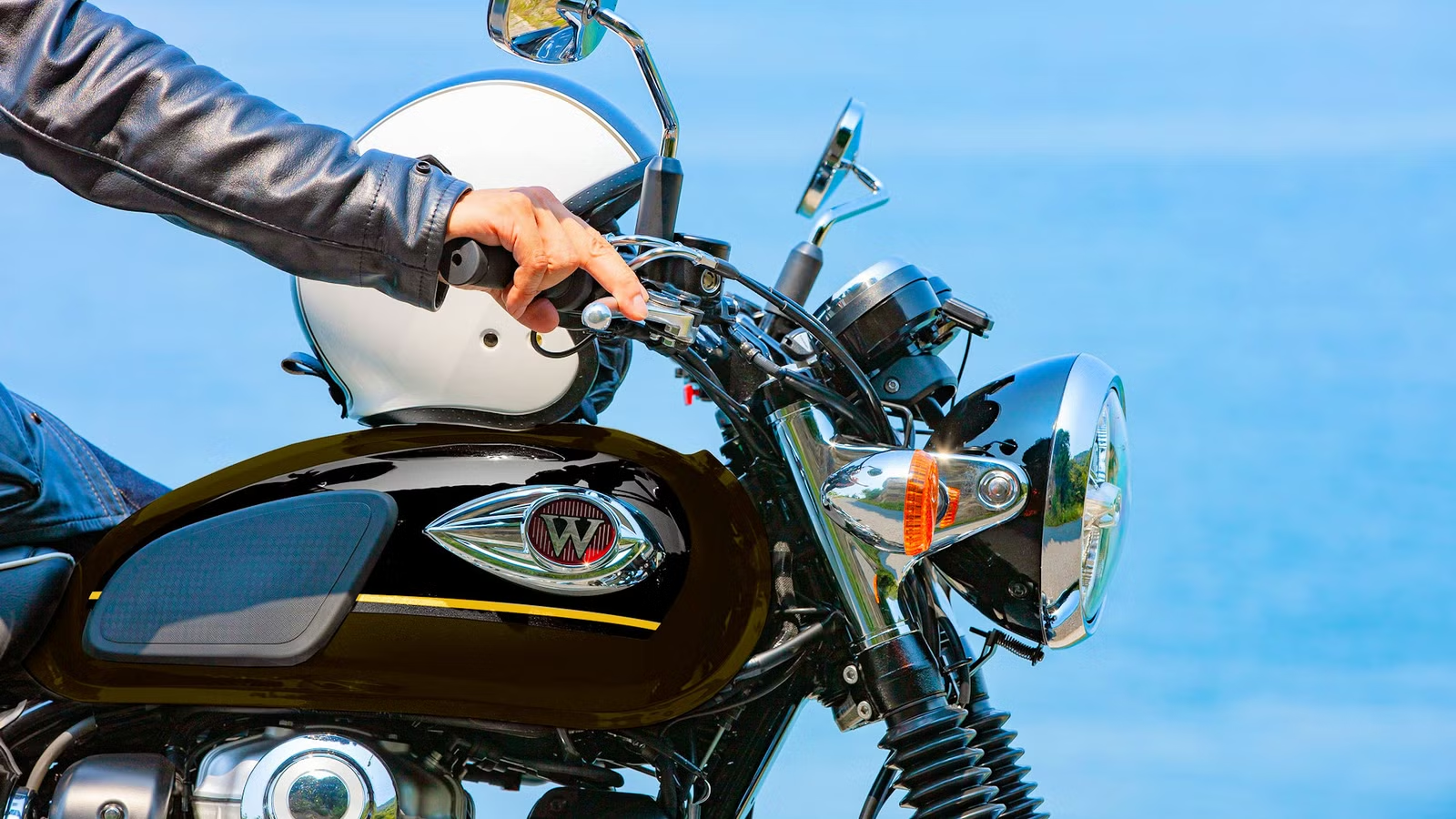
The W series of motorcycles has so much history that when it first launched, the W800 would simply have been a standard motorcycle for the time. It is many decades later now, and the W800 is a bona fide neo-retro motorcycle with a smaller sibling that is affordable and perfect for a first-time buyer. Scratch that – it is the only truly authentic vintage motorcycle you can still buy brand new in 2026, because it retains characteristics like air cooling, a 360-degree firing order, gear-driven cams, and a cable throttle. All of these things would have been right at home on an old motorcycle!
The Only Period-Correct Japanese Roadster Costs $10,699

The W800 is priced at $10,699, which puts it in a gap between retro-styled motorcycles at the premium end. It is also the only Japanese heritage motorcycle available, which makes it unique, and its reliability gives it value. Not to mention that the W series has been around long enough that it has a heritage of its own. To be honest, it is worth buying just for its character.
Bevel-Gear Cams And A 360-Degree Crank Deliver Authentic Mechanical Soul

The W800 has one of the last engines in production today that echo ‘old’ motorcycle tech. This is a parallel twin engine with an SOHC valvetrain and two valves per cylinder. It is air-cooled and fuel-injected, topped with a 360-degree firing order. So both pistons move up and down in unison, like old British twins used to. Today, only the Benelli 500 cc twins use the same firing order, but they are modern engines in all other respects. The Kawasaki even uses bevel gears to drive the valvetrain rather than a timing chain!

Diving deeper, this is a 773 cc engine that is slightly long-stroke and has an extremely relaxed 8.4:1 compression ratio. It generates an equally relaxed 51 horsepower at 6,500 RPM and 46.5 pound-feet at 4,800 RPM. It uses a five-speed gearbox and a final chain drive to send power to the wheel. This engine isn’t one of the most powerful retro-styled bikes, but it is very torquey and smooth, and the rev ceiling is not really low compared to the competition. It offers a wholly unique experience among motorcycles today with its vintage vibe.
A Double-Cradle Steel Frame Balances Period Nostalgia With Modern Handling

The W800’s double cradle tubular steel frame brings retro cool without the headaches, just like the engine does. And just like the engine, it offers modern levels of quality, feel, and feedback within its constraints. The suspension is simple: 41 mm forks at the front and twin coilover shocks with preload adjustment at the rear. The rear springs are single-rate springs. There is 5.1 inches of travel at the front, and 4.2 inches at the rear.

There are disc brakes at both ends, with a 320 mm disc at the front and a 270 mm disc at the rear. Both are paired with a two-piston floating caliper. The spoke wheels have a 19/18-inch size front to rear, and need tubes for the tires. The chassis is simple and rides and handles really well, although progressive springs at the rear would have made the ride more comfortable.
An Upright 31.1-Inch Saddle Anchors Classic Standard Ergonomics
The W800 is a good-sized motorcycle, with a length of 86.2 inches, a width of 31.1 inches, and a wheelbase of 57.7 inches. The seat height is 31.1 inches, which makes it perfect as a first bike for retro fans, as the upright position makes it easy even for beginners to handle. The ground clearance is 4.9 inches, the tank can hold 4 gallons of fuel, and the curb weight is 498.3 pounds. The slightly heavy weight is due to the cradle frame, but it is quite manageable on the move.
Analog Twin Pods And Period Amber Lenses Preserve Vintage Purity

The W800 deliberately keeps things retro with its features but is still worth every penny. It sports a twin-pod analog cluster with a speedometer in one pod and a rev counter in the other. The speedometer has an LCD that displays information like an odometer, trip meters, and a clock. A fuel gauge is conspicuous by its absence; there is only a low fuel warning lamp. ABS is present, but there are no other modern safety devices. Despite the fuel injection, this is a cable throttle.

Kawasaki has given it an LED headlamp, but it is a round unit divided into six sections – four are dedicated to low beam, and two to high beam. The high beam sections have pilot lamps in them, to give the headlamp unit the illusion of being fully lit even with just low beam, like an old halogen and reflector unit. The turn signals are traditional bulbs with period amber lenses. Surprisingly, the hand levers for the brake and clutch are adjustable – five positions for the brake lever, and four for the clutch lever. A center stand is included as standard.
Modernized Bonneville And Moto Guzzi Rivals Challenge The W800 On Tech

The W800 is priced closely with two other genuine roadsters that have arguably just as much heritage. The $11,495 Triumph Bonneville T100 has British cool that will never go out of style, although it has modernized itself with its 270-degree liquid-cooled parallel twin. You still get a 5-speed gearbox, but safety is better with its by-wire throttle and switchable traction control.

The $10,490 Moto Guzzi V7 Special is the kind of roadster that will make you forget about horsepower. However, it also offers a Brembo four-piston front brake caliper and adds a sixth speed to the gearbox. Oh, and don’t forget that iconic longitudinal 90-degree V-twin and shaft drive. This makes it quite the bargain. However, if you’re looking for a bargain on a budget, the $6,149 Royal Enfield INT 650 will do nicely – it celebrates the simplicity of the W800 but in a slightly more modern and definitely more affordable package. It doesn’t have the same level of performance, though.
Source: Kawasaki USA

Related posts




Latest Post


No Comments