
The ’60s Ford Muscle Car That Was Too Powerful For Its Own Good
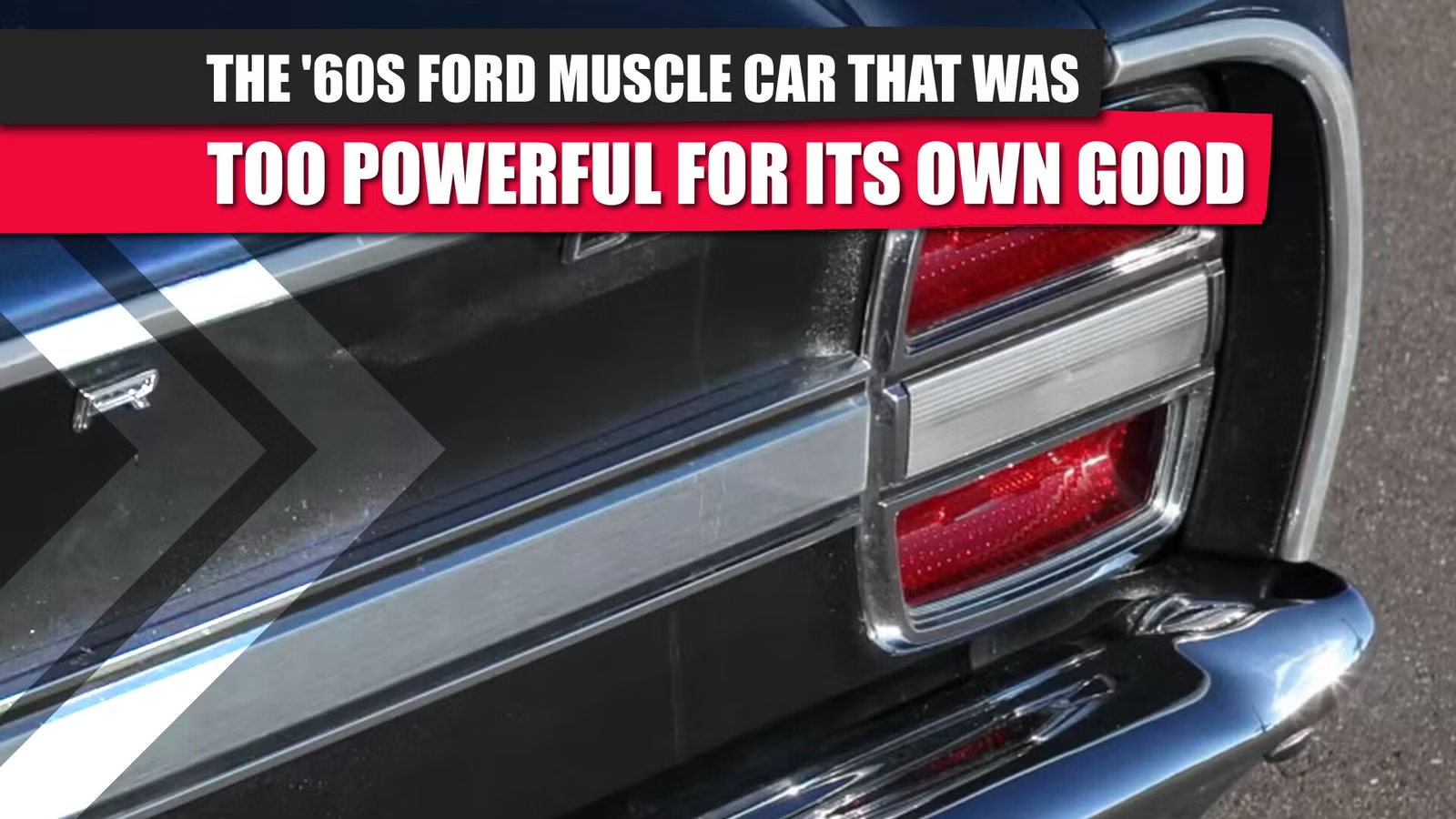
Few muscle cars from the golden era carry a story as wild as this one. Ford engineered a street-legal race weapon so effective that the sanctioning body it was built to conquer eventually had no choice but to ban it. Born from the ruthless logic of homologation, the 1969 Ford Torino Talladega was shaped by wind tunnels and competition rules rather than showroom appeal — and it showed. Its extended nose, flush grille, and lowered stance weren’t styling exercises; they were aerodynamic solutions designed to slice through superspeedway air at triple-digit speeds.

But raw speed has consequences. Capable of topping 140 mph, the Talladega exposed the limits of its street-spec brakes and tires in a hurry. Unpredictable and demanding at the edge, it was a car that rewarded the prepared and punished everyone else. Racing officials eventually outlawed it for being too fast for the rule book to handle — which, depending on how you look at it, is the highest compliment a muscle car can receive.
The Slippery 1969 Ford Talladega Was Too Fast For NASCAR
Ford built the 1969 Torino Talladega as a homologation special to meet NASCAR’s production rules. The league required manufacturers to produce at least 500 road-legal units of any model they planned to race. Using the chassis of the Ford Torino, Ford responded by producing 750 units of the Talladega, each one purpose-built to dominate NASCAR’s speedways.

What set the Talladega apart was its comprehensive aerodynamic upgrade package. Ford extended and reshaped the front end, installed a flush-mounted grille, and modified the rocker panels to lower the car’s overall ride height. The nose was six inches longer than the standard Torino’s, the new short chrome bumpers doubled as spoilers, and the flush-mounted grille and headlights improved airflow, while the rear bumper was a modified and narrowed piece from the 1969 Mercury Cyclone. Together, these changes reduced drag and improved high-speed stability on the track, producing a car that could cut through the air far more efficiently than the standard Torino.
The Talladega used the big-block 428 cubic-inch Cobra Jet V8. Combined with the aerodynamic body, this setup allowed the car to reach top speeds well beyond 140 mph. That level of performance was ideal for the track but far less manageable on public roads.
On the street, the Talladega’s high-speed potential exposed serious flaws — it was simply too fast for its brakes and tires. Running on standard street rubber and relatively modest drum brakes, the car was considered unstable and difficult to control at the upper end of its speed range. The average street driver often found it hard to manage in emergency situations or under heavy braking. Ford had also stripped out comfort features to save weight, making clear that this was a race car first and a road car second.
The Talladega helped ignite NASCAR’s Aero Wars, a brief but intense era when manufacturers pushed the limits of speed and design. By 1971, NASCAR banned extreme aero cars with big-block engines, citing safety concerns and competitive imbalance. The Talladega had done its job too well, proving itself too fast for the rule book to handle.
The ’69 Ford Talledega Packed 428 Cobra Jet Big Block Muscle
Engine Specs
|
Engine Type |
Naturally Aspirated V8 |
|---|---|
|
Displacement |
7.0 liters (428 cu-in) |
|
Power |
335 hp at 5200 rpm |
|
Torque |
440 lb-ft @ 3400 rpm |
|
Transmission |
3-Speed Automatic |
|
Drive |
Rear-Wheel-Drive |
|
Carburetor |
Holley 735 CFM 4-barrel |
|
Compression Ratio |
10.6:1 |
(Source: Ford)
1969 Ford Talladega – Technical Highlights
- Road-legal Talladegas used the C6 3-Speed Automatic.
- Only NASCAR-Ready racing models offered the option of a manual.
- A 9-inch Ford rear end with a 3.25:1 ratio was standard, an optional 3.50:1 rear gear ratio was available.
- All production Talladegas were equipped with the Competition Suspension Package.
- No factory air conditioning or power windows were available to save weight.
Under the hood, the 1969 Ford Talladega packs the 428 cubic-inch Cobra Jet big-block V8. Factory-rated at 335 hp at 5,200 rpm and 440 lb-ft of torque at 3,400 rpm, this engine delivered robust low-end grunt and strong mid-range throttle response. The conservatively advertised output helped keep insurance rates in check, though actual power frequently exceeded the claimed figures when tested under real-world conditions.
The engine used a cast-iron block and cylinder heads, a 10.6:1 compression ratio, and a Holley 735-cfm four-barrel carburetor. Ford paired it with a C6 Select Shift three-speed automatic transmission, which came standard on all road-legal Talladegas. Only the NASCAR-spec racecars offered the option of a manual transmission.
All Talladegas used a 9-inch Ford rear end with a standard 3.25:1 gear ratio, though buyers could opt for a steeper 3.50:1 ratio for quicker acceleration. This setup made the Talladega well-suited for high-speed runs without sacrificing highway usability.
Ford equipped every production model with its Competition Suspension Package, which included heavy-duty shocks, stiffer springs, and upgraded sway bars to help the car handle the torque of the big block while remaining stable at speed. To save weight and improve performance, Ford deleted comfort features like factory air conditioning and power windows.
Together, the 428 Cobra Jet engine, C6 automatic, and performance-geared rear end made the Talladega a powerful and focused muscle car. It delivered the kind of straight-line performance and mechanical durability that met the demands of both the street and the track. Ford built it to win, and under the aerodynamic skin, it had all the right tools for the job.
Only 750 Ford Talladegas Were Built In 1969, And Are Now Worth $68,300
Current Values
|
Condition |
Value |
|
Concours Condition |
$124,000 |
|
Excellent Condition |
$97,300 |
|
Good Condition |
$68,300 |
|
Fair Condition |
$40,100 |
(Source: Hagerty)
Used 1969 Ford Torino Talladega – Values And Sales Highlights
- Only 750 examples were manufactured in 1969, along with four prototypes.
- A 1969 Ford Talladega Prototype sold for $132,000, the highest recorded sale since 2020.
- Overall, a 1969 Torino is worth $49,231 on average, while a Talladega is valued at $68,300 on average.
- Values of the 1969 Ford Talladega have risen by 5% since October 2025.
In 1969, Ford produced just 750 examples of the Torino Talladega to meet NASCAR’s homologation requirements. Alongside these, four prototypes were built for development purposes, bringing the total count to 754 cars.
Today, the Talladega has become a collector’s favorite, not only because of its rarity but also because of its historical impact on American motorsports. According to Hagerty’s valuation data, a Ford Talladega in good condition is currently worth around $68,300 — a figure that reflects a recent 5% increase in value and suggests renewed collector interest in homologation specials from the muscle car era.
Hagerty values a 1969 Talladega in excellent condition at $97,300, while a Concours-condition example commands as much as $124,000. By comparison, a standard 1969 Torino averages around $49,231 according to Classic.com. The highest recorded sale for a Talladega prototype reached $132,000, underscoring how significant the top-tier examples have become among serious collectors.
The limited production run, combined with its purpose-built aerodynamic enhancements and factory-installed performance hardware, continues to set the Talladega apart from other muscle cars of its era. For enthusiasts looking to invest in a rare piece of racing history with a track record of steady value growth, the 1969 Ford Talladega remains one of the most compelling choices in today’s collector market.
Sources: Ford, Mecum Auctions, Hagerty, Classic.

Related posts





Latest Post


No Comments